AI Search Optimization Ecommerce: The Proven 5-Step Playbook for Getting Products Best Recommended by ChatGPT
AI search optimization ecommerce brands need is here: ChatGPT Shopping, Perplexity, and AI visibility strategies that work. Real case study: UV Blocker went from 0 to 38K clicks and doubled orders in off-season. 5-step playbook inside.
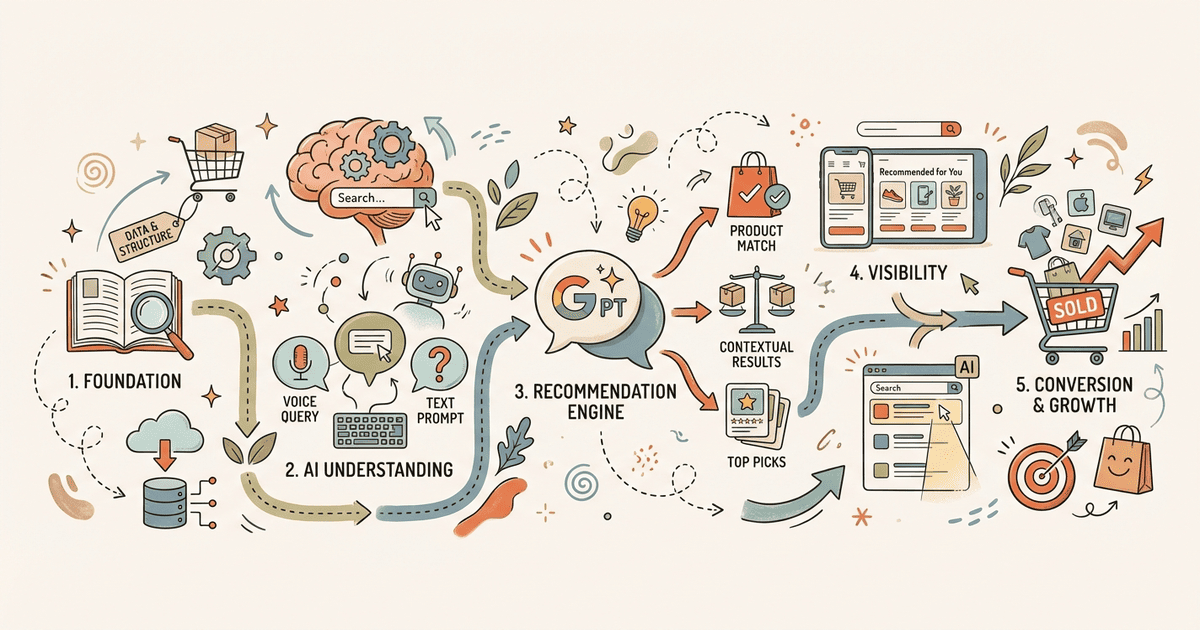
TL;DR
- AI search optimization ecommerce brands need is now unavoidable, ChatGPT processes 50M shopping queries daily.
- ChatGPT cites retailers 36% of the time, versus Google AI Overviews at just 4%.
- 85% of brand citations in AI search come from third-party pages (Reddit, YouTube, reviews).
- Conversational product descriptions, schema markup, and community presence drive AI recommendations.
- UV Blocker went from 0 to 38K clicks and doubled weekly orders in 6 months using this playbook.
- The 5-step framework: conversational descriptions, structured data, third-party signals, comparison content, in-chat checkout readiness.
ChatGPT processes 50 million shopping queries every day. 84 million Americans ask it shopping questions every week. Shoppers who arrive via AI search stay 32% longer on site and bounce 27% less than traffic from other channels.
AI search is now the fastest-growing product discovery channel in ecommerce. And most brands are completely invisible in it. AI search optimization ecommerce brands can't afford to ignore is already here.
Traditional ecommerce SEO optimizes for Google Shopping. But AI search optimization for ecommerce requires different signals entirely. Product page rankings don't automatically translate to AI recommendations.
This AI search optimization ecommerce playbook covers how ChatGPT Shopping decides which products to recommend, the five things ecommerce brands must do for AI visibility, a real case study with real numbers, and a 30-day action plan to get started. One ecommerce brand went from zero AI presence to 38K clicks in 6 months and doubled weekly orders, in off-season. Here's how.
How Does ChatGPT Shopping Actually Recommend Products?
ChatGPT Shopping searches Google Shopping for product data, then layers in third-party signals from Reddit, YouTube, and independent reviews to generate personalized product recommendations.
OpenAI launched ChatGPT Shopping in November 2025, powered by GPT-5 mini trained specifically for shopping tasks. The system doesn't just pull product listings. It builds recommendations by combining product data from Google Shopping with real-world signals from communities, review sites, and editorial sources.
This distinction matters. Google Shopping provides the product catalog. Third-party signals determine who gets recommended.
The numbers confirm the opportunity. ChatGPT cites retailers 36% of the time in shopping queries, 9x more than Google AI Overviews at just 4%, according to BrightEdge research. ChatGPT is the most ecommerce-friendly AI platform by a wide margin.

AI shopping queries also look different from Google searches. The average AI query runs 25 words compared to just 6 on Google. Shoppers type "what's the best SPF umbrella for beach days under $50", not "SPF umbrella." Product content that answers these conversational queries gets cited. Spec sheets don't.
OpenAI has also launched Instant Checkout, shoppers can buy directly inside ChatGPT without leaving the conversation. It's currently live with Etsy and expanding to over a million Shopify merchants. The buying friction between recommendation and purchase is disappearing.
What Are the 5 Things Ecommerce Brands Must Do for AI Visibility?
See where you rank across all AI answer engines.
Enter your domain and we'll scan your citation rate across ChatGPT, Perplexity, and Google AI.
Prefer to talk? Book a free 30-min call
Ecommerce brands need five things for AI visibility: conversational product descriptions, structured data with schema markup, third-party mentions at scale, comparison content, and preparation for in-chat checkout.
1. Optimize Product Descriptions for Conversational Queries
AI shoppers ask questions in full sentences. Product descriptions need to answer those questions directly.
Most product pages read like this: "Premium SPF umbrella. UV 50+ protection. Lightweight aluminum frame. Available in 3 colors."
That works for Google Shopping filters. It fails for AI. A description optimized for AI search reads more like: "Our SPF umbrella blocks 99%+ of UV rays, weighs just 1.2 lbs for all-day portability, and provides UPF 50+ shade that's ideal for beach days. Reviewers consistently rate it the best SPF umbrella under $50 for outdoor use."
The second version answers the conversational queries AI shoppers actually type. Rewrite top product descriptions to match the full-sentence questions customers ask.
2. Build a Structured Data Foundation
Product schema, Review schema, FAQ schema. Pages with FAQ schema see 28% higher AI citation rates, according to BrightEdge.
Schema markup helps AI engines extract structured information from product pages. At minimum, every product page needs:
{
  "@type": "Product",
  "name": "UV Protection Beach Umbrella",
  "description": "UPF 50+ beach umbrella with...",
  "aggregateRating": {
    "@type": "AggregateRating",
    "ratingValue": "4.8",
    "reviewCount": "2,847"
  }
}
FAQ schema on product pages answers the exact questions AI shoppers ask. A developer can implement this in an afternoon.

3. Earn Third-Party Mentions at Scale
This is the most important factor. 85% of brand citations in AI search come from third-party pages, not owned domains. A genuine Reddit thread discussing a product carries more weight with AI than 10 blog posts on the brand's own site.
Reddit is the #1 citation source for Perplexity at 46.7% and shows up as a top source for every major AI platform.
Four specific channels matter:
- Reddit discussions, Authentic posts and comments in communities where customers talk about products in the category
- YouTube reviews, Video reviews that AI platforms reference heavily (especially Perplexity and Google AI Overviews)
- Independent review sites, Wirecutter, niche review blogs, comparison sites
- Editorial mentions, Press coverage, guest features, industry publications
Ignoring Reddit means ignoring the single biggest signal for AI product recommendations.
4. Create Comparison and "Best Of" Content
AI engines love citing well-structured comparison content. When someone asks ChatGPT "what's the best reef-safe sunscreen for surfing," the AI pulls from pages that directly compare options.
Create blog content around "best [product category] for [use case]" queries:
- "Best reef-safe sunscreen for surfing"
- "Best sunscreen for kids with sensitive skin"
- "Best SPF clothing for hiking"
Structure each post with comparison tables, specific product mentions, pros and cons, and FAQ sections. These pages become citation magnets for AI shopping queries.
5. Prepare for In-Chat Checkout
OpenAI's Instant Checkout lets shoppers complete purchases inside ChatGPT without leaving the conversation. It's live with Etsy now and expanding to Shopify merchants.
The brands that have clean product feeds, complete structured data, and conversational descriptions will capture purchases directly inside AI chat. The brands that don't will lose those conversions to competitors who are ready.
Ensure Shopify product feeds are clean, structured data is complete, and product descriptions match conversational query patterns. When Instant Checkout expands to Shopify, products will either be buy-ready or invisible.
How Did UV Blocker Go from Zero to 38K Clicks in 6 Months?
UV Blocker went from zero organic AI presence to 38K clicks in six months by combining GEO-optimized content, Reddit and community presence, product page optimization, and systematic third-party signal building.
UV Blocker is a DTC ecommerce brand selling sun protection products. Six months before working with Cintra, the brand had virtually no organic presence. No AI visibility. No community signals.
Here's what the strategy looked like:
- GEO-optimized content: Created blog content structured for AI extraction, targeting the conversational queries customers actually use when searching for sun protection
- Reddit and community presence: Built a genuine presence in communities where UV Blocker's target customers discuss outdoor activities, sun protection, and skincare
- Product page optimization: Rewrote product descriptions for conversational search patterns and added comprehensive schema markup
- Third-party signal building: Systematically earned reviews on independent sites, editorial mentions, and community discussions
The results:
- 0 to 38K clicks in 6 months
- 3K to 7.5K daily traffic
- Doubled weekly orders in off-season, when competitors typically see declines

"Cintra helped me go from 3k to 7.5k daily traffic and doubled my weekly orders in 1.5 months in off-season.", Russ Coulon, Owner, UV Blocker
Every element of this AI search optimization ecommerce playbook was part of UV Blocker's strategy. The results compound when conversational content, structured data, community presence, and third-party signals work together as a system.
What Mistakes Kill Your Ecommerce AI Visibility?
The biggest ecommerce AI visibility killers are thin product descriptions, ignoring Reddit and community signals, blocking AI crawlers, treating AI optimization as just SEO, and letting product content go stale.
| Mistake | Why It Kills Visibility | What to Do Instead |
|---|---|---|
| Thin product descriptions (specs only) | AI can't extract conversational answers from feature lists | Rewrite as answers to customer questions |
| Ignoring Reddit and community signals | 85% of citations come from third-party pages | Build genuine community presence |
| Blocking AI crawlers in robots.txt | AI can't recommend what it can't access | Allow ChatGPT-User, PerplexityBot, Google-Extended |
| Treating AI search as "just SEO" | Different mechanics, different signals | Build a dedicated AI visibility strategy |
| Stale product content | AI models prefer fresh, recently updated pages | Review and refresh product pages quarterly |
For AI search optimization ecommerce brands often overlook, the two most damaging mistakes are thin product descriptions and ignoring community presence. Spec-only descriptions fail AI search because AI needs to extract natural-language answers. "UV 50+ protection, 1.2 lbs, aluminum frame" gives AI nothing to cite when a shopper asks "what's the best lightweight beach umbrella?"
And brands that have zero Reddit presence are handing the third-party validation signal, the single largest factor in AI citations, entirely to competitors.
Your 30-Day Ecommerce AI Search Action Plan
In 30 days, audit AI visibility, optimize top product pages for conversational queries and schema markup, engage in community discussions, and create comparison content targeting the biggest gaps.

Week 1: Audit AI Visibility
Open ChatGPT and type 5 product queries an ideal customer would ask. Screenshot the results. Then do the same in Perplexity. Note where the brand appears and where it doesn't.
Search competitor brands in both platforms. See who gets recommended and why. Check robots.txt, AI crawlers like ChatGPT-User and PerplexityBot should not be blocked.
This audit takes two hours and reveals exactly where the gaps are.
Week 2: Optimize Top 10 Product Pages
Start with the 10 highest-revenue products. Rewrite descriptions to answer conversational queries in full sentences. Add Product schema, Review schema, and FAQ schema to each page.
Don't try to optimize every SKU at once. Ten pages done well is better than a hundred done poorly.
Week 3: Build Community Presence
Identify 3-5 Reddit communities where customers discuss problems the products solve. Engage authentically, answer questions, share useful information, add value. Reddit detects promotional content instantly. Helpful contributions earn upvotes and visibility.
Respond to YouTube review comments. Engage on independent review sites. Build the third-party signal layer that AI depends on for product recommendations.
Week 4: Create Comparison Content
Write 2-3 "best [product category] for [use case]" blog posts. Include comparison tables, specific product recommendations, and FAQ sections targeting the conversational queries the Week 1 audit revealed.
The queries where the brand didn't appear in ChatGPT or Perplexity? Those are the content targets.
What Comes Next
AI search optimization is the foundation. The next frontier is agentic commerce optimization, preparing products to be selected and purchased by AI shopping agents autonomously. Google's UCP and OpenAI's ACP are already live, and the brands doing AI visibility work today are 60-70% ready.
Frequently Asked Questions About AI Search Optimization Ecommerce Brands Ask
These are the questions ecommerce brand owners ask most often when starting with AI search optimization. Each answer draws from real client work and current platform data.
How does ChatGPT recommend products?
ChatGPT searches Google Shopping for product data, then factors in third-party signals like Reddit discussions, YouTube reviews, and editorial mentions to generate personalized recommendations.
The system uses GPT-5 mini trained specifically for shopping tasks. Products that rank on Google Shopping have an advantage, but third-party validation determines who gets recommended over competitors.
Does AI search optimization work for small ecommerce brands?
AI search optimization works especially well for smaller brands because it rewards genuine expertise, community presence, and helpful content over advertising budgets and domain authority alone.
UV Blocker started with zero organic presence and reached 38K clicks in 6 months. The playing field is more level in AI search than in Google Ads.
How long does ecommerce AI optimization take to show results?
Most ecommerce brands see measurable AI visibility improvements within 8 to 12 weeks, with initial product citations appearing in as few as 4 to 6 weeks.
UV Blocker doubled weekly orders within 1.5 months. Timelines vary based on existing authority, product review volume, and competitive landscape.
Is ChatGPT Shopping replacing Google Shopping?
ChatGPT Shopping is not replacing Google Shopping but is rapidly becoming a parallel discovery channel, processing 50 million shopping queries daily with higher engagement rates than other traffic sources.
AI-referred shoppers stay 32% longer on site and bounce 27% less. Smart brands optimize for both channels rather than choosing one over the other.
What is the difference between ecommerce SEO and ecommerce GEO?
Ecommerce SEO optimizes product pages for Google rankings, while ecommerce GEO optimizes content and third-party signals for AI search engine recommendations across ChatGPT, Perplexity, and AI Overviews.
Traditional SEO focuses on keywords and backlinks. GEO adds conversational content structure, schema markup, community presence, and entity building. Both matter, GEO extends SEO, it doesn't replace it.
The Bottom Line
ChatGPT processes 50 million shopping queries daily. AI-referred shoppers engage longer, bounce less, and convert at higher rates than nearly any other traffic source. The ecommerce brands showing up in those recommendations are capturing revenue that invisible brands never see.
AI search optimization ecommerce success requires five things: conversational product descriptions, structured data, third-party mentions at scale, comparison content, and checkout readiness. Reddit is the common denominator across every AI platform, community presence directly determines whether AI recommends a product.
This isn't theory. UV Blocker went from zero to 38K clicks and doubled weekly orders in off-season using this exact framework.
Run a quick audit. Open ChatGPT and type 5 product queries an ideal customer would ask. See if the brand appears. Then do the same in Perplexity. That's the baseline.
For a deep dive into how ChatGPT Shopping works and what 22.5M product offers reveal about what gets recommended, see ChatGPT Shopping in 2026. For direct-to-consumer brands specifically, AI visibility for DTC brands covers how DTC ecommerce companies can build the third-party credibility signals that drive AI recommendations for their product categories. For the specific strategies DTC brands use to gain AI visibility and revenue impact, see AI visibility for DTC brands: 5 strategies that drive revenue. If you're evaluating the best GEO agency for ecommerce brands, that guide ranks agencies by their documented ecommerce citation results. Also see our Shopify AI search optimization guide for platform-specific implementation steps. Also see our ecommerce AI visibility capability overview for Cintra's ecommerce-specific service details. For ecommerce-focused GEO services, see GEO services for ecommerce brands which covers the specific deliverables and pricing structures.
See where your brand appears in AI search
Scan ChatGPT, Perplexity, and Google AI across buyer-intent queries, instantly, no sign-up.
Find out if AI is sending buyers to your competitors.
We audit your AI visibility across ChatGPT, Perplexity, and Google AI –and show you exactly where you rank and what to fix.
“We went from 200 visitors/day to 1,900 visitors/day and 40% of demos are from AI search.”
Sumanyu Sharma · CEO, Hamming.ai
“Cintra helped me go from 3k to 7.5k daily traffic and doubled weekly orders in 1.5 months.”
Russ Coulon · Owner, UV Blocker
“We saw a lift from 3% to 13% visibility in the first 2 weeks, and organic traffic hit its highest ever.”
Ash Metry · Founder, Keywords.am
Related Articles
Google AI Mode Optimization: How to Get Cited (2026 Guide)
Google AI Mode optimization needs a different approach than AI Overviews. Only 13.7% of sources overlap. Learn…
How to Get Cited by Grok: The xAI Platform Optimization Guide
Learn how to get cited by Grok with a 6-step framework covering the X co-citation mechanic, robots.txt setup,…
Claude for SEO vs AEO: Why the Same Tool Produces Opposite Results
Claude for SEO vs AEO produces opposite results. Prompt stacks generate generic output. Real strategy gets bra…