How to Get Recommended by ChatGPT: The Ultimate Proven 5-Step Framework (2026)
Learn how to get recommended by ChatGPT and every major AI search engine. Our 5-factor framework helped brands achieve 8.5x traffic growth and 38K monthly clicks.
ChatGPT now has over 800 million weekly active users. By the end of 2026, Gartner predicts that traditional search engine volume will drop by 25%. If your brand isn't being recommended by AI, you're invisible to the fastest-growing discovery channel in history.
Most brands are optimizing for an engine that's losing market share while ignoring the one that's gaining it. The reality is that AI search converts 23x higher than traditional search. Inaction is not just a missed opportunity; it's a strategic risk.
This guide provides a clear path forward. We'll cover how AI search engines decide what to recommend, the five specific things that make content AI-citable, the critical differences between platforms, and real case studies from brands that went from invisible to indispensable. Unlike guides that only offer theories, this one delivers proven results from real brands: Hamming.ai achieved an 8.5x traffic increase, UV Blocker went from 0 to 38,000 clicks, and Yoga Democracy saw a 156% increase in AI recommendations.
How to Get Recommended by ChatGPT: Quick Summary
Getting recommended by AI search requires answer-first content, third-party validation from Reddit and media, entity clarity, structured data, and consistent content freshness.
- AI is Different: AI engines blend training data with real-time web searches, prioritizing direct answers and third-party validation over traditional SEO signals.
- Others' Opinions Matter More: 85% of brand mentions in AI search come from third-party pages like Reddit and media outlets, not your own website (AirOps research).
- The 5-Factor Framework: To get cited, focus on an answer-first content structure, clear brand entity definitions, strong third-party validation, structured data (schema), and consistent content freshness.
- Reddit is Key: Reddit is a top-three information source for every major AI platform, including ChatGPT, Perplexity, and Google AI Overviews. A presence there is non-negotiable.
- It's a System, Not a Tactic: Lasting AI visibility comes from a holistic strategy that combines optimized content with genuine community engagement and entity building.
- The Results Are Real: Brands applying this framework see measurable growth. We've seen clients achieve 8.5x traffic growth, go from zero to 38K monthly clicks, and increase AI recommendations by 156%.
How Do AI Search Engines Decide What to Recommend?
See where you rank in ChatGPT's answers.
Enter your domain and we'll scan your ChatGPT citation rate across your highest-value queries.
Prefer to talk? Book a free 30-min call
AI search engines combine training data with real-time web retrieval, prioritizing sources that directly answer questions, carry third-party validation, and present structured content.
They pull from two distinct sources: their vast training data (what they've already learned) and real-time web retrieval (what they are finding right now). Think of it as memory plus research.
This process gives priority to content that exhibits four key traits:
- Directly answers a specific question.
- Comes from authoritative sources with strong third-party validation.
- Is structured in a way that is easy to extract and cite.
- Is fresh and frequently updated.
Here is the most critical takeaway: 85% of brand mentions in AI search originate from third-party pages, not from brands' own domains. Your website matters, but what others say about you matters more. This means that conversations on Reddit, reviews on YouTube, media coverage, and quotes from experts now shape your AI visibility more profoundly than your own blog.
Understanding these mechanics is the first step. Now, here's the framework for making it work for you.
What Are the 5 Things That Make Content AI-Citable?
Five factors drive AI citations: answer-first structure, entity clarity, third-party validation, structured data with schema markup, and consistent content freshness.
Mastering these elements is the key to moving from being ignored by AI to being the brand that gets recommended by ChatGPT, Perplexity, and AI Overviews.
1. Answer-First Structure AI models are designed to find and extract direct answers. By placing a concise, comprehensive answer directly after your heading, you make your content perfectly formatted for citation.
- Before (Vague Intro): "In this section, we will explore the various factors that contribute to AI visibility and how they interact with modern search algorithms."
- After (Direct Answer): "AI visibility is driven by a combination of answer-focused content, third-party validation from sources like Reddit, and clear brand entity signals across platforms."
What to do: Review your key content pages. Edit the first paragraph after each H2 heading to be a direct, self-contained answer. This single change can dramatically improve your chances to get recommended by ChatGPT.
2. Entity Clarity AI needs to understand who you are, not just what you sell. It builds "entity maps" to connect brands to their expertise and authority. If your brand information is inconsistent across the web, AI models can't verify your authority.
What to do: Make yourself unmistakable to AI. Ensure your brand name, website, and description are consistent across Wikipedia, Crunchbase, LinkedIn, and major industry directories. Strong entity clarity is essential if you want to get recommended by ChatGPT and Perplexity.
3. Third-Party Validation AI models trust consensus. When multiple independent sources mention your brand in a positive context, the AI views you as a credible and trustworthy recommendation. This is why 85% of brand mentions come from third-party pages.
What to do: Build a presence where your audience has conversations. A genuine Reddit thread where users recommend your product is often worth more than ten blog posts on your own site. Focus on earning reviews, media coverage, expert quotes, and positive community mentions.
4. Structured Data and Schema Markup Schema markup is a form of code that helps search engines understand and categorize your content more effectively. Pages with FAQ schema see 28% higher citation rates in AI search. It's a direct signal that your content is organized to answer questions.
What to do: Focus on the two most impactful types: "FAQ schema" and "Article schema." Ask your developer to implement these on your core pages; for most modern websites, this is a simple process that can often be done in an afternoon.
5. Content Freshness AI models are biased toward recent information. Content that is regularly updated is seen as more reliable and relevant. A page that hasn't been touched in two years is a decaying asset in the world of AI search.
What to do: Review and update your most important pages at least once per quarter. Add new data points, refresh the examples, and update any dates to signal that the content is actively maintained.
The framework above works across platforms, but each AI search engine has its own preferences.
What Does Each AI Platform Prioritize?
ChatGPT leans heavily on Wikipedia and Reddit, Perplexity favors Reddit and YouTube, while Google AI Overviews prioritize Reddit and YouTube, each requiring a different optimization approach. While the core principles of AI-citable content apply everywhere, the data reveals specific source preferences that should inform your strategy.
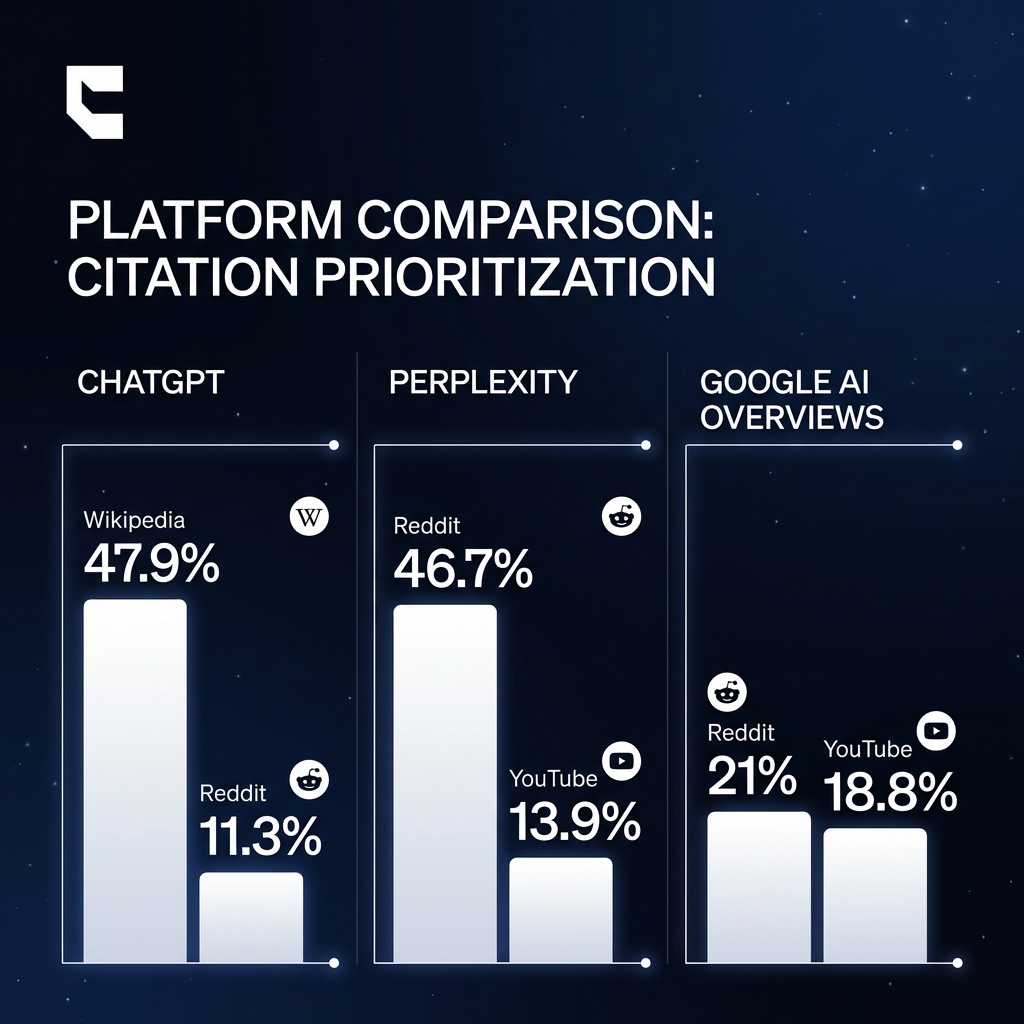
What AI Search Engines Prioritize
| Platform | Top Source | Second Source | Key Behavior |
|---|---|---|---|
| ChatGPT | Wikipedia (47.9%) | Reddit (11.3%) | Favors encyclopedic authority + community consensus |
| Perplexity | Reddit (46.7%) | YouTube (13.9%) | Heavily weights community discussion + video |
| Google AI Overviews | Reddit (21%) | YouTube (18.8%) | Blends community signals with traditional authority |
Notice the pattern? Reddit appears as a top source for every major AI platform. This makes it the single most important channel for building AI visibility. If you're ignoring Reddit, you're ignoring the most influential source for AI recommendations.
These citation patterns can and do shift. For instance, Perplexity's reliance on Reddit citations has evolved following legal discussions in 2025. However, while the exact percentages may change quarterly, the underlying principle does not: be present where the conversations are happening.
What to do: Prioritize building a genuine presence on Reddit and YouTube for the broadest cross-platform impact. For ChatGPT specifically, ensure your brand has a clear and accurate presence on entity-defining sites like Wikipedia and Crunchbase. For Google AI Overviews specifically, the best Google AI Overviews optimization agencies cover the E-E-A-T and structured data factors that determine inclusion. For broader multi-LLM coverage, the top LLM optimization agencies in 2026 track citations across all seven major AI platforms.
Theory is nice. Here's what these strategies look like when they actually work.
Real Results: What AI Visibility Looks Like in Practice
Three brands saw transformative results: Hamming.ai grew 8.5x in organic traffic, UV Blocker went from zero to 38K clicks, and Yoga Democracy increased AI recommendations by 156%.
These aren't just vanity metrics; they represent real business growth driven by a targeted AI visibility strategy. Each case shows what happens when brands learn how to get recommended by ChatGPT and other AI search engines.
Explore the full AI visibility approach at Cintra after seeing these results.
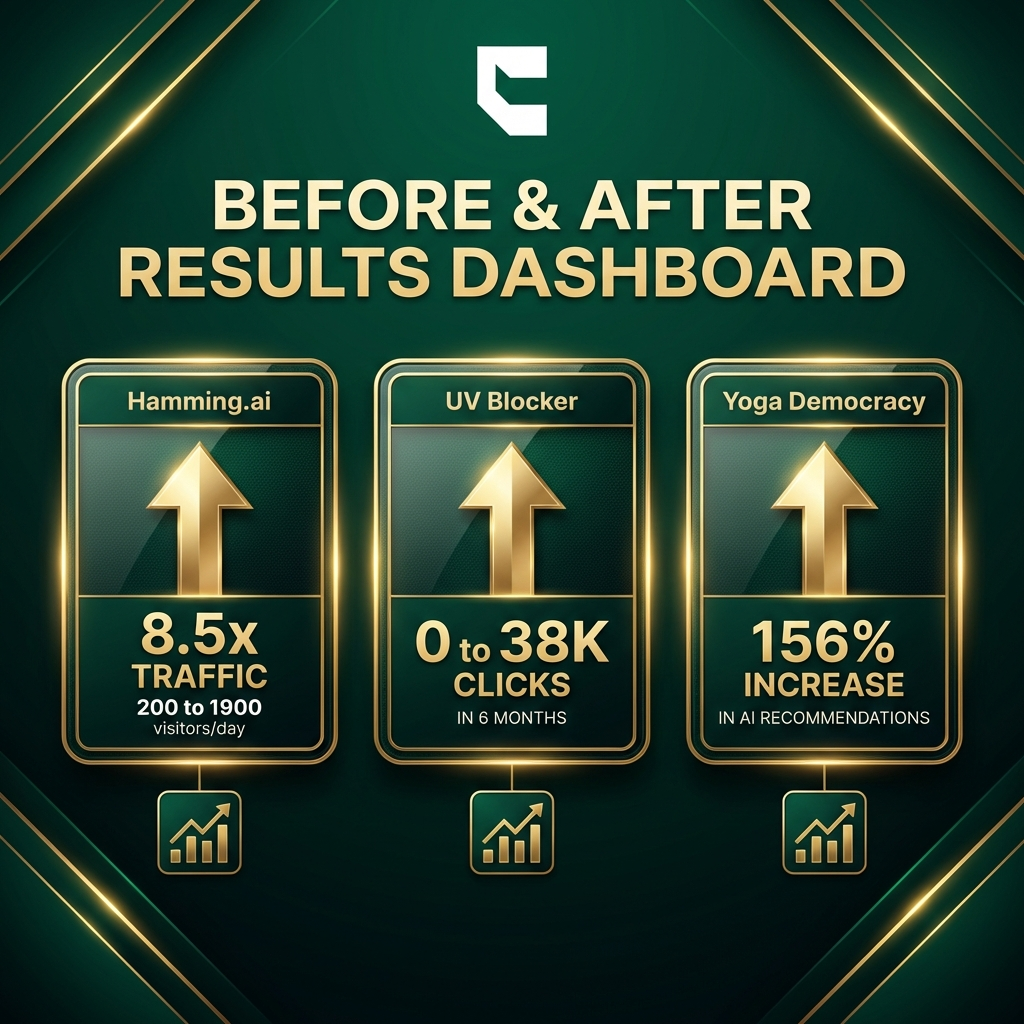
Case Study 1: Hamming.ai This YC-backed AI startup was getting only 200 visitors per day with a minimal AI search presence. We implemented a full AI visibility strategy that included GEO-optimized content, strategic Reddit engagement, and prompt optimization. The result was a surge to 1,900 visitors per day, an 8.5x growth, in just 12 weeks. Today, 40% of their product demos come directly from Reddit or AI search. This is what happens when you learn how to get recommended by ChatGPT systematically. Sumanyu Sharma, the CEO, said, "We went from 200 visitors/day to 1,900 visitors/day and 40% of the demos we get are from Reddit or AI search." The full story is in the AI visibility for SaaS guide, which details the B2B-specific framework behind these results.
Case Study 2: UV Blocker As a new e-commerce brand in the sun protection space, UV Blocker started with zero organic presence. We developed a content strategy built from the ground up for AI visibility. In six months, the brand went from 0 to 38,000 monthly clicks. More importantly, this traffic converted, doubling their weekly orders during their off-season. Founder Russ Coulon noted, "Cintra helped me go from 3k to 7.5k daily traffic and doubled my weekly orders in 1.5 months in off-season."
Case Study 3: Yoga Democracy This established e-commerce apparel brand had a strong SEO foundation but limited visibility in AI-powered search. By applying our AI visibility framework, they achieved a 156% increase in AI recommendations, capturing a new audience segment that was starting its discovery process with AI.
The pattern is clear. All three of these successes were built on a system that combines GEO-optimized content, a strong community presence on platforms like Reddit, and meticulous entity building.
These results came from doing the right things. But just as important is knowing what NOT to do.
What Mistakes Kill Your AI Visibility?
The biggest AI visibility killers are blocking AI crawlers, publishing thin content, ignoring Reddit, over-optimizing for Google alone, and treating AI search as just SEO.
Avoiding these common pitfalls is as crucial as implementing the right strategies. Brands that want to get recommended by ChatGPT need to steer clear of each one.
| Mistake | Why It Kills Visibility | What to Do Instead |
|---|---|---|
| Blocking AI crawlers (robots.txt) | AI can't cite what it can't access | Allow ChatGPT-User, PerplexityBot, Google-Extended |
| Publishing thin, generic content | AI prefers depth with specific answers | Write answer-first content with data and expertise |
| Ignoring Reddit/community presence | 85% of mentions come from third-party pages | Build genuine community presence where your audience talks |
| Over-optimizing for Google only | Google ranking ≠ AI recommendation | Optimize for extractability and citability, not just keywords |
| Treating AI search as "just SEO" | Different mechanics, different signals | Build a dedicated AI visibility strategy alongside SEO |
Of all these, ignoring community presence is the most damaging. Brands that live exclusively on their own website are building a beautiful house in a neighborhood no one visits. The conversations that drive AI recommendations are happening on Reddit, Quora, and industry forums. Being absent from those discussions is choosing to be invisible.
Now you know what works and what doesn't. Here's how to find out where your brand stands.
Frequently Asked Questions About Getting Recommended by AI
These are the questions brands ask most often when they start thinking about AI search visibility. Each answer draws from real client work and current platform data.
Q1: How long does it take to get recommended by ChatGPT?
Most brands see measurable AI visibility improvements within 8-12 weeks of consistent optimization, though initial citations can appear within 4-6 weeks.
The timeline to get recommended by ChatGPT varies based on your existing authority, content volume, and competitive landscape. Hamming.ai saw its 8.5x traffic growth materialize within a 12-week period.
Q2: Can you pay to get recommended by AI search engines?
No, AI search recommendations are earned through content quality, third-party validation, and entity authority. There is no paid placement option.
This marks a fundamental difference from traditional search engines with paid ad placements. AI models recommend what they determine is the most helpful and authoritative answer, not who pays the most.
Q3: Does SEO still matter if AI search is taking over?
SEO still matters, but it is no longer sufficient alone. Brands need both traditional SEO and AI-specific optimization to capture the full search landscape.
Google continues to process billions of queries daily. The smartest approach is to optimize for both human-led and AI-led search. The good news is that much of what works for AI visibility, such as structured data and high-quality content, also benefits traditional SEO. For brands re-evaluating their agency mix, the best alternative to a traditional SEO agency guide covers what to look for, and the best AI search optimization agencies in 2026 ranks the firms that have built genuine methodology for this channel.
Q4: What is generative engine optimization (GEO)?
Generative engine optimization is the practice of optimizing content to be cited and recommended by AI-powered search engines like ChatGPT, Perplexity, and Google AI Overviews.
GEO is a holistic approach that includes answer-first content structure, building a clear brand entity, fostering a strong community presence, and using schema markup, all designed to make your brand the one AI recommends.
Q5: How do you measure AI search visibility?
Track AI visibility through prompt monitoring tools, referral traffic from AI platforms, citation tracking across ChatGPT, Perplexity, and AI Overviews, and share of voice analysis.
Traditional keyword rank tracking is ineffective for AI search. You need to shift your focus to monitoring a core set of customer prompts to see if and where your brand appears in the generated responses.
Conclusion
Brands that want to get recommended by ChatGPT need answer-first content, entity clarity, third-party validation, structured data, and consistent freshness.
The digital landscape is shifting. AI search is no longer a future concept; it's the fastest-growing discovery channel available today.
- The Scale is Immense: With 800M+ weekly ChatGPT users and Gartner predicting a 25% decline in traditional search volume, the time to adapt is now.
- The Framework is Proven: Getting recommended requires a new approach focused on answer-first content, entity clarity, third-party validation, structured data, and content freshness.
- Community is Crucial: Reddit is the common denominator across all major AI platforms. Your community presence directly fuels your AI recommendations.
- The Results Are Tangible: This isn't theory. Hamming.ai achieved an 8.5x traffic increase, UV Blocker went from 0 to 38K clicks, and Yoga Democracy saw a 156% rise in AI recommendations.
Take one immediate action: run a prompt audit. Open ChatGPT and Perplexity, type in five questions your ideal customer would ask, and see if your brand appears. The results may surprise you.
See where your brand appears in AI search
Scan ChatGPT, Perplexity, and Google AI across buyer-intent queries, instantly, no sign-up.
Find out if AI is sending buyers to your competitors.
We audit your AI visibility across ChatGPT, Perplexity, and Google AI –and show you exactly where you rank and what to fix.
“We went from 200 visitors/day to 1,900 visitors/day and 40% of demos are from AI search.”
Sumanyu Sharma · CEO, Hamming.ai
“Cintra helped me go from 3k to 7.5k daily traffic and doubled weekly orders in 1.5 months.”
Russ Coulon · Owner, UV Blocker
“We saw a lift from 3% to 13% visibility in the first 2 weeks, and organic traffic hit its highest ever.”
Ash Metry · Founder, Keywords.am
Related Articles
Google AI Mode Link Updates: What Five Changes Mean for Your Brand's AI Visibility
Google AI Mode link updates add five new outbound link features. We analyze what changed on May 6, how each up…
AI Visibility for Automotive: The Two-Layer Problem Dealerships Don't See
AI visibility for automotive is a two-layer problem. 84% of dealership websites are invisible to AI. Learn the…
How to Fix Wrong AI Answers Brand Owners Get (2026 Guide)
Fix wrong AI answers brand owners encounter with this 6-step playbook. Learn why ChatGPT, Perplexity, and AI M…