How to Measure AI Visibility: The Complete Audit Framework for 2026
Learn how to measure AI visibility with a proven audit framework. Track brand mentions in ChatGPT, Perplexity, and AI Overviews using four key metrics and a step-by-step DIY process anyone can follow in 2 hours.
Only 16% of brands track their AI search performance. Meanwhile, AI-referred visitors convert at 23 times the rate of traditional organic traffic (McKinsey CMO Survey, Ahrefs). This gap is critical. Without knowing how to measure AI visibility, we cannot improve what we cannot see. When prospects ask ChatGPT or Perplexity, "what's the best [product] for [use case]?" do you know if your brand appears? Most do not. Your competitors might be getting recommended right now. You would never know.
This guide teaches you how to measure AI visibility with a complete audit framework. We outline the 4 metrics that matter. We detail a step-by-step DIY audit process. We recommend essential tools. We show how to connect AI visibility to actual revenue impact. This article provides a practical, repeatable framework. Marketers can follow it in under two hours. You can do this before spending a dollar on monitoring tools.
Why Does AI Visibility Matter for Your Brand?
AI visibility matters because AI-referred traffic converts 23x higher than organic search. Yet 84% of brands still don't track their presence in AI responses.
AI search traffic is small in volume. Its conversion impact is massive. Ahrefs data shows AI traffic makes up 0.5% of visits but 12.1% of signups. This is a 23x conversion uplift. Users arrive pre-qualified because AI already synthesized comparisons. Half of consumers now intentionally use AI-powered search engines. A majority say it's their top digital source for purchase decisions (McKinsey). This is mainstream. Gartner predicts traditional search volume drops 25% by 2026. Users are shifting to AI answer engines. LLM-driven traffic is up 800% year-over-year. This is happening now.
The measurement gap is stark. Only 16% of Fortune 500 brands systematically track AI search performance. This means most brands are flying blind in their fastest-growing channel. If you do not know how to measure AI visibility, you cannot improve.
The good news: learning how to measure AI visibility is straightforward. Here are the four metrics that matter.
What Are the 4 Key AI Visibility Metrics?
See where you rank across all AI answer engines.
Enter your domain and we'll scan your citation rate across ChatGPT, Perplexity, and Google AI.
Prefer to talk? Book a free 30-min call
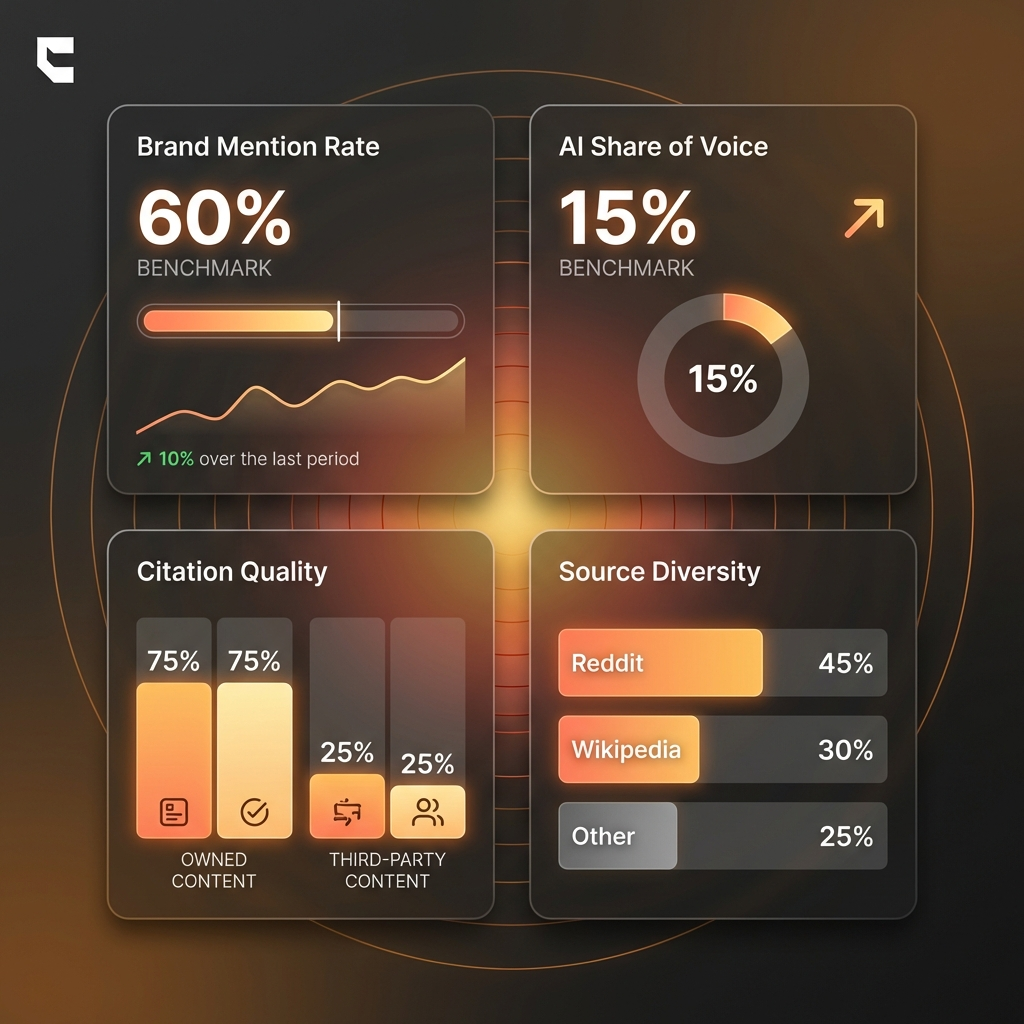
The four key AI visibility metrics are brand mention rate, AI share of voice, citation quality, and source diversity. Each measures a different dimension of your AI presence.
- Brand Mention Rate, How often your brand appears in AI responses for relevant queries. Test 20 prompts. If your brand appears in 12, that is a 60% mention rate. This is your baseline visibility.
- AI Share of Voice, When buyers ask AI for help in your category, which brands appear most? We calculate (your mentions ÷ total brand mentions across category queries) × 100. Top performers capture 15%+ share (AirOps). Only 30% of brands stay visible across consecutive answers.
- Citation Quality, Are you mentioned positively, neutrally, or negatively? Is the information accurate? Score each mention: positive (+1), neutral (0), negative (-1), hallucination (-2). AI can cite your brand with wrong pricing or false claims. 64% of consumers have encountered AI-generated misinformation.
- Source Diversity, Where are AI citations pulling from? ChatGPT favors Wikipedia (47.9%), Reddit (11.3%). Perplexity favors Reddit (46.7%). Google AI Overviews favors Reddit (21%), YouTube (18.8%) (Search Engine Land). If your owned content is not cited, your narrative depends on third parties. 85% of brand mentions come from third-party pages.
| Metric | What It Measures | How to Calculate | Good Benchmark |
|---|---|---|---|
| Brand Mention Rate | Frequency of appearance | (Mentions ÷ Total prompts) × 100 | >40% |
| AI Share of Voice | Competitive position | (Your mentions ÷ All brand mentions) × 100 | >15% |
| Citation Quality | Accuracy & sentiment | Score: +1 positive, 0 neutral, -1 negative, -2 hallucination | Average >0.5 |
| Source Diversity | Citation origin spread | % from owned vs. third-party vs. UGC | >20% owned |
Now that you know what to measure, the next step in learning how to measure AI visibility is running your first audit.
How Do You Run a DIY AI Visibility Audit?
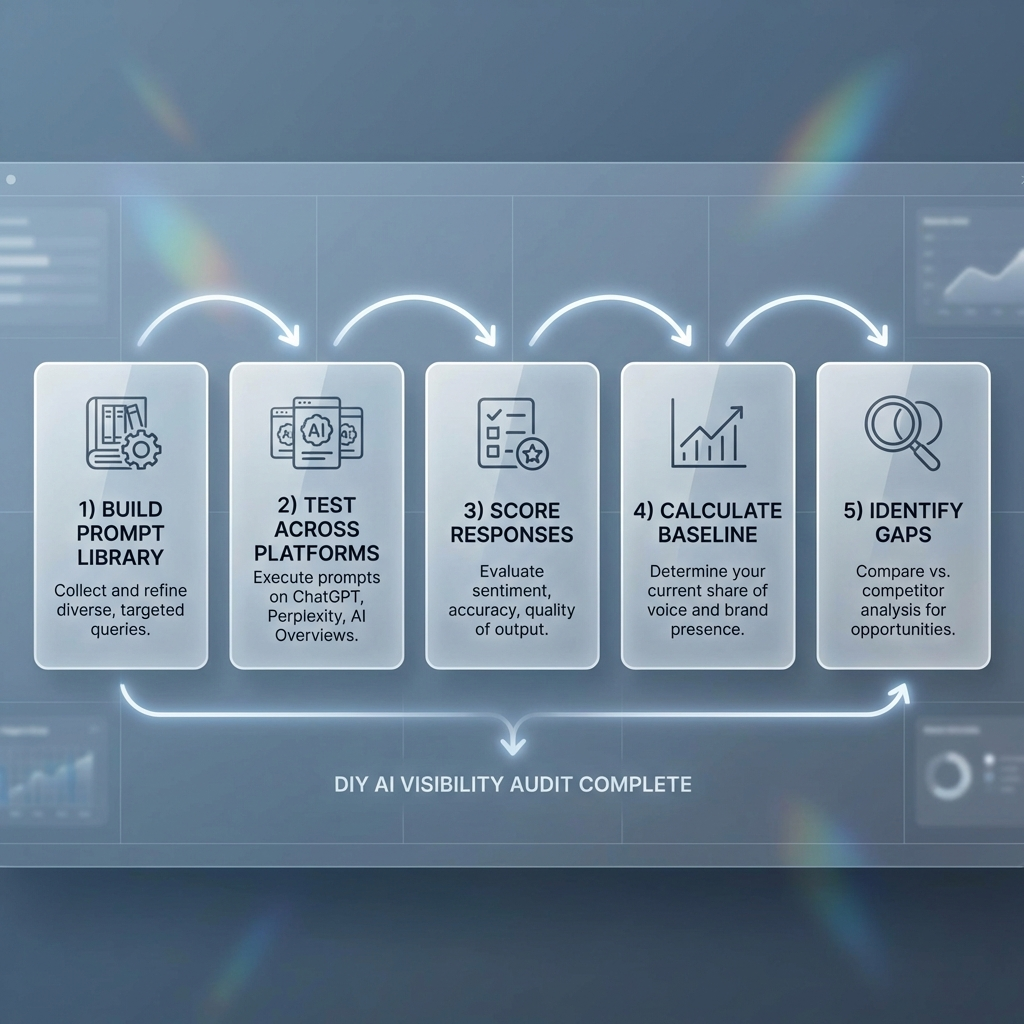
- Step 1: Build Your Prompt Library (20 min), Create 15-20 prompts your ideal customer would ask. Include three categories:
- Brand queries: "Is [your brand] good for [use case]?"
- Category queries: "best [product] for [use case]"
- Comparison queries: "[your brand] vs. [competitor]" Emphasize branded and unbranded queries. For more, read our guide on how AEO prompt selection works.
- Step 2: Test Across 3+ Platforms (45 min), Run each prompt on ChatGPT, Perplexity, and Google AI Overviews. Run each prompt 3 times per platform. SparkToro research found less than a 1-in-100 chance of getting the same recommendation list twice. This variability is how probability-based systems work. Three runs gives directional signal; enterprise-grade monitoring uses 60-100 runs per prompt.
- Step 3: Score Each Response (30 min), For each response, record: Was your brand mentioned? (Y/N). Sentiment (positive/neutral/negative). Information accuracy (correct/hallucination). Which competitors appeared? What sources were cited? A simple spreadsheet with columns is enough.
- Step 4: Calculate Your Baseline (15 min), Plug scores into the four metrics. Your mention rate = total mentions ÷ total prompt runs. Share of voice = your mentions ÷ all brand mentions in category queries. Citation quality = average sentiment score. Source diversity = % of citations from owned content. For example, if you ran 20 prompts and got 10 mentions, your mention rate is 50%.
- Step 5: Identify Gaps (10 min), Which queries are you missing? Who is being recommended instead? What third-party sources are cited? Which platform has your weakest presence? Frame gaps as opportunities. Each missing query is a specific action item.
| Prompt Category | # Prompts | Mention Rate | Avg Sentiment | Top Competitor | Key Gap |
|---|---|---|---|---|---|
| Brand queries | 5 | , % | , /1.0 | , | , |
| Category queries | 7 | , % | , /1.0 | , | , |
| Comparison queries | 5 | , % | , /1.0 | , | , |
| Problem queries | 3 | , % | , /1.0 | , | , |
| Total | 20 | , % | , /1.0 | , | , |
Manual auditing is the simplest way to learn how to measure AI visibility. For ongoing monitoring, here are the tools worth considering.
What Tools Track AI Brand Visibility?
Several purpose-built tools now track AI brand visibility. These include Semrush, Peec AI, Profound, and Otterly.ai, though manual auditing is sufficient for establishing a baseline.
For most brands starting out, manual auditing with the framework above is enough. Do not buy tools before you have a baseline. Tools add value when you need continuous monitoring at scale. They help with competitive benchmarking across hundreds of prompts.
- Semrush AI Visibility Index, Tracks AI Overview presence alongside traditional rankings.
- Peec AI, Purpose-built for AI citation tracking with competitive benchmarking. Backed by a €21 million Series A.
- Profound, Offers front-end monitoring and synthetic queries across ChatGPT, Claude, Perplexity. Integrates with GA4.
- Otterly.ai, Lightweight AI search monitoring focused on ChatGPT and Perplexity tracking.
- HubSpot AEO Grader, A free tool for a quick AI visibility health check.
Tools help you track the numbers. But the metric that ultimately matters is revenue.
How Does AI Visibility Connect to Revenue?
AI visibility connects to revenue through higher conversion rates. AI-referred traffic converts 23x higher because visitors arrive pre-qualified by AI recommendations.
The conversion math is compelling. AI search drives 0.5% of traffic but 12.1% of signups at Ahrefs. That is a 23x uplift. Users arriving from AI citations have already read synthesized comparisons. They arrive with purchase intent. If a brand gets 100 AI-referred visitors versus 100 organic visitors, the AI visitors generate 23x more conversions.
Structured, factual content receives 340% more AI citations than promotional content. Brands that invest in expert-driven content win disproportionately in AI search. This is where the strategy shifts from "get mentioned" to "get mentioned well."
Consider the NerdWallet case study. Revenue rose 35% in 2024. Traditional traffic fell 20%. This occurred because AI-mediated discovery replaced direct search clicks (HubSpot AEO Trends). The brands winning do not have more traffic. They have more influence in AI conversations. Once you understand how to measure AI visibility, even small improvements compound. Moving from a 20% to 40% mention rate means doubling your presence in the highest-converting search channel.
So you have run your audit and understand the stakes. Here is what to do next.
What Should You Do After Your AI Visibility Audit?
After your audit, follow one of three paths based on your mention rate: foundational work below 20%, optimization between 20-50%, or maintenance and defense above 50%.
- If mention rate is below 20%: Foundational work needed. You need content architecture, entity building, and third-party signal strategy. Focus on creating expert content that AI models recognize as authoritative. Build presence on platforms AI models cite (Reddit, Quora, review sites). Fix any inaccuracies.
- If mention rate is 20-50%: Optimization phase. You have visibility, now improve it. Improve citation quality and fix inaccuracies. Expand to more platforms and query types. Build more third-party signals. Monitor competitor moves.
- If mention rate is above 50%: Maintenance and defense. You are well-positioned. Monitor competitors. Keep content fresh and accurate. Expand to adjacent query categories. Set up ongoing monitoring (monthly minimum).
| Mention Rate | Phase | Priority Actions | Timeline |
|---|---|---|---|
| Below 20% | Foundation | Content architecture, entity building, third-party presence | 3-6 months |
| 20-50% | Optimization | Citation quality, platform expansion, competitor monitoring | 1-3 months |
| Above 50% | Maintenance | Ongoing monitoring, content freshness, adjacent query expansion | Ongoing |
Frequently Asked Questions About How to Measure AI Visibility
These are the most common questions brands ask when starting to measure their AI visibility for the first time.
How do I check if my brand appears in ChatGPT?
Ask ChatGPT direct questions like "what is the best [your category]?" and "tell me about [your brand]", run each prompt three times since responses vary with every query.
ChatGPT draws from training data and browsing results. Test with both branded and category queries. SparkToro research found less than 1-in-100 chance of identical recommendation lists across runs.
What is AI share of voice?
AI share of voice measures how often your brand is mentioned compared to competitors when AI platforms answer queries in your category.
Calculate by dividing your brand mentions by total brand mentions across relevant prompts. A share above 15% is strong. Track over time to spot trends.
How often should I audit AI visibility?
AI models update frequently. Competitor content strategies also evolve. A quarterly full audit catches major shifts. Monthly spot-checks on top prompts keep you aware of changes.
What tools track AI brand mentions?
Leading tools include Semrush AI Visibility Index, Peec AI, Profound, and Otterly.ai, though manual auditing works well for brands establishing their first baseline.
Free starting points include HubSpot's AEO Grader. Purpose-built tools add value once you have a baseline and need continuous monitoring.
Does AI visibility actually affect revenue?
Yes, AI-referred traffic converts at 23x the rate of traditional organic search because visitors arrive pre-qualified through AI-synthesized recommendations.
Ahrefs found AI traffic was just 0.5% of visits but drove 12.1% of signups.
Conclusion
AI visibility is measurable with four clear metrics: mention rate, share of voice, citation quality, and source diversity. A DIY audit takes about 2 hours and gives you a baseline most brands still do not have. AI-referred traffic converts 23x higher, even small visibility improvements drive outsized revenue. The framework matters more than the tools. Start manual, invest in tools when you need scale.
Start today: open ChatGPT and run 5 category queries right now. Note which brands appear. That's your 10-minute visibility check.
See where your brand appears in AI search
Scan ChatGPT, Perplexity, and Google AI across buyer-intent queries, instantly, no sign-up.
Find out if AI is sending buyers to your competitors.
We audit your AI visibility across ChatGPT, Perplexity, and Google AI –and show you exactly where you rank and what to fix.
“We went from 200 visitors/day to 1,900 visitors/day and 40% of demos are from AI search.”
Sumanyu Sharma · CEO, Hamming.ai
“Cintra helped me go from 3k to 7.5k daily traffic and doubled weekly orders in 1.5 months.”
Russ Coulon · Owner, UV Blocker
“We saw a lift from 3% to 13% visibility in the first 2 weeks, and organic traffic hit its highest ever.”
Ash Metry · Founder, Keywords.am
Related Articles
Google AI Mode Link Updates: What Five Changes Mean for Your Brand's AI Visibility
Google AI Mode link updates add five new outbound link features. We analyze what changed on May 6, how each up…
AI Visibility for Automotive: The Two-Layer Problem Dealerships Don't See
AI visibility for automotive is a two-layer problem. 84% of dealership websites are invisible to AI. Learn the…
How to Fix Wrong AI Answers Brand Owners Get (2026 Guide)
Fix wrong AI answers brand owners encounter with this 6-step playbook. Learn why ChatGPT, Perplexity, and AI M…