SEO vs AI Search Optimization: Why Your Agency Can't Save You
You're paying $5-15K a month for an SEO agency. Your Google rankings are fine. But when a prospect asks ChatGPT for recommendations in your category, your brand doesn't exist.
Tanush Yadav
February 19, 2026 · 8 min read

TL;DR:
- Google still dominates raw traffic, but AI search traffic converts 4-23x higher
- 40-60% of AI citations change every month — static SEO can't keep up
- Traditional agencies fail at GEO for three structural reasons: output limits, wrong metrics, wrong content type
- Reddit is the #1 cited domain by Perplexity, and most SEO agencies don't touch it
- Content with statistics and authoritative citations improves AI visibility by up to 40%
- Companies investing in GEO-native strategies see 8.5x traffic growth and doubled orders within weeks
You're paying $5-15K a month for an SEO agency. Your Google rankings are fine. But when a prospect asks ChatGPT for recommendations in your category, your brand doesn't exist.
This isn't a hypothetical. When you look at SEO vs AI search optimization, the data is clear — and it's the reality for thousands of brands that invested heavily in SEO but never thought about where search is actually heading.
Google still sends 413x more raw traffic than all AI platforms combined. But AI search traffic converts at dramatically higher rates — up to 23x for B2B SaaS, and 4-9x across broader studies. The buyers asking ChatGPT and Perplexity for recommendations aren't browsing. They're ready to buy. And the marketers who ignore this gap are handing those high-intent buyers to competitors who figured it out first.
Your SEO agency — no matter how good — structurally can't solve this. Here's why, and what to do instead.
Traditional SEO optimizes for Google's link-based ranking system. AI search engines reward citation-worthiness, entity clarity, and third-party validation — fundamentally different signals.
The numbers tell the story. Google still dominates raw volume. But AI referral traffic grew 527% year-over-year between 2024 and 2025. The gap is closing fast.
And when AI traffic does arrive, it's different. Ahrefs published their own data: AI search accounted for just 0.5% of their total traffic but drove 12.1% of new signups — a 23x conversion efficiency advantage. Broader studies from Semrush and Growth Marshal show 4-9x across industries. Either way, AI sends fewer visitors. They're just the right visitors.
Here's what makes this worse for traditional SEO strategies: 40-60% of AI citations change every single month. Profound's platform breakdown is stark — Google AI Overviews show 59% monthly drift, ChatGPT 54%, Perplexity 41%. A quarterly content refresh cycle doesn't work when citations turn over monthly.
Research from a multi-institution study published at KDD 2024 confirmed it: content optimized with statistics, quotations, and authoritative citations improves AI visibility by up to 40%. None of that is traditional SEO.
So if the game has changed, why can't your SEO agency just adapt?
Traditional agencies fail at GEO for three structural reasons: they can't produce enough content, they measure the wrong metrics, and they create the wrong type of content. This isn't about talent. It's about model.
The Output Bottleneck
Traditional agencies cap at 8-10 pieces per month. They're limited by headcount — one content manager, two freelance writers, a designer. That works for SEO, where ranking for 50 keywords means publishing 50 optimized pages over time.
GEO doesn't work that way. AI visibility requires presence across multiple platforms simultaneously — Reddit threads, community engagement, comparison content, product guides, FAQ optimization, expert roundups, industry analysis. All of it needs to be fresh, because citation sources turn over monthly. That's not 10 blog posts. That's 50x the output, running continuously.
The data makes this clear. Reddit is the #1 cited domain by Perplexity at 6.3% of all citations. A Press Gazette study of 150,000+ LLM responses found Reddit cited in 40% of AI-generated answers. Your SEO agency isn't producing Reddit content. They're not even thinking about it.
The Wrong Measurement Framework
SEO agencies report on rankings, traffic, and keyword positions. These metrics mean nothing for AI visibility.
GEO success is measured by mention rate, share of voice in AI responses, and citation quality across platforms like ChatGPT, Perplexity, and Google AI Overviews. These are fundamentally different KPIs.
Ask your agency to show you your AI share of voice. If they can't — and most can't — they can't optimize for it. The major SEO tools were built for Google's ranking system. They don't track AI citations, mention frequency, or how often your brand appears in AI-generated recommendations.
The Content Quality Mismatch
SEO agencies produce content optimized for Google's algorithm: keyword-focused, link-building-driven, formulaic. AI search engines reward something different — real expertise, original data, expert quotes, and proprietary insights.
The KDD 2024 research proved this: statistics and authoritative quotations boost AI visibility by up to 40%. Generic "SEO content" designed to rank doesn't pass the citation-worthiness test.
AI platforms also redistribute visibility more evenly than Google. Foundation Marketing documents what they call "citation flattening" — Position 10 on Google gets roughly 2% of human clicks, but achieves approximately 4% of ChatGPT citations. AI search doesn't care about your Google rank. It cares about whether your content is worth citing.
Effective AI search optimization shifts from keywords to entities, from backlinks to brand mentions, from ranking to being cited, and from monthly reports to continuous multi-platform presence.
Every assumption that makes SEO work gets inverted for GEO. Instead of targeting keyword volume, focus on entity recognition — making sure AI models understand what your brand does and why it's credible. Instead of building backlinks, build brand mentions in the places AI actually cites: Reddit, industry forums, comparison sites, expert communities. Instead of measuring rank positions, measure how often AI recommends you when someone asks a buying question.
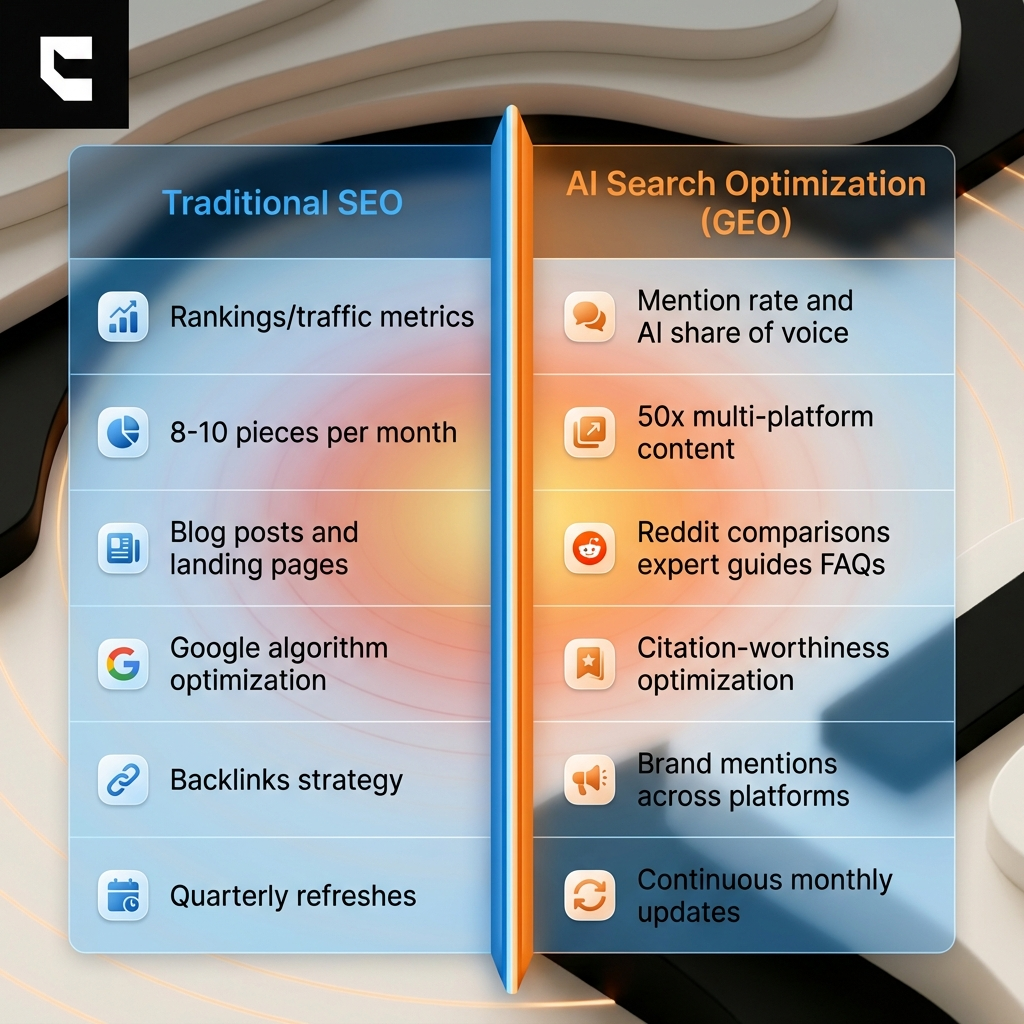
The contrast between traditional SEO and AI search optimization is structural:
| Dimension | Traditional SEO | AI Search Optimization (GEO) |
|---|---|---|
| Success Metric | Rankings, traffic | Mention rate, AI share of voice |
| Content Volume | 8-10 pieces/month | 50x multi-platform content |
| Content Type | Blog posts, landing pages | Reddit, comparisons, expert guides, FAQs |
| Optimization Target | Google algorithm | Citation-worthiness |
| Link Strategy | Backlinks | Brand mentions across platforms |
| Measurement | Google Search Console | AI visibility tracking |
| Update Cadence | Quarterly refreshes | Continuous (40-60% monthly citation drift) |
The solution to all three agency problems — output, measurement, and quality — is the same: a GEO-native approach that combines human strategy with agent-scale execution. Set strategy with human expertise. Execute at scale with AI agents. Same expertise, 50x the output, results in half the time.
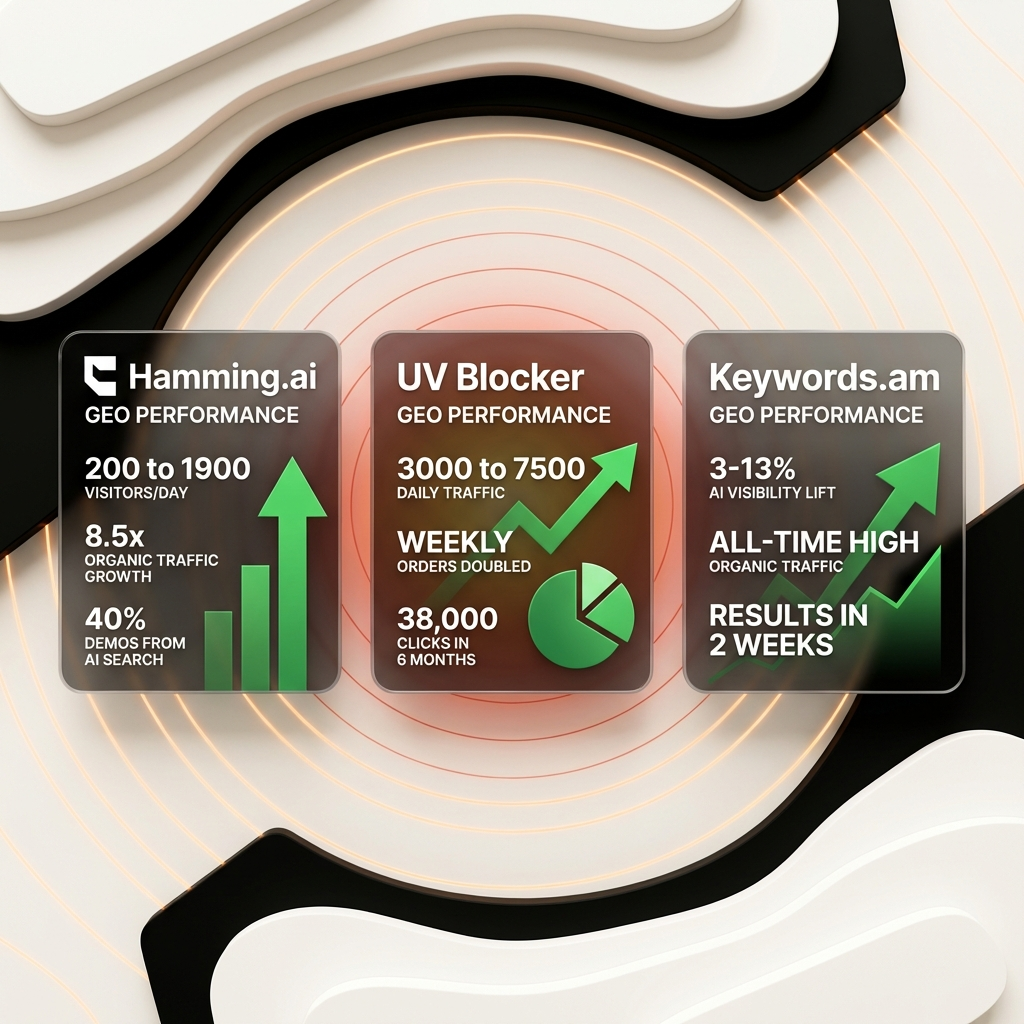
Companies that invest in GEO-native strategies see dramatic results: 8.5x organic traffic, doubled orders, and measurable AI visibility lifts within weeks, not months.
Hamming.ai went from 200 visitors per day to 1,900 visitors per day — 8.5x organic traffic in 12 weeks. 40% of their demos now come from Reddit or AI search.
"We went from 200 visitors/day to 1,900 visitors/day and 40% of the demos we get are from Reddit or AI search." — Sumanyu Sharma, CEO, Hamming.ai
UV Blocker went from zero to 38,000 clicks in 6 months. Daily traffic grew from 3,000 to 7,500. Weekly orders doubled in 1.5 months — during off-season.
"Cintra helped me go from 3k to 7.5k daily traffic and doubled my weekly orders in 1.5 months in off-season." — Russ Coulon, Owner, UV Blocker
Keywords.am saw a 3% to 13% AI visibility lift in the first two weeks. Organic traffic hit an all-time high.
"We saw a lift of 3% to 13% in the first 2 weeks, and organic traffic bumped to the highest I've ever had." — Ash Metry, Founder, Keywords.am
These aren't SEO results. They're GEO results. And they came from a fundamentally different approach to search visibility.
You can keep optimizing for a search paradigm that's losing share every quarter. Or you can start showing up where your buyers are actually making decisions.
AI search converts higher. It changes faster. And it rewards a completely different type of content than what your SEO agency is producing. The brands winning in 2026 aren't choosing between SEO and GEO. They're running both — but they're running GEO with teams built for it, not retrofitted SEO agencies learning on the job.
The question isn't whether AI search matters. The data already answered that. It's how long you can afford to be invisible in the channel that converts your best buyers.
Find out where you stand in AI search — and what it would take to show up.