Why Content Is Hard
Building a content pipeline from scratch revealed why most founders struggle with consistent content creation - and how AI changes the economics
Tanush Yadav
January 1, 2025 · 4 min read
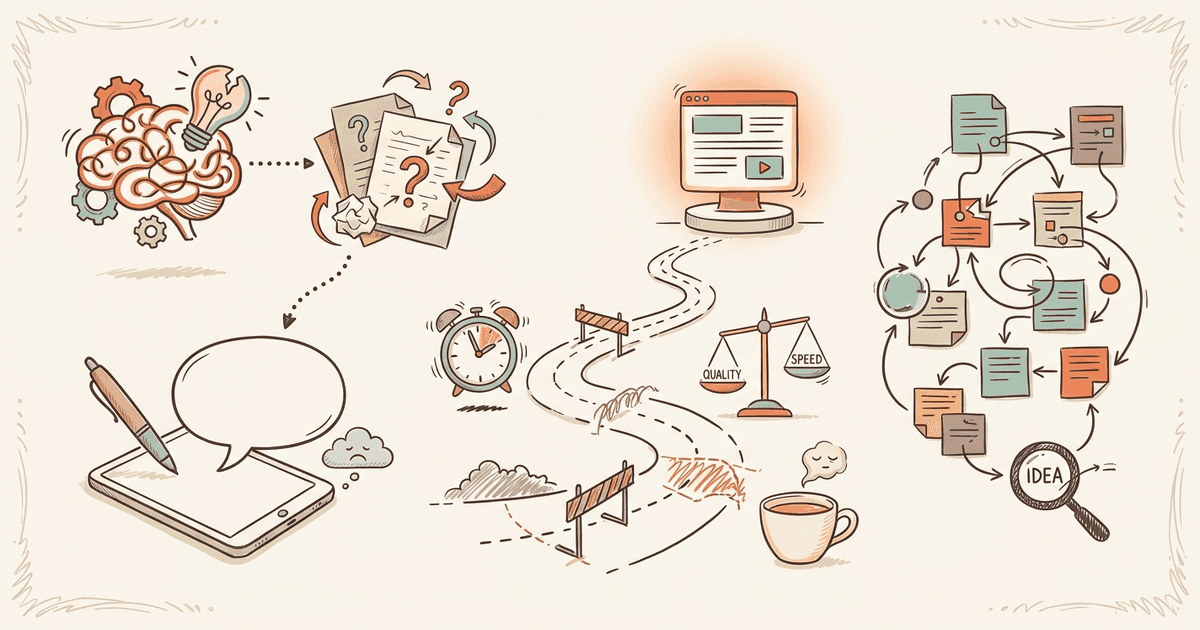
I recently built a content pipeline from scratch (hired contractors, got agency quotes, set up the content calendar). Building the whole system from the ground up taught me why content is hard. Why only a small percentage of founders get active & consistent content pipelines that compound.
TL;DR:
- Context awareness - Getting the CEO's brain and the team's sauce into content.
- Big turnaround times - The mechanical work that eats most of the time
- Misalingment - Misalignment between what founders want and what writers deliver
The Context Awareness Problem
The people with the insight rarely own the calendar. The people with the calendar rarely have the insight. This gap governs quality more than skill does. When you say exactly what you do, it becomes the sauce for the content to stand out.
What's in a founder's head does not travel well. It's tacit, layered, and pattern-based, built from hundreds of customer calls and hard-won judgments. Briefs collapse this context into bullet points that doesn't actually translate the depth.
Why a decision was made is more important than the decision itself. The "why" usually doesn't survive, because it's not communicated, and even if it is, it's not percieved properly.
80/20 ; Why AI Doesn't Solve This
Content production divides into two distinct value streams:
- Strategic Layer (20%): Point of view development, positioning decisions, messaging hierarchy
- Execution Layer (80%): Research, fact-checking, formatting, approval workflows, distribution
The strategic layer determines quality ceiling. The execution layer amplifies strategic decisions through operational efficiency.
AI systems handle execution-layer tasks with superior speed and consistency: research compilation, structural organization, format standardization, first-draft generation. The strategic layer requires human judgment: insight development, positioning choices, editorial decisions.
The breakthrough isn't replacing humans with AI. It's using AI to eliminate the mechanical work so humans can focus on the creative 20% full throttle.
Economics (Time & Money)
Actual turnaround times:
- Contractors: 3-4 days minimum for a single piece. $200-400 per piece. Quality is on the high side of average with some loss of context and high revisions.
- Agency: 4 days to 2 weeks. They deliver in bulk so you might get 5 pieces in 2 weeks. $150-200 per piece. Quality is mediocre, lacking context.
- Full-time hire: Nobody hires a writer who's only a writer. They're usually a marketing person handling all socials. You get max 3 articles a week because 2 days is the fastest turnaround time. However the quality is super high.
Pricing comp:
- $50 writers need everything spelled out. They execute exactly what you give them, nothing more. If the brief is wrong, the content is wrong.
- $150 writers can fill in some gaps. They'll research basic facts and make reasonable assumptions. But they can't read between the lines.
- $400 writers understand the assignment behind the assignment. They can take a loose brief and produce something that feels right because they get what you're really trying to say.
Verdict: To build a consistent 5 deep articles a week cadence you need a team of 3 good writers (10k+ / mo spend)
The Internal Content Machine
We achieved highest efficiency by hiring the $400 writer full-time and getting their help building an internal content machine. Mix of Gemini, Claude, and GPT-5. Seven agentic steps with two approval steps, one editing step for the writer, and one review step for leadership.
This reduced:
- Time to gain context - The system is as aware as the CEO
- Time to research and talk to engineers - The internal truth is baked in
- Time to read and rewrite - Cutting human productivity bias completely
We got consistent 8/10 articles that edited to 9/10. The writer now produces a full week of content (6 pieces, not 2). Review and final drafts done by Monday. Each article takes 45-60 minutes of final review and editing.