How to Choose an AI Visibility Agency (Without Getting Burned)
Tanush Yadav
February 23, 2026 · 15 min read
TL;DR
- Every "best GEO agency" listicle is self-promotional because every agency ranks themselves #1.
- Five criteria matter: named case studies, cross-platform skills, community strategy, strict measurement, and clear pricing.
- Watch for red flags. Guaranteed rankings, nameless case studies, rebranded SEO, and zero community strategy.
- Look for early visibility bumps in 4-8 weeks. Real results hit at 8-12 weeks.
- Pricing ranges from DIY tools at $200-$500/month to enterprise done-for-you service at $8,000-$15,000+/month.
Google "best GEO agency" and you'll find 10+ listicles. Every single one ranks the author's own agency #1. Rock The Rankings lists themselves first. Scopic Studios lists themselves first. uSERP lists themselves first. The pattern is obvious. And it proves completely useless for buyers searching for truth.
The AI visibility agency market is 18 months old. No established playbooks exist. No industry standards exist. Committing $2,000 to $15,000 per month with a 6-month minimum is standard practice. Choosing the wrong partner represents an expensive mistake. You burn cash. You lose months of potential growth. You let competitors establish authority in AI models while you wait for results that never arrive.
This guide is different. You won't find a ranked list of agencies here. Instead, you'll learn the five criteria separating a real AI visibility agency from a rebranded SEO shop. You'll learn the red flags that disqualify pretenders immediately. You'll get realistic expectations for cost and timeline. The evaluation criteria work for testing any agency on the market. Read this before signing a contract.
Table of Contents
- Why Is Choosing an AI Visibility Agency So Hard Right Now?
- What Should You Actually Look for in an AI Visibility Agency?
- What Red Flags Should Disqualify an Agency?
- What Results Should You Expect (And How Fast)?
- How Much Does AI Visibility Cost?
- Frequently Asked Questions About Choosing an AI Visibility Agency
- Conclusion
The GEO industry is barely 18 months old with no standards, no playbooks, and every agency claiming expertise while most just rebranded their SEO services.
The category is too new for established evaluation frameworks. Generative Engine Optimization gained traction in mid-2024. Most agencies simply added "GEO" to their services page in 2025. They saw a new keyword. They created a new landing page. They kept their fulfillment process identical. Ask any AI visibility agency what changed in their process when they added GEO services. Most can't answer. They stumble. They talk about high-quality content. They mention keywords. They describe standard search engine optimization.
Every agency claims AI visibility expertise today. But most just renamed their SEO services. The "best GEO agency" listicles are all self-promotional traps. Rock The Rankings, Scopic Studios, and uSERP each list themselves as the absolute best option. This is a verifiable observation. It isn't an opinion. They create these lists to capture search intent, not to provide objective analysis. Decision-makers reading these lists get a distorted view of the market. They assume the highest-ranking article contains the best recommendations.
The financial stakes are real. Industry data shows $2,000 to $15,000 per month with 6-month minimums is standard pricing for GEO services. Agencies lock you in early. They demand commitment before proving competence. You sign the contract. You pay the invoice. You wait six months to discover they don't know how to influence Perplexity or ChatGPT.
AI citations change 40% to 60% monthly based on Yext Research. Agencies can't coast on early wins. Maintaining visibility requires ongoing expertise. An AI visibility agency getting lucky once won't protect your brand against aggressive citation drift. The models update. The sources shift. The context windows expand. An agency must actively monitor and adjust strategy to keep your brand visible.
So how do you actually evaluate an agency when the normal signals don't work?
Judge AI visibility agencies on five things: named case studies tied to revenue, cross-platform skills, community strategy, strict measurement, and clear pricing.
Master these five core pillars. You'll hire a solid partner who drives measurable business revenue, not just empty talk.
- Named case studies with revenue metrics Ask for named brands. Ask for specific numbers and timelines. Reject stories about "Client A seeing 200% improvement." If an agency can't name a single client publicly and show revenue impact, they haven't proven their methods at scale. They might understand the theory. They haven't executed it successfully.
Our clients prove what is possible when execution matches theory. Hamming.ai saw 8.5x traffic in 12 weeks. UV Blocker went from zero to 38,000 clicks in 6 months. Yoga Democracy saw a 156% increase in AI recommendations. Demand these kinds of specific metrics from any prospective agency. Ask to speak with their past clients. Verify the numbers. Confirm the timeline. Ensure the agency actually drove the results rather than riding a seasonal wave.
- Cross-platform expertise (ChatGPT, Perplexity, AI Overviews, Claude) AI visibility isn't a single platform. An agency optimizing for only one platform fights with one arm tied behind its back. Ask which AI platforms they have optimized for and demand results from at least two.
Google AI Overviews shows 59.3% citation drift. ChatGPT shows 54.1% drift. Each platform has completely different optimization requirements. Perplexity wants dense technical docs and breaking news. But ChatGPT looks for structured data and strict authority. Claude devours massive, long-form guides. Your agency needs to grasp these exact differences. You can't use one playbook for every AI search engine.
- Community strategy (Reddit, Quora) Third-party sources provide 85% of AI brand mentions. If an agency only creates blog content, they miss the biggest lever available. Ask about their Reddit and Quora strategy. If the answer sounds vague or they admit they don't do community work, they don't understand how AI models source information.
AI models ingest massive amounts of conversational data. They trust authentic user discussions over polished marketing copy. A dedicated Reddit strategy for AI visibility is non-negotiable. Agencies must know how to plant brand mentions naturally within niche communities. They must build authority where the models look for consensus.
- Measurement framework How does the agency track results? Citation monitoring, referral traffic, and pipeline attribution should all be covered. If they report Google rankings only, they're measuring the wrong thing. Tracking AI visibility requires specialized tools. It requires custom dashboards.
You need to know your exact share of voice across specific prompts. You need to see how often models recommend your competitors instead of you. Review a complete framework for how to measure AI visibility to know what reports should look like. An agency failing to provide this level of detail is guessing.
- Transparent pricing The industry ranges from $2,000 to $15,000 per month. Agencies refusing to share pricing upfront are often the most expensive. They use sales calls to gauge your budget before revealing their fees.
At minimum, an agency should tell you their starting price and what is included before scheduling a sales call. Clear pricing shows confidence. Hidden fees mean they focus on maximizing margins, not delivering value.
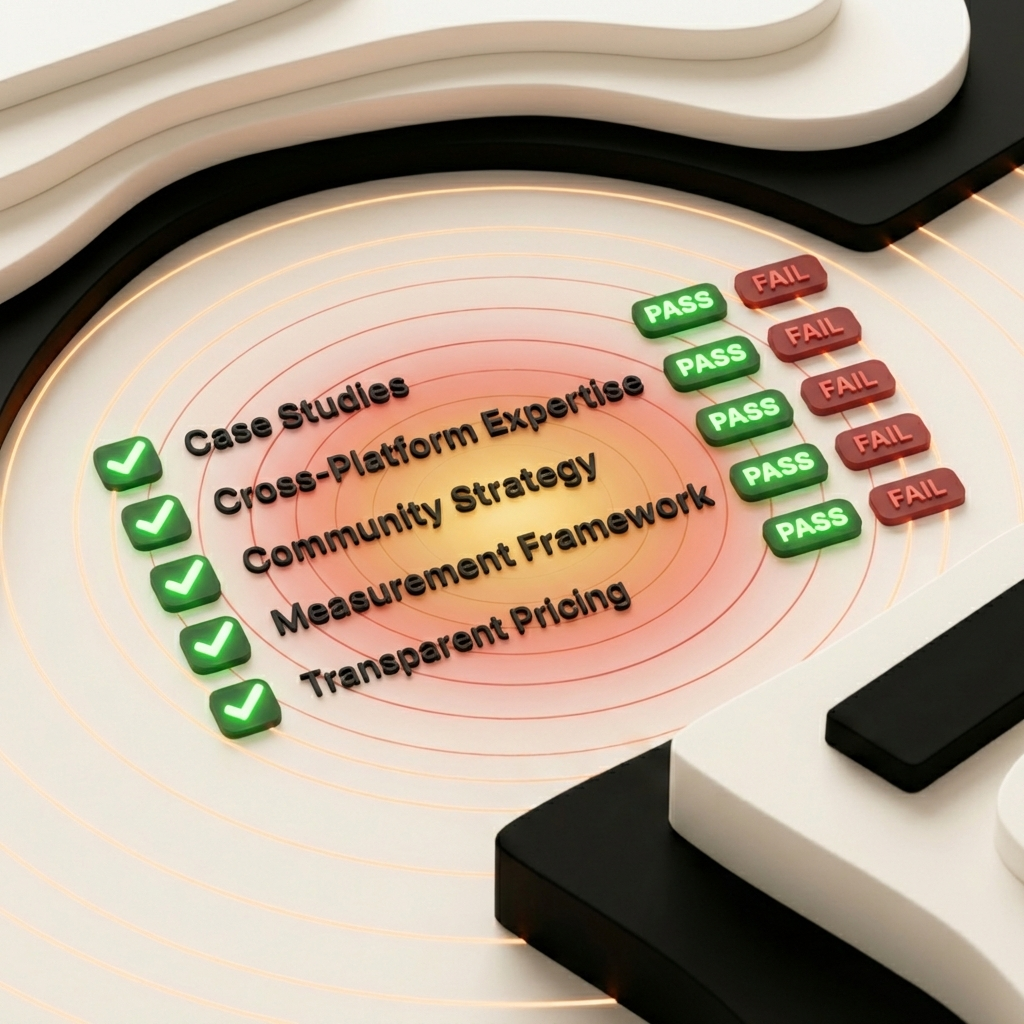
| Criterion | What to Ask | Green Flag | Red Flag |
|---|---|---|---|
| Case Studies | "Show me named clients and revenue results" | Named brands, specific metrics, timelines | "Client A", anonymized results, vague percentages |
| Platform Expertise | "Which AI platforms have you optimized for?" | Results from 2+ platforms (ChatGPT, Perplexity, AI Overviews) | Single-platform focus or vague "all of them" |
| Community Strategy | "What's your Reddit/Quora approach?" | Specific subreddit strategies, authentic engagement | "We don't do community" or blog-only approach |
| Measurement | "What metrics do you report?" | Citation monitoring, referral traffic, pipeline attribution | Google rankings only, vanity metrics |
| Pricing | "What does your service cost?" | Published pricing, clear deliverables per tier | "Let's discuss after a call", no transparency |
Knowing what to look for is half the battle. You also need to know what should immediately disqualify an agency.
Drop any agency promising guaranteed AI rankings. Walk away if they hide case studies. And run if they can't separate GEO from standard SEO.
Catch these warning signs early. You'll avoid signing expensive contracts with rookie teams pushing false promises.
-
"We guarantee page 1 rankings in AI search" AI citations change 40% to 60% every single month. Nobody can guarantee stable placement in a system refreshing this aggressively. This is the equivalent of guaranteeing the weather. The models constantly re-evaluate source authority. They ingest new data daily. They adjust their internal weights. Run away from anyone making a guaranteed placement promise. They are lying to secure your signature.
-
No named case studies If they can't name a single client publicly and show real numbers, they either haven't done this at scale or the results weren't worth showing. Real case studies use real names. They show the exact problem, the exact strategy, and the exact business outcome. Agencies hiding behind non-disclosure agreements usually lack a track record of success.
-
Pure SEO rebranding Ask what differentiates their GEO process from their SEO process. If they can't articulate the difference clearly, they are just doing SEO with a new name. Traditional SEO focuses on keyword density, backlinks, and technical site structure. GEO focuses on conversational context, entity relationships, and third-party consensus. The difference between SEO vs AI search optimization dictates completely different execution strategies. If their process sounds identical to building backlinks and writing 500-word blog posts, they aren't doing GEO.
-
No community/Reddit strategy Blog-only approaches miss 85% of AI citation sources. If they only optimize your website content, they ignore where most AI recommendations actually originate. Large language models crave human experience. They scrape Reddit. They scrape Quora. They scrape niche forums. An AI visibility agency ignoring these platforms cannot deliver comprehensive results.
-
Tool-first, strategy-second Some agencies act as tool companies upselling services. They pitch their proprietary dashboard as the main value proposition. The tool should serve the strategy. It should never be the other way around. Ask what happens if you cancel. If you lose your content and strategy insights because they stay locked in a proprietary platform, find another partner. You should own your strategy. You should own your data.
Now that you know what to look for and what to avoid, what should you actually expect when you hire an agency?
Expect initial AI visibility improvements in 4-8 weeks and significant results (traffic growth, pipeline impact) in 8-12 weeks based on real case study benchmarks.
Initial visibility improvements surface in 4-8 weeks. Significant results arrive in 8-12 weeks. This is faster than traditional SEO, which takes 6-12 months. But it isn't instant. The models need time to crawl new content. They need time to process community discussions. Set your expectations clearly before signing a contract.
Reviewing real benchmarks across verticals shows what good looks like. Our SaaS client Hamming.ai saw 8.5x organic traffic in 12 weeks. They grew from 200 to 1,900 visitors per day. Reddit and AI search drove 40% of their demos. This translates directly to pipeline velocity. Our ecommerce client UV Blocker grew from 0 to 38,000 clicks in 6 months. Daily traffic jumped from 3,000 to 7,500. They doubled weekly orders in 1.5 months during their off-season. Yoga Democracy achieved a 156% increase in AI recommendations.
Use these benchmarks to calibrate expectations when talking to agencies. Demand realistic projections. Evaluate deeper AI visibility ROI data to understand the revenue potential. If an agency promises millions of impressions in week one, they are fabricating numbers.
Agencies must report on AI citation rate increases, referral traffic from AI platforms, and pipeline attribution. Google rankings alone are insufficient. Traffic quality matters more than traffic volume. AI search users carry high commercial intent. They ask specific questions. They want specific solutions. Any credible AI visibility agency must track how many of these users convert into paying customers.
Citation volatility guarantees month-over-month numbers will fluctuate. Look at 3-month trends instead of weekly snapshots. A 40-60% citation drift per month means short-term swings are normal behavior. An agency showing a 20% drop without providing context is either inexperienced or cherry-picking data. Look for long-term growth trajectories. Expect bumps along the way.
Results expectations are one thing. But how much should you actually budget?
AI visibility services range from $200/month for DIY monitoring tools to $15,000+/month for enterprise done-for-you agencies, with most brands spending $3,000-$8,000/month.
The required investment varies based on execution needs. You pay for strategy, content creation, community engagement, and reporting.

| Tier | Monthly Cost | What You Get | Best For |
|---|---|---|---|
| DIY monitoring tools | $200-$500 | Citation tracking, basic optimization suggestions | Teams exploring AI visibility before committing |
| DIY with coaching | $1,500-$3,000 | Strategy, playbooks, templates (you execute) | Teams with in-house writers who need direction |
| Done-for-you agency | $3,000-$8,000 | Full content creation, community strategy, optimization | Brands that want hands-off growth |
| Enterprise/multi-brand | $8,000-$15,000+ | Multi-market support, dedicated creative, custom reporting | Large brands with multiple product lines |
Industry data confirms these standard pricing ranges. Agencies with transparent pricing publish it on their website, like our pricing page outlining DIY, Done-For-You, and custom Enterprise options.
The cost of inaction dwarfs the cost of an agency. While you evaluate agencies, competitors capture AI citations in your category. AI visibility is a land grab right now. Early movers compound their advantages because AI models favor established authority signals. Taking time to choose the right AI visibility agency makes sense. Stalling for months costs you market share.
Brands delaying their GEO strategy will find it exponentially harder to break into AI recommendations next year. The models cement their preferred sources. Dislodging an entrenched competitor requires massive resources. Act carefully, but act now.
These are the most common questions decision-makers ask when evaluating AI visibility agencies for the first time.
Can I do AI visibility in-house instead of hiring an agency?
Yes, if you have a content team, community managers, and someone who understands AI citation mechanics (most teams need at least one of these roles filled by an agency).
DIY is viable for teams with existing content infrastructure. The gap is usually in AI-specific expertise. Internal teams often lack understanding of citation mechanics across platforms, community strategy, and proper measurement. They write good blog posts but fail to structure them for AI ingestion. Many brands start with a coaching-tier agency for $1,500-$3,000 per month to build internal capability. They learn the playbooks. They execute internally.
How long should I commit to an AI visibility agency?
Give any agency 90 days minimum to show measurable results (if nothing moves by week 12, the strategy or execution has a problem).
Most agencies require 3-6 month minimums. This is reasonable. AI visibility builds over time rather than overnight. Producing content takes weeks. Community seeding requires patience. The models take time to process new signals. But insist on monthly reporting with clear KPIs defined upfront. You need to evaluate progress before the commitment ends. Do not accept silence for three months.
What's the difference between a GEO agency and an SEO agency?
SEO agencies optimize for Google rankings. GEO agencies chase AI citations on ChatGPT, Perplexity, AI Overviews, and Claude. That means different platforms, tactics, and metrics.
You'll find some overlap. Great content works everywhere. A fast, clean site helps Google bots and AI scrapers alike. But GEO demands more. You need active community engagement, tight citation tracking, and structured data built for AI consumption. An SEO agency adding "GEO" to their menu isn't the same as a GEO-native agency. They use old tactics for new platforms.
Should I prioritize AI visibility or traditional SEO?
Both. Traditional SEO still drives 413x more raw traffic, but AI search traffic converts at 4-23x higher rates (the smart play is doing both simultaneously).
Google still dominates raw traffic volume. You cannot ignore traditional search. But AI search captures high-intent buyers converting at dramatically higher rates. Users asking ChatGPT for product recommendations are ready to buy. The best agencies integrate both rather than treating them as separate channels. They secure Google traffic for top-of-funnel awareness. They secure AI visibility for bottom-of-funnel conversions.
The GEO industry remains too new for "best of" listicles to be trustworthy because every agency ranks themselves number one.
Five evaluation criteria separate a real AI visibility agency from a rebranded SEO shop. Evaluating named case studies, cross-platform expertise, community strategy, measurement frameworks, and pricing transparency protects your budget. Red flags like guaranteed rankings, anonymous case studies, and missing community strategies should immediately disqualify agencies. Budget $3,000 to $8,000 per month for done-for-you service, give a 90-day minimum, and measure 3-month trends.
Use the evaluation checklist from this article in your next agency call. Ask the five questions. The answers will tell you everything you need to know about their true capabilities. Refuse to settle for vague promises.
If you want to see how this framework applies to your brand, start with a free AI visibility audit. We will show you exactly where you stand across ChatGPT, Perplexity, and AI Overviews with no commitment required.