AI Search Statistics 2026: 30+ Data Points Every Marketer Needs
AI search statistics 2026: 900M ChatGPT users, 23x conversion rates, 61% CTR drops from AI Overviews. 30+ verified stats with sources for strategy decks and internal pitches.
Tanush Yadav
March 1, 2026 · 9 min read
- What Do the AI Search Adoption Numbers Look Like in 2026?
- How Does AI Search Traffic Convert Compared to Traditional Search?
- What Impact Do AI Overviews Have on Search Behavior?
- Where Do AI Models Pull Their Citations From?
- What Is the Business Case for AI Search Visibility?
- What Do These AI Search Statistics 2026 Mean for Marketing Strategy?
- Frequently Asked Questions About AI Search Statistics
- Conclusion
TL;DR
- 900M+ weekly active ChatGPT users (Backlinko)
- 23x higher conversion rate from AI search traffic (Ahrefs)
- 61% organic CTR drops from AI Overviews (Seer Interactive)
- 85% of AI brand mentions are from third-party pages (AirOps)
- $7.3B Generative Engine Optimization (GEO) market by 2031 (Valuates Reports)
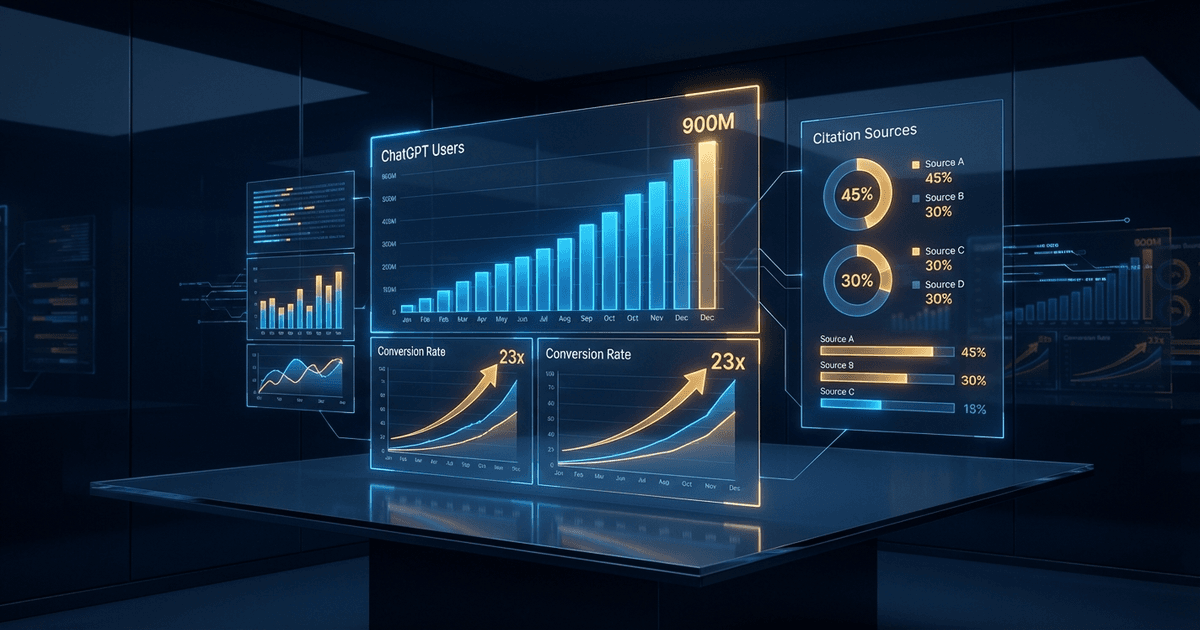
900 million people use ChatGPT every week. AI-referred traffic converts 23x higher than organic. And Google's own AI Overviews are cutting organic click-through rates by 61%. If you're building a strategy deck or pitching AI search investment internally, these are the AI search statistics 2026 that'll make your case.
The problem? These numbers live in dozens of separate reports, and half go stale within a few months. So this page pulls together 30+ verified stats, organized by what actually matters (adoption, conversions, citations, platforms, business impact) with strategic context after each section. It's updated quarterly. Bookmark it.
What Do the AI Search Adoption Numbers Look Like in 2026?
AI search hit mainstream scale in 2026, with 900 million weekly ChatGPT users and half of B2B buyers now starting vendor research in AI chatbots instead of Google.
ChatGPT crossed 900 million weekly active users in February 2026. That's up from 400 million just a year earlier. Gartner predicted in 2024 that traditional search volume would drop 25% by 2026. Critics called the number aggressive, but the direction? Spot on. Understanding this shift is key to generative engine optimization.
The B2B numbers are striking. Half of B2B software buyers now start vendor research in AI chatbots, not search engines. And 87% say AI chat has changed how they evaluate software. Perplexity alone processes 1.2 to 1.5 billion queries monthly in early 2026 (up from 780 million in May 2025). All of this drives referral traffic: LLM referrals jumped 527% year-over-year between January-May 2024 and 2025.
But adoption alone doesn't tell the full story. The real question: do these visitors convert?
How Does AI Search Traffic Convert Compared to Traditional Search?
AI search visitors convert at dramatically higher rates. Ahrefs found a 23x higher signup rate from AI-referred visitors compared to organic.
This is the stat that wins internal pitches. Ahrefs tracked its own AI search traffic and found it converts 23x higher than organic. Just 0.5% of visits came from AI sources, yet those visitors drove 12.1% of all signups. That's Ahrefs-specific data, but the pattern shows up everywhere. Forrester found AI-referred visitors stick around 3x longer on-page.
Other studies back it up. Semrush and Growth Marshal reported in June 2025 that AI visitors convert 4.4x better than traditional organic. Right now, 2-6% of B2B organic traffic comes from AI, and it's growing 40%+ per month (Forrester). Small percentage. Massive conversion gap. That's the core of the AI visibility ROI argument.
So if the visitors convert, what determines whether they find you? Citations.
What Impact Do AI Overviews Have on Search Behavior?
AI Overviews cut organic click-through rates by 61% on informational queries. But here's the twist: pages that get cited inside AI Overviews earn 35% more clicks.
Seer Interactive tracked 3,119 queries across 42 companies from June 2024 through September 2025. Organic CTR? Down 61% when AI Overviews triggered. Paid CTR cratered 68%. These aren't fluctuations you can wait out.
But there's a flip side. Pages cited within AI Overviews saw 35% more organic clicks and 91% more paid clicks. Being cited isn't just nice to have; it's the difference between gaining and losing traffic. Almost all AI Overview sources (99.5%) come from pages already in the top 10 organic results (SeoClarity). Here's an interesting split: Pew Research says only 1% of general users click links inside AI summaries. But Demand Gen Report found 90% of B2B buyers do click through to cited sources. The B2B opportunity is real. Measuring it requires a structured approach to AI visibility.
So if citations determine whether you win or lose traffic, where do AI models actually pull them from?
Where Do AI Models Pull Their Citations From?
Third-party pages drive 85% of AI brand mentions. Reddit shows up as a top citation source across ChatGPT, Perplexity, and AI Overviews.
Here's what most brands get wrong: they optimize their own website and expect AI models to cite it. But AirOps analyzed 21,311 brand mentions and found 85% came from third-party pages, not owned domains. It's earned media that drives AI visibility. Reddit alone appears in roughly 40% of AI-generated answers.
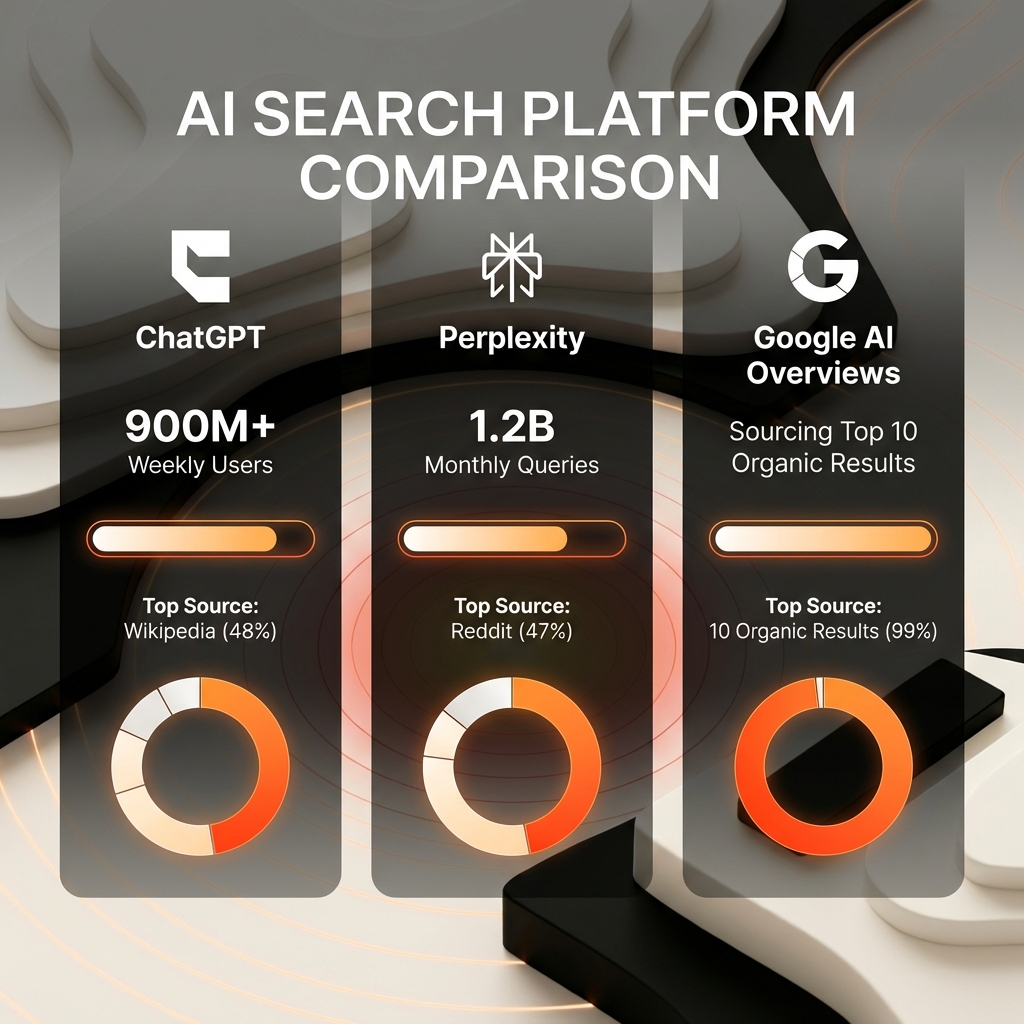
The platform breakdown tells you where to focus. Profound's research shows ChatGPT pulls most heavily from Wikipedia (47.9%) and Reddit (11.3%). Perplexity leans even harder on Reddit at 46.7%, with YouTube second at 13.9%. That makes a Reddit strategy for AI visibility non-optional for most brands. And the content itself matters: articles with statistics improve AI visibility by up to 40% (Princeton/KDD). Pages with schema markup are 3x more likely to earn citations. One big caveat though: 40-60% of AI citations change every month, so this isn't a set-and-forget game. For more on getting recommended by ChatGPT, there's a dedicated playbook.
| Platform | Top Source | % | Second Source | % |
|---|---|---|---|---|
| ChatGPT | Wikipedia | 47.9% | 11.3% | |
| Perplexity | 46.7% | YouTube | 13.9% | |
| AI Overviews | Top 10 organic | 99.5% | N/A | N/A |
Knowing where citations come from is half the battle. The other half? Making the business case to invest in it.
What Is the Business Case for AI Search Visibility?
The GEO services market is projected to hit $7.3 billion by 2031 (up from $886 million in 2024). Early movers like NerdWallet have already grown revenue 35% despite a 20% drop in traditional traffic.
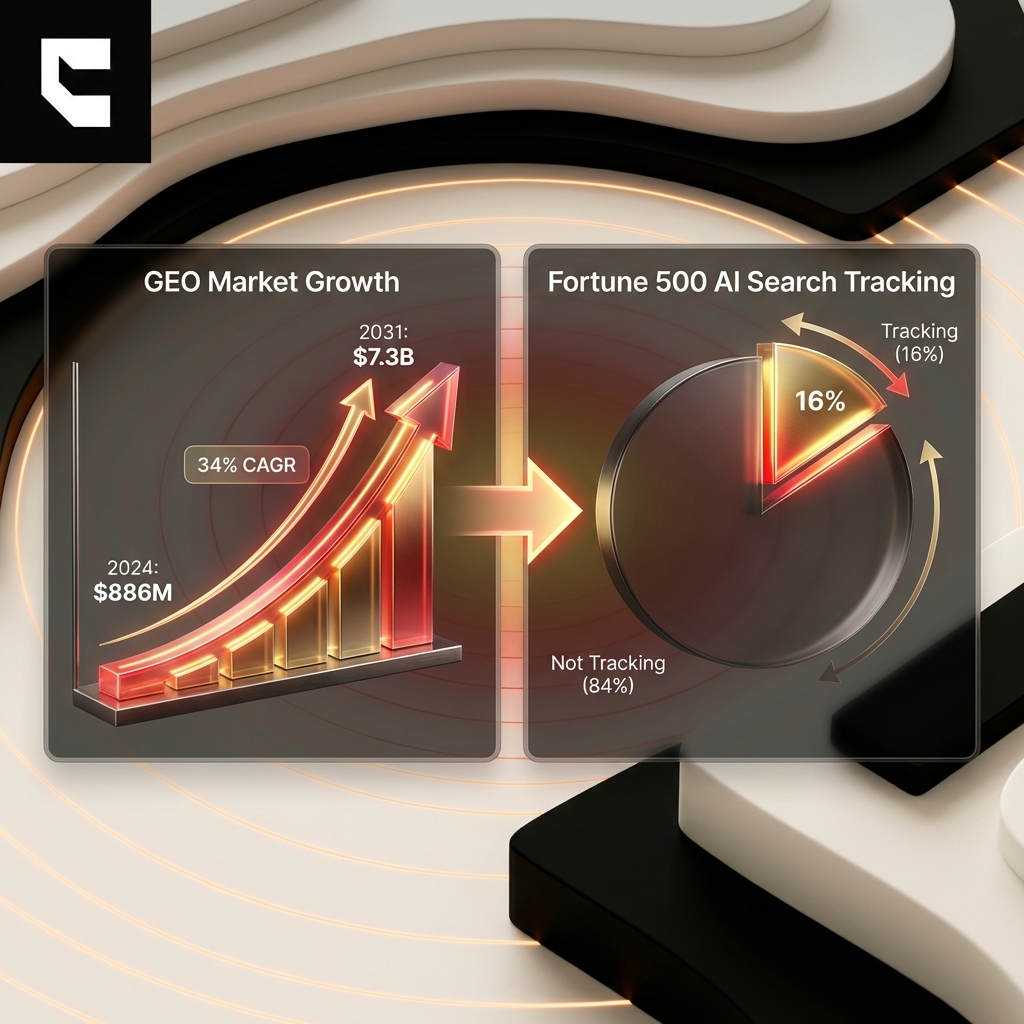
There's a massive first-mover advantage right now. Only 16% of Fortune 500 brands even track AI search performance. That leaves an 84% gap for companies willing to move first. The market opportunity backs this up: Valuates Reports projects GEO services growing from $886 million (2024) to $7.3 billion by 2031, a 34% CAGR.
NerdWallet is the best proof this works. Revenue up 35%, traditional traffic down 20% (HubSpot). They didn't fight the shift; they rode it. Content freshness matters too: pages updated within two months earn 28% more citations than stale ones. And for B2B marketers, this stat should get attention: GenAI chatbots are now the #1 source influencing vendor shortlists at 17.1%, beating review sites (15.1%) and vendor websites (12.8%). These AI search statistics 2026 build the full AI visibility ROI case.
What Do These AI Search Statistics 2026 Mean for Marketing Strategy?
Three priorities emerge from these AI search statistics 2026: optimize for citation quality (not traffic volume), invest in third-party presence, and track AI search performance separately from SEO.
Priority 1: Chase conversions, not clicks. The 23x conversion rate from Ahrefs' data flips traditional thinking. Even if AI search sends 10x fewer visitors than Google, those visitors are worth more per head. Stop measuring success by traffic volume alone.
Priority 2: Earn mentions on pages you don't own. AirOps' data is clear: 85% of AI citations come from third-party pages. That means Reddit threads, review sites, and comparison articles matter more than blog posts on your own domain. Earned media isn't optional anymore.
Priority 3: Measure AI search separately. With 40-60% monthly citation churn, you can't afford to check quarterly. And since only 16% of Fortune 500 brands track this at all, doing so is a competitive edge in itself. Cintra's team uses exactly these data points when building client strategies. Check out pricing or dig into the measurement framework to see how it works in practice.
Frequently Asked Questions About AI Search Statistics
These are the most common questions marketers ask when compiling AI search data for pitches and strategy documents.
Where do these AI search statistics come from?
Published research only. Ahrefs, Seer Interactive, G2, AirOps, Profound, Gartner (and a few others) all contributed data, and every number links back to its original source.
The biggest studies behind this page? Seer Interactive's 3,119-query CTR analysis, AirOps' study of 21,311 brand mentions, and Ahrefs' first-party conversion data. Nothing here is unattributed.
How often do AI search statistics change?
Fast. 40-60% of AI citations change every month, and platform user counts get updated quarterly. What's accurate today may be outdated in 90 days.
This page gets refreshed quarterly to catch the latest shifts. Bookmark it and check back before building your next deck.
What is the most important AI search statistic for a pitch deck?
The Ahrefs finding that AI search traffic converts 23x higher than organic search is the single most compelling stat for internal pitches.
Pair it with the G2 stat showing 50% of B2B buyers now start in AI chatbots to demonstrate both demand shift and conversion quality.
Conclusion
The numbers tell a clear story. 900 million weekly ChatGPT users. 23x conversion rates. 85% of brand mentions coming from pages brands don't control. This isn't a "future of search" conversation anymore. It's how buyers already find and pick vendors today.
Here's one thing to do right now: open Google Analytics, filter referrals from chatgpt.com and perplexity.ai, and compare those conversion rates against your organic channels. The gap will make the case better than any deck slide. For a complete framework, explore Cintra's AI visibility measurement guide or see service options.