Generative Engine Optimization: The Ultimate Guide for 2026
Generative engine optimization (GEO) is how brands get cited by ChatGPT, Perplexity, and AI Overviews. Learn core tactics, case studies, and a GEO playbook.
TL;DR
- Generative engine optimization (GEO) is the practice of getting your brand cited by AI search engines like ChatGPT, Perplexity, and AI Overviews
- 87% of ChatGPT citations match Bing's top 10 results, so SEO is still the foundation
- Content with statistics and authoritative citations improves AI visibility by up to 40% (Princeton/KDD 2024 research)
- Five core tactics drive results: answer-first structure, entity clarity, third-party validation, structured data, and content freshness
- Companies using GEO see 8.5x traffic growth and doubled orders within weeks
- 40-60% of AI citations change every month, so GEO requires continuous optimization, not a one-time project
More than 800 million people use ChatGPT every week to find answers and make buying decisions. Gartner predicts traditional search volume will drop 25% by 2026 as users migrate to AI assistants. A new discipline called generative engine optimization determines which brands get recommended by AI and which get ignored.
The GEO landscape is flooded with academic theory, tool-vendor marketing, and generic advice that lacks proof. This guide provides a comprehensive, practitioner-led breakdown of GEO: how it works, the core tactics, verified case studies, and a clear playbook for getting started. For the B2B side specifically, the AI search for B2B guide covers the enterprise buyer journey in detail. The AI search statistics page gathers the data points behind these trends in one place.
What Is Generative Engine Optimization?
Generative engine optimization is the practice of optimizing content to appear in AI-generated search results from ChatGPT, Perplexity, Google AI Overviews, and Claude.
GEO is the strategic process of creating and structuring content so that generative AI models select it as a source when answering user queries. Unlike traditional SEO, which focuses on ranking positions and click-through rates, GEO focuses on mention rate and share of voice within synthesized answers. The shift requires moving from keyword-optimized pages designed for algorithms toward authoritative, citation-worthy content designed for synthesis.
The terminology has been fluid. Answer Engine Optimization (AEO), Large Language Model Optimization (LLMO), and AI SEO are all used interchangeably. The industry is converging on "generative engine optimization" as the standard, largely influenced by a 2023 research paper from Princeton, IIT Delhi, and other institutions. The researchers demonstrated that content with statistics, quotations, and authoritative citations improved visibility in AI responses by up to 40%. Their study also introduced GEO-bench, a benchmark of 10,000 queries across nine domains to measure AI visibility.
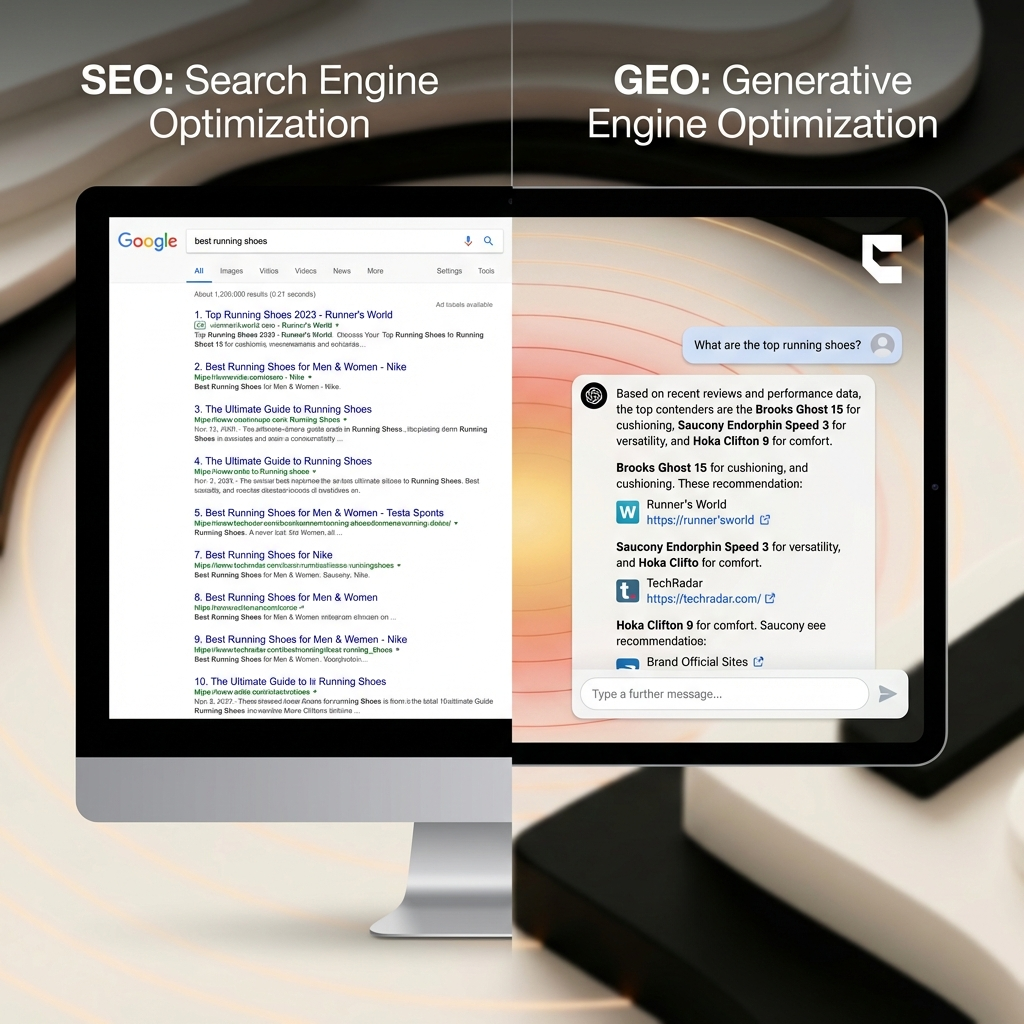
While SEO and GEO share the goal of driving traffic, the mechanisms differ fundamentally. Traditional SEO targets a retrieval algorithm that ranks documents by relevance and authority. GEO targets a generation model that reads, synthesizes, and cites information.
| Dimension | Traditional SEO | Generative Engine Optimization |
|---|---|---|
| Target engine | Google, Bing (ranking algorithms) | ChatGPT, Perplexity, AI Overviews (LLMs) |
| Primary goal | Rank on page 1 | Get cited in AI-generated answers |
| Content focus | Keyword-optimized pages | Answer-first, citation-worthy content |
| Key metrics | Rankings, organic traffic, CTR | Mention rate, AI share of voice, citation frequency |
| Validation signals | Backlinks, domain authority | Third-party mentions, Reddit, reviews, media |
| Timeline to results | 3-6 months | 4-12 weeks for initial citations |
For a deeper analysis of how these strategies diverge, see the full breakdown on SEO vs AI search optimization.
How Do AI Search Engines Actually Find and Cite Sources?
See where you rank in generative engine results.
Enter your domain and we'll scan your generative engine citation rate across your highest-value queries.
Prefer to talk? Book a free 30-min call
AI search engines use retrieval-augmented generation (RAG) to search the web, retrieve relevant pages, synthesize answers, and cite sources in real time.
When a user asks a question to ChatGPT or Perplexity, the system does not rely solely on static training data. It acts like a research assistant: it interprets the query, performs a live search, reads the content of retrieved pages, synthesizes a coherent answer, and adds citations to the sources it used. This happens in seconds, but it fundamentally changes the nature of search.
Different platforms handle this differently. ChatGPT uses a hybrid model, combining pre-trained knowledge with real-time web search powered by Bing. Perplexity is built almost entirely around real-time retrieval, browsing the web and summarizing findings on every query. Google AI Overviews blend Google's traditional search index with generative summaries at the top of results.
Despite these differences, traditional SEO remains the foundation. A Seer Interactive study analyzing 500+ citations found that 87% of sources cited by ChatGPT matched Bing's top 10 organic results. Ranking well gets a brand into the consideration set, but ranking alone does not guarantee citation. The content must also be structured for easy summarization and reference.
The biggest challenge is citation volatility. Profound's data reveals that 40-60% of AI citations change every month: 59% monthly drift for Google AI Overviews, 54% for ChatGPT, and 41% for Perplexity. Quarterly content refresh cycles are too slow. Brands that treat GEO as an ongoing channel, not a one-time project, maintain their visibility.
For a detailed look at ChatGPT-specific optimization, see the ChatGPT optimization deep dive.
What Are the Core Tactics That Drive GEO Results?
The five core GEO tactics are answer-first content structure, entity clarity, third-party validation, structured data markup, and consistent content freshness.
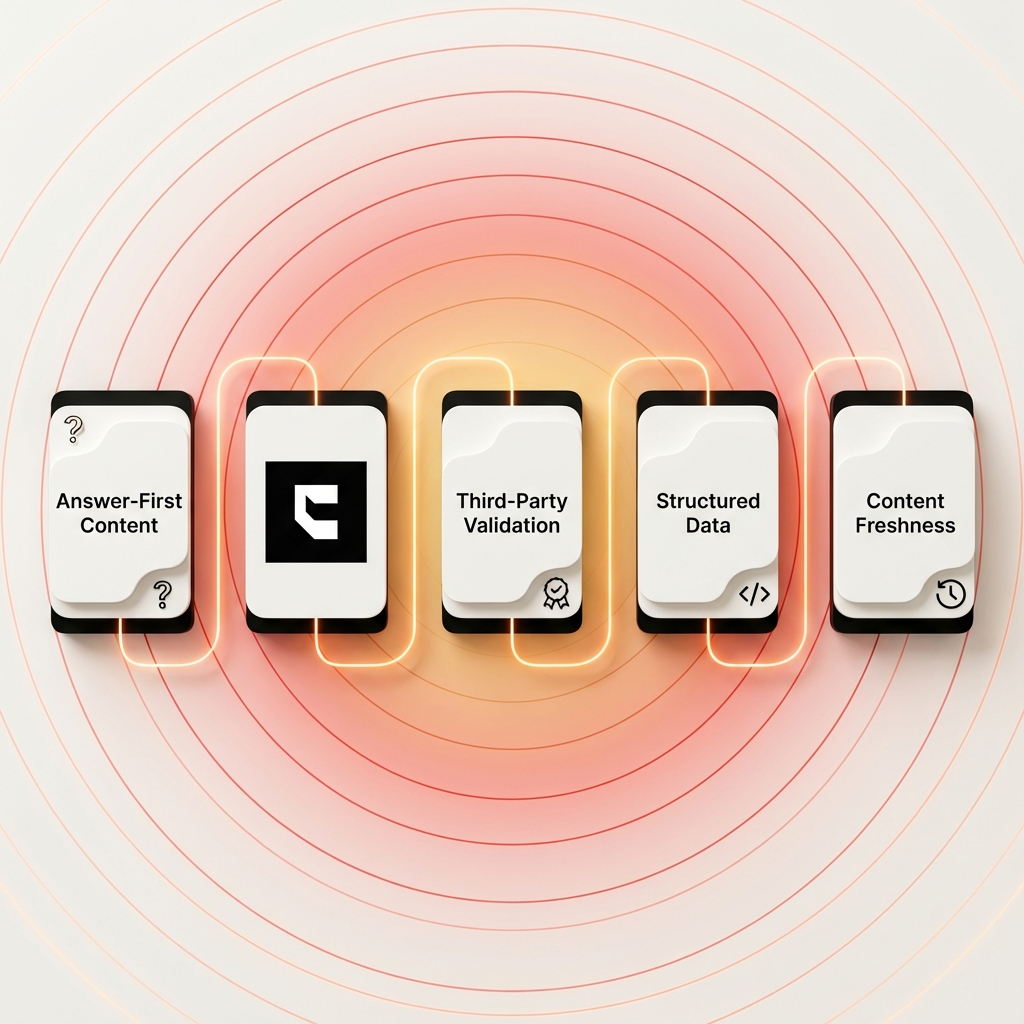
1. Answer-First Content Structure
The most effective way to earn citations is to lead every major section with a direct, concise answer (15-30 words) before elaborating with details. The Princeton GEO research highlighted this as one of the most effective optimization methods. Placing the core answer first makes it easy for RAG systems to extract and verify information, increasing the probability of citation.
2. Entity Clarity
AI models rely on entities (brands, products, people) they can identify and categorize. For a brand to get recommended, the AI must clearly understand what it is, what it offers, and who it serves. Consistent brand descriptions across all digital properties, including schema markup (Organization, Product, FAQ), reduce ambiguity. If an AI cannot confidently categorize a business, it will likely exclude it from recommendations.
3. Third-Party Validation
AirOps research found that 85% of brand mentions in AI responses come from third-party pages, not brand-owned content. AI engines scan Reddit, review sites, media outlets, and industry forums for consensus and social proof. Reddit alone appears in approximately 40% of AI-generated answers. A deliberate Reddit strategy for AI visibility is essential for any brand serious about GEO. The same third-party validation principle is what makes backlinks for AI visibility work differently than traditional link building.
4. Structured Data and Schema Markup
Structured data (Schema.org markup) translates website content into a language LLMs parse with high accuracy. Implementing FAQPage, HowTo, Organization, and Product schemas provides explicit signals about content meaning and context, making pages more attractive for retrieval and citation.
5. Content Freshness
Given that 40-60% of citations change monthly, static content gets deprioritized. Successful GEO strategies involve updating pillar content on a monthly cadence: refreshing statistics, adding recent case studies, and updating references. Freshness signals that a source is active, current, and reliable.
What Results Does GEO Actually Deliver?
Companies executing GEO strategies see 8.5x organic traffic growth, doubled ecommerce orders, and 156% increases in AI recommendations within weeks.
Hamming.ai implemented a comprehensive GEO strategy and saw organic traffic grow 8.5x in 12 weeks, from 200 to 1,900 visitors per day. 40% of demos now come from Reddit or AI search.
"We went from 200 visitors/day to 1,900 visitors/day and 40% of the demos we get are from Reddit or AI search." - Sumanyu Sharma, CEO, Hamming.ai
UV Blocker grew from zero to 38,000 clicks in 6 months. Daily traffic surged from 3,000 to 7,500, and weekly orders doubled in 1.5 months during off-season.
"Cintra helped me go from 3k to 7.5k daily traffic and doubled my weekly orders in 1.5 months in off-season." - Russ Coulon, Owner, UV Blocker
Yoga Democracy focused on entity clarity and third-party validation, achieving a 156% increase in AI recommendations.
These results track with broader industry data. Ahrefs found that AI search traffic converts at 23x the rate of traditional organic traffic. Semrush and Growth Marshal report that AI search reaches a 4.4x broader audience. With the GEO market projected to grow from $886 million in 2024 to $7.3 billion by 2031, the commercial case for adoption is clear. The complete breakdown of AI visibility ROI, including revenue-tied case studies, covers the financial case in detail.
How Do You Get Started with GEO?
Step 1: Audit Your Current AI Visibility. Ask ChatGPT, Perplexity, and Google AI Overviews buying questions in your category. Record whether your brand appears, in what position, and with what context. For a structured process, see the guide on how to measure AI visibility.
Step 2: Optimize Existing High-Value Content. Take top-performing SEO pages and restructure them for AI citation: add answer capsules at the top of key sections, include statistics with source citations, implement structured data markup, and ensure entity clarity.
Step 3: Build Third-Party Presence. Engage authentically on Reddit, Quora, and industry forums. Don't spam links. Provide helpful, detailed answers that naturally reference your brand. Remember: 85% of AI brand mentions come from third-party sources. For the operational playbook, see the Reddit strategy for AI visibility.
Step 4: Monitor and Refresh Monthly. Track AI mention rate and citation frequency. Update content monthly with fresh data. The brands that maintain visibility treat GEO as an ongoing program, not a one-time project.
DIY vs. Agency: If an internal team can produce 50+ pieces of optimized content per month, engage in communities, and monitor citations across platforms, DIY is viable. For brands that need to scale quickly, a GEO-native agency delivers the same results faster.
Frequently Asked Questions About Generative Engine Optimization
These are the most common questions about generative engine optimization, answered with current data and practitioner experience.
Is generative engine optimization replacing SEO?
No. GEO complements SEO. Since 87% of ChatGPT citations come from Bing's top 10 results, strong SEO remains the foundation for AI visibility. SEO handles discovery; GEO adds the citation-worthiness layer that ensures content actually gets used in AI answers. Brands need both. For the full comparison, see the SEO vs AI search optimization breakdown.
How much does generative engine optimization cost?
DIY costs are primarily time and internal resources. Agency services range from $2,000 to $10,000+ per month depending on scope, content volume, and competitive landscape. The right investment depends on your goals and competitive landscape. For a current benchmark of who specializes in this work, see the top LLM optimization agencies in 2026 ranked on multi-LLM coverage and client results.
How long does GEO take to show results?
Initial AI citations typically appear within 4-12 weeks. Hamming.ai saw 8.5x traffic growth in 12 weeks. UV Blocker doubled orders in roughly 6 weeks. Results depend on existing domain authority, content volume, and competitive landscape. Brands with strong SEO foundations see faster GEO results.
Which AI platforms should I prioritize for GEO?
Start with ChatGPT (800M weekly users) and Perplexity (fastest-growing AI search engine), then expand to Google AI Overviews and Claude. Each platform has different citation behavior: ChatGPT leans on Bing's index, Perplexity prioritizes real-time retrieval, and AI Overviews blend Google's index with generative summaries. Platform-specific guidance is in the ChatGPT optimization guide. If you need agency support for ChatGPT specifically, the best ChatGPT optimization agencies in 2026 are evaluated on citation methodology and cross-platform depth.
Can I do GEO myself or do I need an agency?
Teams with content capacity and technical skills can execute GEO in-house. The core tactics (answer-first content, entity clarity, community presence) are learnable. The challenge is scale and consistency. GEO requires continuous execution, not a one-time project. Brands needing scale (50+ pieces/month) often benefit from agency support, see the best GEO agencies in 2026 ranked by methodology, multi-LLM coverage, and documented results.
Conclusion
The shift from traditional search to generative answers is a fundamental restructuring of how information gets accessed online. Generative engine optimization allows brands to navigate this shift and remain visible in an AI-first world.
- GEO is a defined discipline backed by academic research and practitioner data, not a buzzword.
- AI search converts dramatically higher than traditional search, offering a path to more efficient growth.
- The five core tactics from answer-first structure to third-party validation are actionable, proven, and ready to implement.
- Results come quickly, often in weeks rather than the months typical of traditional SEO.
- Consistency matters. GEO is an ongoing program that requires regular attention to maintain visibility.
The most immediate step: ask ChatGPT a buying question in your category right now. If your brand does not appear, that silence is your starting point.
See where your brand appears in AI search
Scan ChatGPT, Perplexity, and Google AI across buyer-intent queries, instantly, no sign-up.
Find out if AI is sending buyers to your competitors.
We audit your AI visibility across ChatGPT, Perplexity, and Google AI –and show you exactly where you rank and what to fix.
“We went from 200 visitors/day to 1,900 visitors/day and 40% of demos are from AI search.”
Sumanyu Sharma · CEO, Hamming.ai
“Cintra helped me go from 3k to 7.5k daily traffic and doubled weekly orders in 1.5 months.”
Russ Coulon · Owner, UV Blocker
“We saw a lift from 3% to 13% visibility in the first 2 weeks, and organic traffic hit its highest ever.”
Ash Metry · Founder, Keywords.am
Related Articles
Product Feed Optimization AI Shopping Engines Actually Read (10-Point Audit)
Product feed optimization AI shopping engines need to recommend your products. Platform-by-platform feed requi…
Google AI Mode Optimization: How to Get Cited (2026 Guide)
Google AI Mode optimization needs a different approach than AI Overviews. Only 13.7% of sources overlap. Learn…
How to Get Cited by Grok: The xAI Platform Optimization Guide
Learn how to get cited by Grok with a 6-step framework covering the X co-citation mechanic, robots.txt setup,…