AI Search for B2B: The Enterprise Playbook for Getting Cited by ChatGPT, Perplexity, and Copilot
AI search for B2B is reshaping how enterprise buyers find vendors. Learn the multi-platform playbook for ChatGPT, Perplexity, and Copilot visibility.
Tanush Yadav
March 4, 2026 · 12 min read
- Why Are B2B Buyers Abandoning Google for AI Search?
- How Do B2B Buyers Actually Use AI Search?
- What Is the Platform Overlap Problem in B2B AI Search?
- What Gets Cited in B2B AI Search Results?
- The Enterprise AI Visibility Playbook
- How Do You Measure B2B AI Visibility?
- Frequently Asked Questions About AI Search for B2B
TL;DR: 50% of B2B buyers now start in AI chatbots, not Google. Only 11% of domains overlap between ChatGPT and Perplexity citations. Earned media drives 89% of AI citations, and AI referral traffic converts at 15.9% vs 2.8% for organic. You need a multi-platform strategy matched to your buyer's actual behavior.
50% of B2B buyers now start their buying journey in an AI chatbot instead of Google. That number was near zero three years ago. The G2 2025 Buyer Behavior Report shows this shift represents a fundamental change in how enterprise software is evaluated. Your board is asking about this transition. And you likely don't have a concrete answer yet.
89% of B2B buyers use generative AI at every stage of the purchase process. Forrester research highlights a gap that most marketing teams haven't addressed. Most B2B companies have no AI search strategy. They remain invisible where their buyers actually make decisions.
We helped Hamming.ai fix this exact problem. They went from invisible in AI search to 1,900 visitors per day. Now, 40% of their demos come from AI and Reddit channels. We achieved this in just 12 weeks.
This guide provides the multi-platform AI search for B2B playbook you need. You'll learn which AI platforms your buyers actually use, what content gets cited, and how to measure pipeline impact.
Why Are B2B Buyers Abandoning Google for AI Search?
B2B buyers are shifting to AI search because it synthesizes vendor comparisons, technical specs, and peer reviews into a single answer. It's simply faster than clicking through ten Google results.
50% of B2B buyers now start with AI chatbots instead of Google. B2B professionals no longer want to sift through SEO-optimized landing pages. They demand immediate synthesis. They want direct answers to complex questions about integration capabilities and pricing models. To understand the business case for capturing this demand, analyzing your AI visibility ROI is a great place to start.
90% of Fortune 500 companies now use Microsoft Copilot. Enterprise buyers are already locked into an AI ecosystem. They don't even need to open a browser to search. They just prompt Copilot right inside Teams or Outlook.
And this traffic converts. ChatGPT referral traffic converts at 15.9% compared to traditional organic search at 2.8% (according to Amsive's analysis). B2B buyers using AI search have serious intent. They aren't browsing casually. They're building vendor shortlists and evaluating highly specific features.
The B2B AI search journey looks very different from B2C behavior. Consumers look for quick product recommendations. Enterprise buyers require deep technical validation across strict security requirements and budget constraints. AI models pull from deep case studies and analyst reports. So if your brand lacks this depth, you won't make the shortlist.
How Do B2B Buyers Actually Use AI Search?
B2B buyers use ChatGPT for initial vendor discovery, Perplexity for deep comparison research, and Copilot for enterprise validation. Each platform serves a completely different research stage.
ChatGPT dominates the discovery phase. 47% of B2B buyers prefer it over any other tool (three times higher than competing LLMs based on G2 data). A marketing director looking for a new CRM usually starts here. They might ask for tools suited for mid-market manufacturing companies. This is your new top of funnel. We cover the tactical details in How to get recommended by ChatGPT.
Perplexity serves a different purpose. Buyers use it for rigorous comparison research because it heavily relies on cited sources. When comparing the security protocols of two vendors, buyers turn to Perplexity. They want to see exactly where those claims originate.
Microsoft Copilot handles enterprise workflow validation. 58% of enterprises have adopted it. Yet your competitors ignore this platform entirely. Fortune 500 buyers validate vendors inside Copilot during their actual workday. A CISO might ask Copilot to summarize a vendor's compliance documentation without ever leaving a Word document.
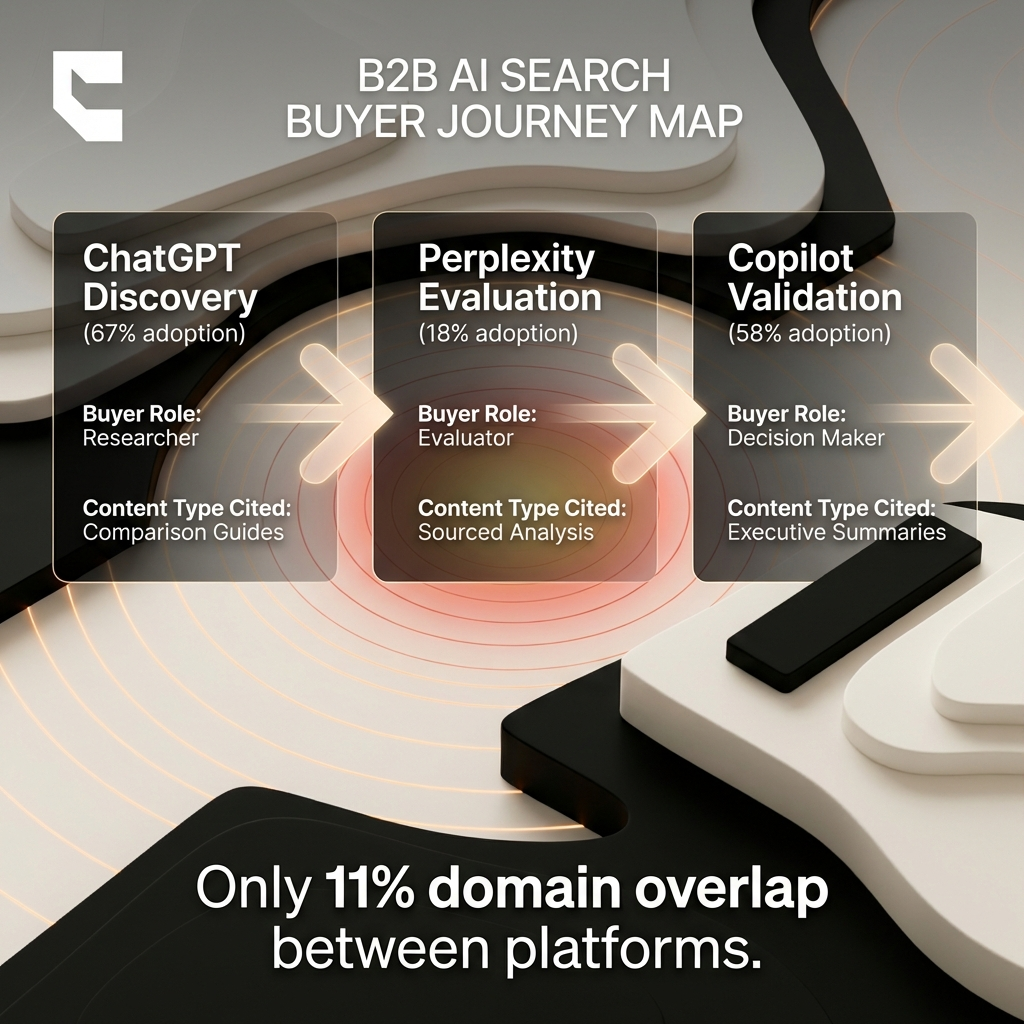
B2B buying committees consist of 10 to 11 people (per Gartner research). Each member uses different AI tools at different stages. A junior researcher uses ChatGPT to build the initial list. The technical evaluator then uses Perplexity to narrow it down based on documentation. Finally, the decision-maker gets a Copilot summary before signing off.
| Dimension | B2C AI Search | B2B AI Search |
|---|---|---|
| Primary use | Product recommendations | Vendor shortlisting |
| Decision maker | Individual | Committee of 10-11 |
| Evaluation depth | Quick comparison | Multi-week research |
| Key platforms | ChatGPT, Google AI Overviews | ChatGPT, Copilot, Perplexity |
| Content type cited | Reviews, listicles | Case studies, analyst reports, peer reviews |
| Conversion path | Direct purchase | Demo/consultation request |
What Is the Platform Overlap Problem in B2B AI Search?
Only 11% of domains appear in both ChatGPT and Perplexity citations. Optimizing for one platform means remaining completely invisible on the other. And most B2B companies pick the wrong one.
Deepak Gupta's research revealed this 11% domain overlap problem. The domains cited by ChatGPT rarely appear in Perplexity responses. The reverse is also true. This breaks single-platform strategies. You can't just write one blog post and expect visibility across the entire AI ecosystem. To really grasp what is AI visibility, you have to accept this fragmented landscape.
Platform adoption rates make this even messier. ChatGPT grabs 67% adoption, while Copilot captures 58%. Perplexity trails behind at just 18%. Yet most SEO agencies fixate on Perplexity. Why? Its citation mechanics feel familiar. They look like traditional search. So they end up optimizing for a platform your enterprise buyers barely touch.
Here's a real example of persona mismatch. A cybersecurity firm dumps resources into Perplexity optimization. Meanwhile, their actual target buyers (Fortune 500 CISOs) live inside the Microsoft ecosystem. They use Copilot daily. That firm stays invisible to the people writing the checks.
Match your platform strategy directly to your buyer profile. If you sell enterprise software to massive corporations, Copilot matters more than Perplexity. If you sell developer tools to startups, prioritize ChatGPT and Perplexity. You have to audit your visibility across all these platforms to find the hidden gaps.
What Gets Cited in B2B AI Search Results?
Third-party validation dominates B2B AI citations. 89% of AI citation sources come from earned media. Brands are 6.5x more likely to be cited through third-party sources than their own sites.
MuckRack's analysis of over one million citations proves this counterintuitive point. Brands obsess over publishing to their own blogs. They assume AI models will naturally surface their messaging. The reality is the exact opposite. AI models actively look for external validation. They prioritize independent analysis over corporate marketing.
This off-site authority paradox dictates your entire strategy. Brands are 6.5x more likely to be cited via third-party sources than through their own domains. Writing on your own blog won't secure those citations. You need analyst mentions, press coverage, and active community discussions to break through. Building a Reddit strategy for AI visibility injects the exact community signals these models crave.
Verified peer reviews on G2 and Capterra directly fuel AI recommendations. Models weigh these platforms heavily for any B2B query. They treat aggregated user reviews as ground truth for feature comparisons. A dominant G2 presence directly translates into more ChatGPT and Copilot citations.
Active community presence carries real weight. Reddit threads, niche industry forums, and Stack Overflow discussions pop up frequently in citations. AI models rely on these communities to measure real-world sentiment. They need them to establish technical consensus.
Analyst mentions wield outsized influence. A mention from Gartner or Forrester is high-value for B2B AI citations. Even a brief callout in an analyst's blog post signals authority to an LLM.
The Enterprise AI Visibility Playbook
Our enterprise AI visibility playbook relies on three core phases. First, audit your multi-platform visibility. Second, build citation-worthy content for the entire buying committee. Third, amplify everything through earned media and community engagement.
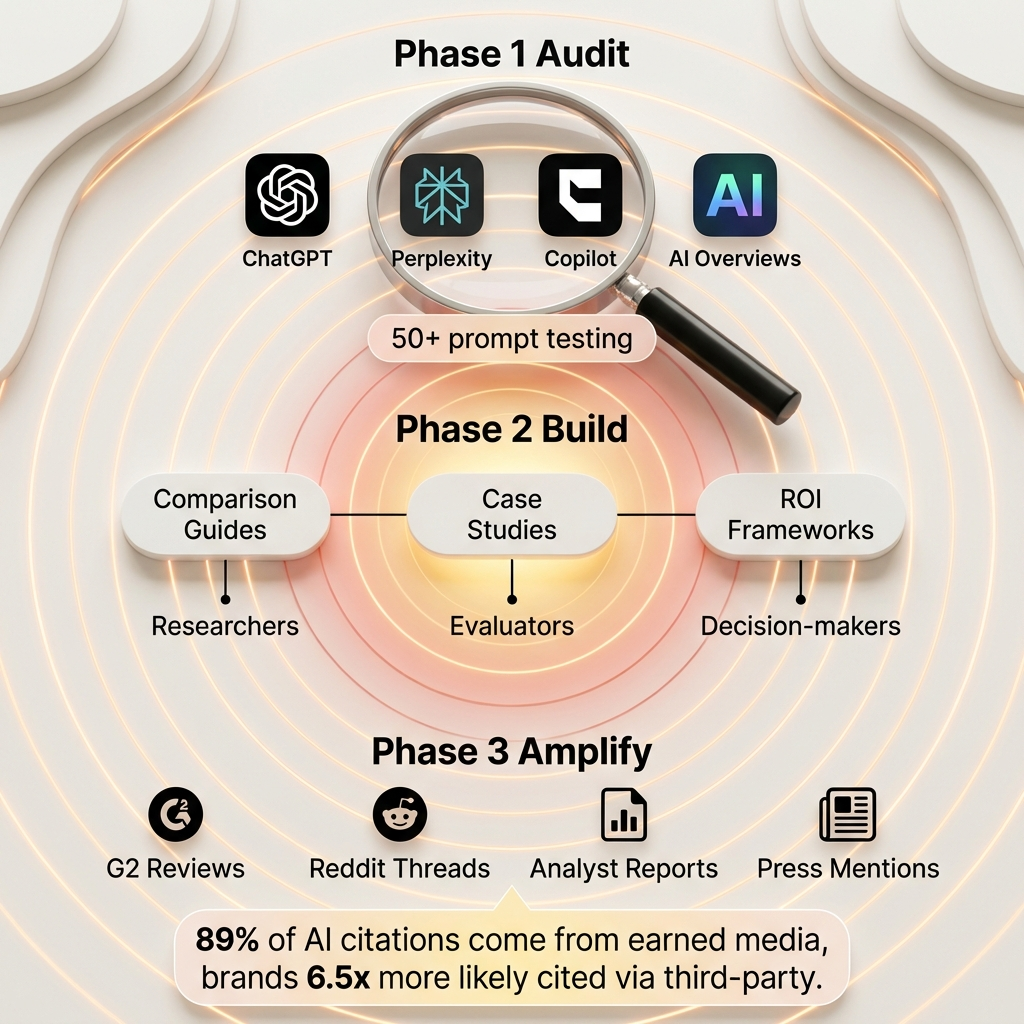
Phase 1: Audit Multi-Platform Visibility. Start by mapping your brand mentions across ChatGPT, Perplexity, Copilot, and Google AI Overviews. A thorough audit requires testing at least 50 specific buyer-intent prompts across every single platform. Document exactly where competitors appear. Note exactly where you vanish. Selling to the Fortune 500? Audit Copilot first. Targeting lean startups? Hit ChatGPT and Perplexity immediately.
Phase 2: Build Citation-Worthy Content. Your content has to serve researchers, technical evaluators, and final decision-makers. Researchers crave comparison guides. Evaluators demand technical case studies. Decision-makers require hard ROI frameworks. You have to answer the exact questions each buyer role feeds into their preferred AI tool. A VP of Engineering queries ChatGPT very differently than a CFO does. Applying generative engine optimization principles guarantees your formatting aligns with how LLMs actually parse data. This strategy is critical for AI visibility for SaaS (where dense technical details consistently drive citations).
Phase 3: Amplify Through Earned Media and Community. Build presence on G2 and Capterra. Push for reviews from satisfied customers because AI models scrape and cite these platforms constantly. Engage in Reddit and niche industry communities with genuine contributions. That 6.5x off-site authority multiplier is real. Keep pursuing analyst mentions and earned press. Even small mentions on authoritative industry blogs compound into AI citations over time.
How Do You Measure B2B AI Visibility?
We measure B2B AI visibility through four pipeline-relevant KPIs. Track your brand mention rate per platform. Monitor citation frequency. Analyze sentiment framing. And measure your AI referral traffic conversion rate.
Brand mention rate establishes your baseline. You need to track exactly how often your brand surfaces in responses to high-intent prompts. Test 50 or more prompts every month across ChatGPT, Perplexity, and Copilot. Log your mention rate as a hard percentage. Dive into our detailed AI visibility ROI framework to see exactly how this connects to revenue.
Citation frequency measures true authority. Track how often models cite your content as a primary source. Always distinguish between direct citations (hitting your own domain) and indirect citations (third-party sites mentioning you). Both types matter heavily. But they require very different optimization approaches.
Sentiment framing determines your actual positioning. Merely being mentioned isn't enough anymore. You have to analyze whether the AI positions you as a dominant market leader, a budget alternative, or a total afterthought. If ChatGPT frames your premium enterprise software as a cheap option for small teams, you have a sentiment problem that will quietly kill enterprise deals.
AI referral traffic conversion proves the financial impact. ChatGPT referral traffic converts at 15.9%. Traditional organic sits at 2.8%. You must track demo requests specifically originating from AI referral channels. Gartner predicts AI agents will command $15 trillion in B2B purchases by 2028. The brands establishing visibility today will capture that shift.
We helped Hamming.ai prove this exact framework works. They drove 40% of their demo requests purely from AI search and Reddit in just 12 weeks.
Frequently Asked Questions About AI Search for B2B
These are the most common questions we hear from B2B marketing leaders. They're all trying to evaluate AI search for B2B as a viable channel.
Does Traditional SEO Still Matter for B2B?
Traditional SEO still matters. But it's no longer enough on its own. AI models do pull from SEO-optimized content, but they prioritize third-party validation, community signals, and structured answers over raw search rankings.
SEO remains your structural foundation. Solid technical structure helps AI crawlers parse your site efficiently. But AI models weigh expertise signals, citation diversity, and community consensus far more heavily than traditional backlink profiles. Building a strong generative engine optimization layer on top of your existing SEO captures traffic from both traditional and AI search engines.
Which AI Platform Should B2B Companies Prioritize?
Always prioritize based on your specific buyer profile. Enterprise sellers should focus on Copilot (58% enterprise adoption) and ChatGPT (67% adoption). Startup-focused companies should lead heavily with ChatGPT and Perplexity.
That 11% domain overlap between platforms means you can't optimize for one and expect coverage everywhere. Start with a rigorous audit of where your brand appears today. Then allocate your effort to the highest-gap platform where your actual buyers spend their time.
How Long Until We See Pipeline Impact from AI Visibility?
Most B2B companies see measurable AI visibility improvements within 8 to 12 weeks. Hamming.ai went from near-zero to driving 40% of their demos from AI channels in exactly 12 weeks.
The timeline depends on your starting position. Brands with existing content and a strong review presence see faster results. The content already exists. It just needs structural optimization for AI extraction. Brands starting entirely from scratch should budget three to six months.
What's the ROI of B2B AI Visibility?
AI search referral traffic converts at 15.9%. That's roughly 5.7x higher than traditional organic traffic at 2.8%. For B2B companies, this directly translates to needing fewer leads to hit pipeline targets.
The ROI compounds quickly because AI visibility is inherently self-reinforcing. Content cited by one platform actively builds the authority signals that other platforms then reference. Read our full AI visibility ROI breakdown for the detailed calculations.
Conclusion
The data proves it. AI search for B2B isn't some distant future trend. It's happening right now.
- 50% of B2B buyers start in AI chatbots (not Google).
- Only 11% of domains overlap between ChatGPT and Perplexity citations.
- Brands with strong third-party validation are 6.5x more likely to be cited.
- AI referral traffic converts at 15.9% (vs 2.8% for organic).
Stop guessing. Run a multi-platform AI visibility audit today. Test your brand across 50 buyer-intent prompts on ChatGPT, Copilot, and Perplexity. You must know exactly where you stand before building a strategy.
We built this playbook from real B2B client work. If you want our team to execute this for your brand, see our enterprise plan. Or learn more about partnering with an AI visibility agency to accelerate your timeline.