What Is AI Visibility? The Definitive Guide for Brands (2026)
AI visibility determines whether ChatGPT, Perplexity, and Google AI Overviews recommend your brand – or your competitor. Here's the complete guide: definition, metrics, real client results, and a 3-step framework to get started.
TL;DR
AI visibility is whether your brand gets recommended when someone asks ChatGPT, Perplexity, or Google's AI Overviews for a solution. AI search converts 23x higher than traditional search. ChatGPT alone crossed 1 billion monthly active users in early 2026. And 58.5% of Google searches already end without a single click. This is the complete guide, definition, signals, metrics, client results, and a 3-step framework to start winning.
Ask ChatGPT "best CRM for startups" and note which brands appear. Now ask the exact same question again. Different brands surface. That inconsistency, which company shows up and which gets skipped, is AI visibility in action. Right now, it decides whether your brand gets recommended or gets ignored entirely.
AI visibility means your brand appears when someone asks an AI for a recommendation in your category. Think of it as the AI equivalent of page-one rankings. Except here, the AI picks one answer, not ten blue links, and most users never look further.
The business stakes are not theoretical. AI search converts 23x higher than standard Google traffic. ChatGPT has surpassed 1 billion monthly active users. And 58.5% of all Google queries now end without a click. Buyers are getting answers directly inside the AI interface. They never visit your website.
Every other guide on this topic comes from a SaaS vendor pitching monitoring tools. We run these campaigns daily for real clients. This guide is built from practitioners, hard numbers, proven execution, honest timelines.
What Is AI Visibility? (The 30-Second Definition)
AI visibility is the degree to which your brand appears, by name, with positive framing, when AI search engines generate answers to questions in your category.
That includes ChatGPT, Perplexity, Google AI Overviews, and Gemini. It is not a ranking position. There is no "position 1" in a ChatGPT response the way there is in a Google SERP. AI visibility is a probability: how often does your brand appear across the universe of relevant queries, across multiple AI platforms, when buyers are asking for what you sell?
The clearest way to think about it: if 100 potential customers asked ChatGPT for a recommendation in your category today, how many of those 100 responses would include your brand name? That percentage, your mention rate, is the core measure of AI visibility.
AI visibility sits at the intersection of three disciplines:
- GEO (Generative Engine Optimization): Structuring and distributing content so AI engines can extract and cite it
- AEO (Answer Engine Optimization): Writing content as direct answers to the specific questions buyers ask
- Entity Authority: Building your brand's footprint across trusted third-party sources so AI engines recognize you as a credible actor in your category
None of these replace SEO. They build on top of it. But they require different tactics, different content formats, and different success metrics than traditional search optimization.
Why AI Visibility Matters in 2026
See where you rank across all AI answer engines.
Enter your domain and we'll scan your citation rate across ChatGPT, Perplexity, and Google AI.
Prefer to talk? Book a free 30-min call
The shift has already happened. AI search is not a future trend, it is the present channel where your highest-intent buyers are making decisions right now.
The Numbers Are No Longer Deniable
ChatGPT crossed 1 billion monthly active users in January 2026 and 900 million weekly active users by February 2026. The platform receives 2.5 billion prompts every single day. Google's Gemini app has surpassed 750 million monthly users. AI-referred sessions to websites jumped 527% year-over-year in the first half of 2025 alone.
These are not niche tools. They are the default research interface for a generation of buyers.
Meanwhile, traditional search is eroding faster than most CMOs have planned for. Gartner predicts a 25% decline in traditional search volume by 2026. Zero-click searches already account for 58.5% of all Google queries, Google's own AI Overviews hand users the answer before they ever reach a result page.
The Conversion Advantage Is Decisive
AI search converts 23x higher than traditional organic search. The reason is intent. When someone asks ChatGPT "what's the best project management software for a 10-person engineering team," they have already decided they want a solution. They want a recommendation. They are at the bottom of the funnel. Being the brand that ChatGPT names in that moment is equivalent to a warm referral from a trusted advisor.
That conversion premium explains why 32% of digital marketing leaders now rank generative engine optimization (GEO) as their single most critical performance priority for 2026, ahead of traditional SEO, paid media, and social.
The Window to Act Is Still Open
Most brands have not moved yet. The market for AI visibility optimization is at the same stage that SEO was in 2005, the category is real, the data is clear, but most companies are still waiting. The brands moving now are building a compounding advantage: AI engines trust sources they have seen mentioned before, which means early movers get cited more, which builds more trust, which generates more citations. It is a flywheel that gets harder to break into over time.
You can explore the AI visibility ROI data in depth to build your internal business case.
How Does AI Visibility Differ from Traditional SEO?
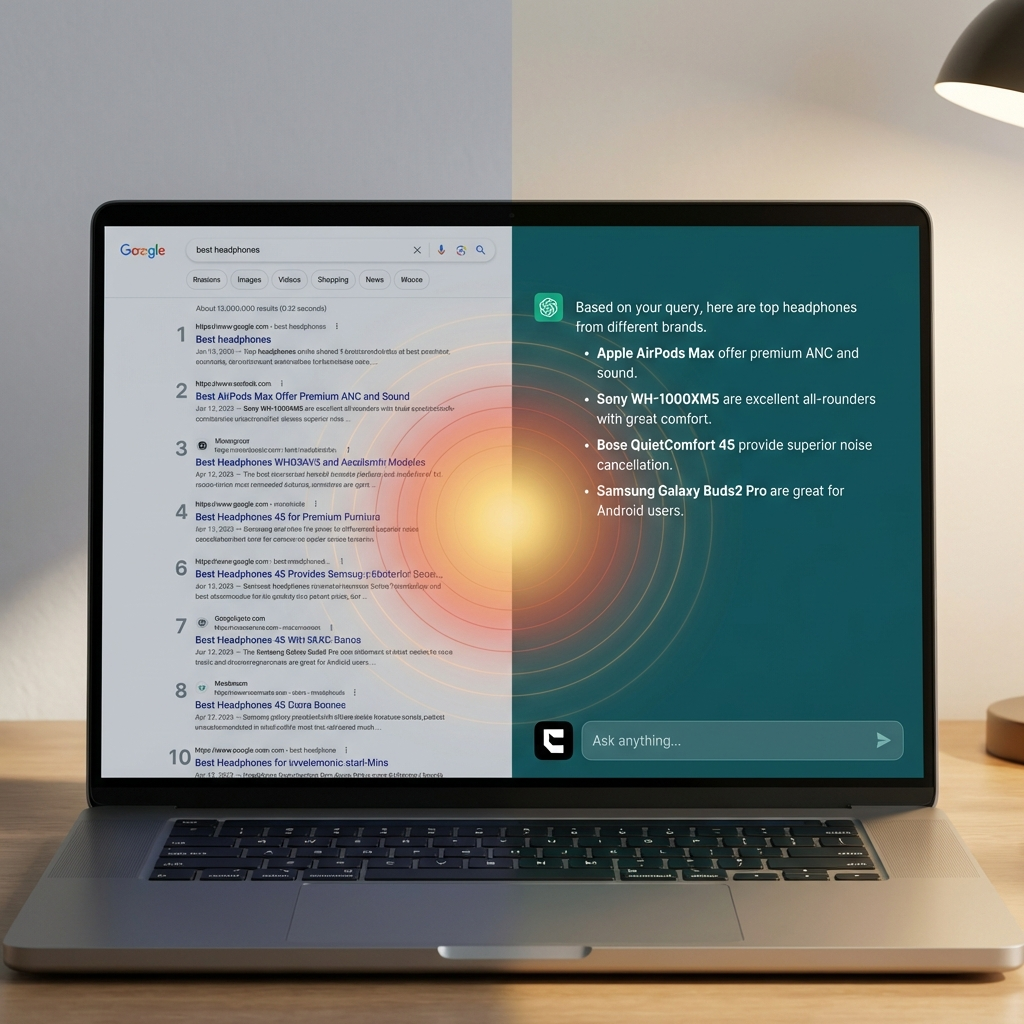
AI visibility and SEO are not opponents, SEO creates the technical foundation AI engines require. But the goal, mechanism, content format, and success metrics are all different.
SEO creates the technical foundation that AI engines require to read, crawl, and trust your site. The similarities end there.
| Traditional SEO | AI Visibility | |
|---|---|---|
| Goal | Rank on page 1 of Google | Get recommended by ChatGPT, Perplexity, AI Overviews |
| How it works | Keywords, backlinks, technical optimization | Entity authority, citations, structured content |
| Success metric | Rankings, organic clicks | Mention rate, citations, sentiment, share of voice |
| User behavior | User scans 10 results, clicks one | AI synthesizes one answer from multiple sources |
| Content format | Keyword-optimized web pages | Expert content AI trusts enough to extract and cite |
| Citation signal | Domain authority, backlink count | Third-party mentions across trusted sources |
| Timeline | 3–6 months typical | 2–4 weeks to initial movement |
| Consistency | Stable rankings | Probabilistic, varies by query, platform, and date |
The key conceptual shift: SEO is about ranking for queries. AI visibility is about being recognized as a category authority by AI systems that synthesize answers from thousands of sources simultaneously.
A number-one Google ranking does not guarantee AI citation. An AI engine might pull from a mid-authority blog that wrote a cleaner, more direct answer to the specific question being asked. What matters is whether your brand appears in the sources AI engines trust, not where you rank on a SERP.
This is why Generative Engine Optimization requires its own playbook. If you are spending your entire budget optimizing for Google indexing without building your AI entity footprint, you are optimizing for a channel that is shrinking while the one that is growing goes unaddressed.
The comparison between SEO vs AI search optimization runs deeper than tactics, it affects how you budget, how you create content, and which metrics you report to leadership. Brands actively evaluating a switch often look for the best alternative to a traditional SEO agency that can handle both the SEO foundation and the AI visibility layer.
How AI Search Engines Decide Who to Recommend
Understanding the mechanism is the difference between guessing and executing. AI search engines use Retrieval-Augmented Generation (RAG), not Google's ranking algorithm.
AI search engines do not operate like Google's algorithm. The selection logic follows a specific, repeatable pattern.
Step 1: Retrieval
When a user submits a query, the AI engine scrapes relevant content from across the web in real time (for live-search-enabled tools) or draws from its training corpus plus indexed sources. It assembles a pool of candidate sources that appear relevant to the query.
Step 2: Scoring
The engine assigns confidence scores to each candidate source based on signals including:
- Cross-web mention frequency: How often is this brand or source referenced on other trusted sites?
- Content clarity: Does this source give a direct, extractable answer to the question?
- Entity consistency: Is the brand mentioned consistently across multiple independent sources?
- Structured data: Does the source use schema markup, clear headings, and FAQ formatting?
- Recency: Is the content current and regularly updated?
Step 3: Synthesis
The AI generates a single synthesized answer, drawing from the highest-confidence sources. It may cite some of those sources with links (citation) or simply incorporate the information without attribution (mention). The output is one answer, not a list of options the user must evaluate.
This explains a critical finding from SparkToro research: AI recommendation lists repeat less than 1% of the time when the same question is asked twice. There is no fixed "position 1." Which means showing up 60% of the time across 100 queries is far more valuable than dominating a single query. Breadth of coverage beats depth on any one keyword.
What AI Engines Look For (The 5 Core Signals)
-
Third-party validation: Your brand name mentioned in independent sources, industry publications, review sites, forums, podcasts, and news coverage. AI engines treat cross-web mentions as the rough equivalent of a citation network.
-
Structured, extractable content: Clear definitions, comparison tables, numbered frameworks, FAQ sections. AI engines are built to extract and synthesize, content that resists extraction gets skipped.
-
Expert depth: Original data, original research, specific case studies with numbers. Generic content trained on generic sources produces generic outputs. AI engines reward specificity and evidence.
-
Consistent entity signals: Your brand name, core product descriptions, and category associations should be consistent across your website, third-party review sites, PR mentions, and social presence. Inconsistency creates low-confidence signals.
-
Semantic authority: Being associated with the vocabulary of your category at scale, across many sources, not just your own website. If a hundred independent sources describe you as "the leading tool for X," AI engines build that association into their confidence model for your brand.
That explains why old-school SEO fails here. Traditional SEO rewards keyword density and backlink counts. AI visibility rewards distributed entity authority, being trusted across the web, not just ranking highly on one query.
What Are the 4 Metrics That Define AI Visibility?
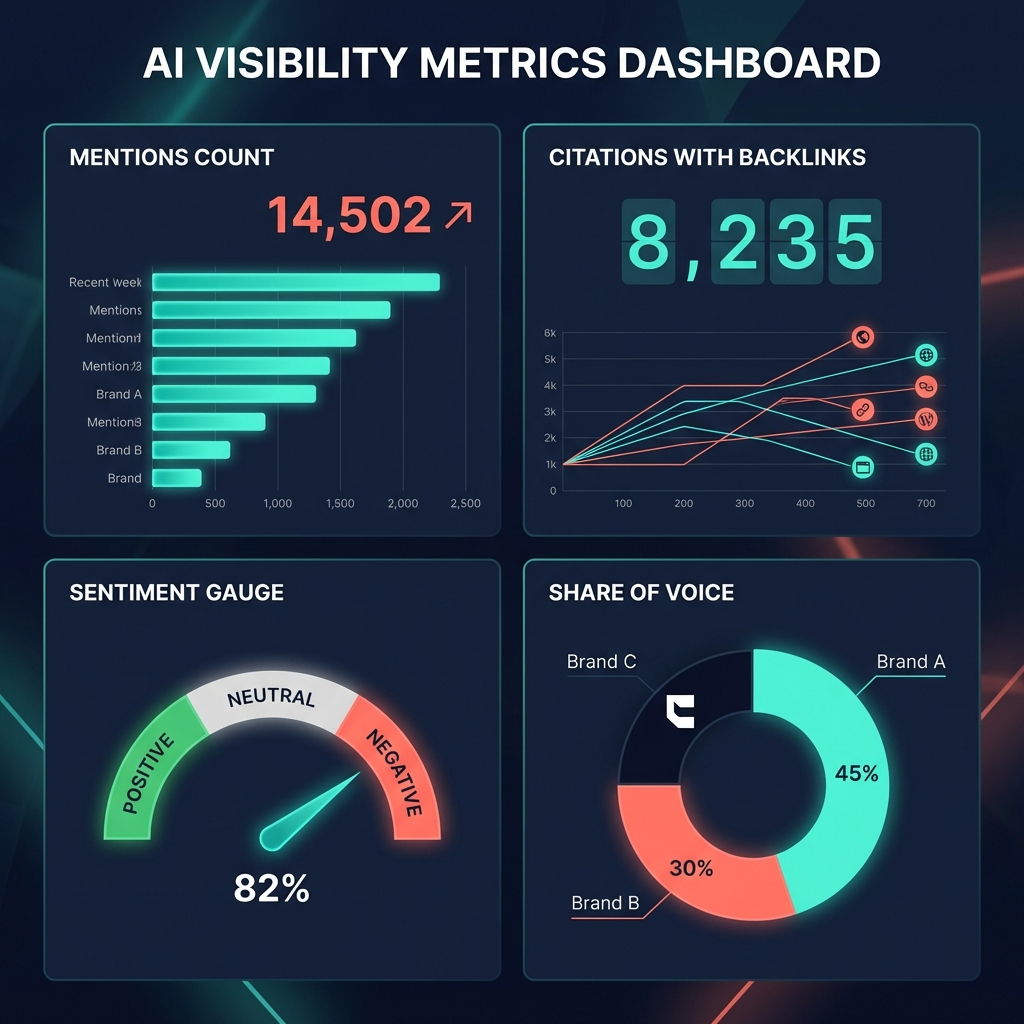
You cannot improve what you do not measure. AI visibility requires four distinct metrics, each capturing a different dimension of how AI engines perceive your brand.
1. Mention Rate
The percentage of relevant queries where your brand name appears in the AI-generated response, regardless of whether a link is included. To establish a baseline: select 50 buyer-intent queries relevant to your category. Run them across ChatGPT, Perplexity, and Google AI Overviews. Count how many responses include your brand name. Divide by total queries run. That percentage is your mention rate.
A mention rate below 10% means you are essentially invisible in AI search. Above 40% means you have meaningful AI presence. Above 60% means you are genuinely dominating your category in AI.
2. Citation Rate
The subset of mentions where the AI engine includes a direct link to your website. Citations are more valuable than plain-text mentions because they drive actual traffic, buyers can click through to your site directly from the AI response.
The citation rate gap (mention rate minus citation rate) tells you how much unrealized value you are leaving on the table. A brand with 35% mentions but only 5% citations has strong brand recognition in AI but is failing to convert that recognition into clicks.
3. Sentiment Score
How the AI frames your brand when it mentions you. Does it describe you as "an excellent option for enterprise teams with complex workflows" or does it note you are "known for a steep learning curve and high pricing"? Sentiment is not binary, it has intensity.
Negative AI sentiment is a serious problem because it is harder to identify than a negative review on G2. You have to run the queries to see it. And it compounds: AI engines pull sentiment signals from the same third-party sources that inform mention rate, which means bad reviews on forums and review sites directly affect how AI describes you.
Track sentiment by logging the exact language AI engines use when mentioning your brand. Identify recurring negative descriptors and address them through content, product updates, and review management.
4. Share of Voice (SOV)
Your mention rate expressed as a percentage of total brand mentions across your competitive category. If you and your three main competitors appear in 200 total AI mentions across 100 queries, and 52 of those are your brand, your share of voice is 26%.
Share of voice is the competitive metric. Mention rate tells you how you are doing in absolute terms. SOV tells you whether you are winning or losing relative to the companies you actually compete against.
Run 100 prompts across your category. Track every brand that appears. Calculate SOV for each. That data, not one query, not five queries, is your actual market position in AI search.
Learn how to measure AI visibility with the complete audit framework.
Real Results: What Good AI Visibility Looks Like
Numbers matter. Here is what AI visibility improvement actually produced for three brands operating in different categories.
Hamming.ai: 8.5x Traffic in 12 Weeks
Hamming.ai builds AI testing infrastructure for engineering teams. YC-backed, technical product, competitive category. When they engaged Cintra, they were getting roughly 200 visitors per day from organic search. Twelve weeks later, daily visitors hit 1,900, an 8.5x increase.
More importantly, the source of that traffic shifted. CEO Sumanyu Sharma: "40% of the demos we get are from Reddit or AI search." This is the signal that separates AI visibility impact from standard SEO growth, demo volume and pipeline quality, not just traffic counts. AI-search visitors arrived with specific intent and converted at rates that changed the economics of their entire acquisition model.
UV Blocker: 0 to 38,000 Clicks in 6 Months
UV Blocker entered the market as a total unknown, no domain authority, no backlink profile, no existing organic traffic. Starting from zero is normally a multi-year SEO project. Six months into an AI visibility program, they reached 38,000 monthly clicks.
The more striking data point: weekly orders doubled in six weeks. During their slow season. AI visibility delivered bottom-of-funnel traffic, buyers who had already decided to purchase a sun protection solution and needed a trusted recommendation. That buying intent converted directly into orders in a compressed timeframe that traditional SEO could not have produced.
Owner Russ Coulon: "Cintra helped me go from 3k to 7.5k daily traffic and doubled my weekly orders in 1.5 months in off-season."
Keywords.am: Mention Rate 3% to 13% in 2 Weeks
Keywords.am is an Amazon SEO tool competing against established platforms with years of authority. Starting AI visibility mention rate: 3% across relevant buyer queries. After two weeks of structured content and entity-building work, mention rate rose to 13%, a 4x improvement.
Founder Ash Metry: "We saw a lift of 3% to 13% in the first 2 weeks, and organic traffic bumped to the highest I've ever had."
The 2-week timeline is the notable part. Traditional SEO does not move in two weeks. AI visibility does, because the signals that trigger AI citations (structured content, clear entity definitions, new third-party mentions) can be published and indexed quickly. The AI engine refreshes its view of your brand faster than Google refreshes a domain authority score.
The Compounding Pattern
Across every client, the same pattern holds: early wins build on themselves. When an AI engine cites your brand once, it increases the probability of citing you again. Those additional citations surface in more third-party contexts, which further strengthens the entity signal. Visibility compounds. The earlier you start, the more the flywheel turns in your favor.
For AI visibility for SaaS companies, the compounding effect is even more pronounced, buyers rely heavily on AI recommendations for software purchasing decisions.
How to Get Started: The 3-Step AI Visibility Framework
AI visibility is not a single tactic. It is a discipline with three interdependent layers. Each layer depends on the one beneath it.
Step 1: Audit Your Current AI Visibility Baseline
- Mention rate: Select 50 buyer-intent queries in your category. Run every query through ChatGPT, Perplexity, and Google AI Overviews. Record whether your brand appears.
- Citation rate: Of the responses that mention your brand, how many include a link to your website?
- Sentiment: Copy the exact language AI engines use when mentioning your brand. Identify recurring positive and negative descriptors.
- Share of voice: Track every competitor mention in those same 100 query runs. Calculate what percentage of total mentions belongs to your brand.
This audit gives you a baseline. It tells you exactly where you are losing to competitors and which specific queries you need to win. Run the audit before you spend a single dollar on optimization.
Our guide on how to measure AI visibility walks through the complete framework with templates.
Step 2: Optimize Your Content for AI Citation
AI engines cite content that is easy to extract. That means restructuring your highest-value pages to make the AI's job simple:
- Lead with definitions. Every page that covers a core concept should open with a clear, single-sentence definition of that concept. AI engines pull these definitions directly.
- Use structured formatting. Comparison tables, numbered lists, FAQ sections, and step-by-step frameworks are extracted more reliably than flowing prose.
- Add schema markup. FAQ schema, HowTo schema, and Organization schema give AI engines machine-readable signals about your content's structure and your brand's category.
- Publish original data. Generic content about generic topics generates generic AI citations, or no citations at all. Original research, case studies with real numbers, and primary data give AI engines something worth citing.
- Write direct answers. For every key query in your category, write content that answers the question in the first two sentences. Do not bury the answer under background context.
The best AI visibility tools can help you audit existing content for AI-readiness and identify gaps in your coverage of key buyer queries.
Step 3: Build Your Entity Authority Across the Web
This is the layer most brands underinvest in, and it is the most important for long-term AI visibility. Entity authority means that independent sources across the web consistently mention your brand, describe it accurately, and associate it with the right category vocabulary.
Tactics that build entity authority:
- Earn coverage in industry publications. A mention in Search Engine Journal, TechCrunch, or a major vertical publication carries much higher AI trust weight than a mention on a low-authority blog.
- Build your review-site presence. G2, Capterra, Trustpilot, and category-specific review platforms are among the most-trusted sources AI engines pull from. Strong, recent reviews with specific language about your product's benefits directly influence how AI describes you.
- Participate in forums and communities. Reddit threads, Quora answers, and industry-specific communities are regularly scraped by AI engines. Authentic, helpful participation in conversations about your category puts your brand name in the right context, at scale.
- Pursue strategic PR and podcast appearances. Every time a journalist, podcaster, or analyst mentions your brand name in a substantive context, it adds a trusted node to your entity graph.
- Maintain consistency. Your brand name, product descriptions, and category associations should be identical across your website, social profiles, review sites, and press coverage. AI engines use consistency as a confidence signal.
Explore the best AI visibility tools to automate monitoring of your entity footprint and track where new mentions are emerging.
Frequently Asked Questions About AI Visibility
What exactly is AI visibility and how is it different from regular SEO?
AI visibility is the probability that your brand gets recommended by AI search engines, ChatGPT, Perplexity, Google AI Overviews, when buyers ask questions in your category. Traditional SEO optimizes for a ranked list of links. AI visibility optimizes for being synthesized into a single answer. The user behavior is fundamentally different: SEO users scan a list and choose; AI search users receive one answer and typically act on it. The content requirements, success metrics, and competitive dynamics are all different. Good SEO is a prerequisite for AI visibility, but it is not sufficient on its own.
How long does it take to improve AI visibility?
Initial movement, measurable increases in mention rate, typically happens within 2 to 4 weeks of publishing structured, AI-optimized content and beginning entity-building work. Keywords.am saw their mention rate go from 3% to 13% in two weeks. Meaningful compounding ROI, traffic growth and conversion impact, typically builds over 2 to 3 months as entity signals accumulate and AI engines increase their confidence in your brand. UV Blocker doubled weekly orders in 6 weeks. Hamming.ai hit 8.5x traffic growth at the 12-week mark.
Is AI visibility only relevant for B2B or SaaS companies?
No. AI visibility matters for any brand whose buyers research options before purchasing, which includes nearly every product and service category. The case studies span B2B SaaS (Hamming.ai, Keywords.am) and direct-to-consumer ecommerce (UV Blocker). The tactics differ by category, a DTC brand focuses heavily on review-site presence and forum mentions, while a SaaS company prioritizes comparison content and G2 reviews, but the underlying mechanism is identical.
What tools can I use to track AI visibility?
Purpose-built platforms like Peec.ai, Profound, and Otterly automate mention and citation tracking across ChatGPT, Perplexity, and other AI engines. They run queries at scale and report mention rates, sentiment, and share of voice without manual effort. That said, manual query testing remains the most direct way to understand exactly what AI engines are saying about your brand, the software summarizes; the raw query shows you the actual language being used. See the complete breakdown in our best AI visibility tools review.
Can I do AI visibility optimization myself, or do I need an agency?
The baseline audit is entirely DIY, any marketer can run 50 queries across three AI platforms and build a meaningful snapshot of their current AI visibility in an afternoon. Ongoing optimization at scale, producing the volume and quality of structured content, earned coverage, and review-site presence required to move mention rates significantly, is where teams typically need dedicated resources. The brands hitting 8.5x traffic growth in 12 weeks are running coordinated, daily execution across content, PR, and community channels. That requires either a dedicated internal team or a specialized agency. See the best AI visibility agencies in 2026 ranked by citation methodology and verified results, or explore Cintra's done-for-you AI search optimization for a fully managed approach.
How do AI search statistics support the case for investing in AI visibility?
ChatGPT alone has surpassed 1 billion monthly active users and receives 2.5 billion prompts per day. AI-referred website sessions jumped 527% year-over-year in 2025. AI Overviews now appear in at least 16% of all Google searches. And AI search converts 23x higher than traditional organic search, the buyers arriving via AI recommendation are bottom-of-funnel, high-intent, and more likely to purchase. Explore the full AI search statistics dataset to build the business case internally.
The Bottom Line
AI visibility is not a buzzword. It is the new battleground for buyer attention, and the brands building their presence there now are compounding an advantage that will be very difficult for late movers to close.
When a prospect asks ChatGPT for a recommendation in your category, does your brand show up? Is the description positive? Does it include a link back to your site? Those three questions define your AI visibility, and increasingly, they define whether you win the deal before your competitor even knows the buyer was looking.
The entry point is lower than most brands expect. A baseline audit takes one afternoon. Initial content optimization can go live in days. And as the results above show, the first meaningful signals of improvement can arrive within weeks, not the months-long timelines that traditional SEO requires.
Or if you are ready to build: start with the AI visibility playbook for the full 90-day framework. If AEO is the specific gap you need to close, the best AEO agencies in 2026 are ranked on citation performance and cross-platform methodology.
See where your brand appears in AI search
Scan ChatGPT, Perplexity, and Google AI across buyer-intent queries, instantly, no sign-up.
Find out if AI is sending buyers to your competitors.
We audit your AI visibility across ChatGPT, Perplexity, and Google AI –and show you exactly where you rank and what to fix.
“We went from 200 visitors/day to 1,900 visitors/day and 40% of demos are from AI search.”
Sumanyu Sharma · CEO, Hamming.ai
“Cintra helped me go from 3k to 7.5k daily traffic and doubled weekly orders in 1.5 months.”
Russ Coulon · Owner, UV Blocker
“We saw a lift from 3% to 13% visibility in the first 2 weeks, and organic traffic hit its highest ever.”
Ash Metry · Founder, Keywords.am
Related Articles
Google AI Mode Link Updates: What Five Changes Mean for Your Brand's AI Visibility
Google AI Mode link updates add five new outbound link features. We analyze what changed on May 6, how each up…
AI Visibility for Automotive: The Two-Layer Problem Dealerships Don't See
AI visibility for automotive is a two-layer problem. 84% of dealership websites are invisible to AI. Learn the…
How to Fix Wrong AI Answers Brand Owners Get (2026 Guide)
Fix wrong AI answers brand owners encounter with this 6-step playbook. Learn why ChatGPT, Perplexity, and AI M…