Best AI Visibility Tools in 2026: An Agency's Honest Review
Every AI visibility tool vendor ranks themselves #1. Cintra tested 8 tools for client work and shares what actually works, no vendor bias, just practitioner experience.
Tanush Yadav
February 28, 2026 · 11 min read
- What Should You Look for in an AI Visibility Tool?
- How Do the 8 Best AI Visibility Tools Compare?
- What Did We Find Testing Each Tool?
- Do You Even Need a Tool Yet?
- Which Tool Should You Pick?
- Frequently Asked Questions
- Conclusion
TL;DR: Every AI visibility tool comparison online is written by a vendor who ranks their own product first. We use these tools daily for client work and don't sell any of them. Otterly.ai ($29/mo) is the best entry point. Peec AI is best for agencies. Profound leads at enterprise scale. Semrush is the best bolt-on for existing users. Run a free DIY audit before buying anything.
Every AI visibility tool comparison on Google right now is written by a vendor who ranks their own product first. Rankability puts Rankability first. SE Visible puts SE Visible first. LLMClicks puts LLMClicks first. Marketers researching the best AI visibility tools cannot trust any of these reviews. The incentive structure is broken.
We are an AI visibility agency. We use these tools daily for client campaigns. We don't sell any of them. This review reflects what we actually experience in the field. What follows is an honest assessment of eight tools: what works, what falls short, and which platform fits your specific situation.
What Should You Look for in an AI Visibility Tool?
Finding the best AI visibility tools comes down to five criteria: multi-platform coverage, data accuracy, competitive benchmarking, stack integration, and cost per actionable insight.
After running campaigns across dozens of brands, here is how each criterion plays out in practice.
Multi-platform coverage is the baseline requirement. The tool must track ChatGPT, Perplexity, and Google AI Overviews at minimum. Coverage for Claude, Gemini, and Microsoft Copilot is increasingly important. AI answers vary between models. You cannot rely on ChatGPT data to predict Perplexity results. Watch the pricing structures too. Some tools charge extra per platform. Peec AI charges EUR 20 to 30 per add-on platform, and those costs add up.
Data accuracy separates the strong tools from the weak ones. AI models change answers frequently. The tool needs to track answer volatility over time, not just snapshots. Most tools fall short here. They provide a static look at a dynamic response.
Competitive benchmarking provides the real context. You need to see where competitors appear and where you don't. Gap analysis is the highest-value feature in any platform. A raw list of your brand mentions won't help you win share of voice. The value comes from seeing which queries your competitors own.
Stack integration saves hours of manual work. Connections to GA4, Google Search Console, or your CMS make data actionable. Platforms like Semrush and Profound handle this well. Standalone tools force CSV exports and manual merging. If you're building a business case for leadership, our guide on AI visibility ROI breaks down how to quantify this investment.
Cost per actionable insight is the true metric. Don't evaluate on cost per prompt or cost per seat. A $29/mo tool with no clear insights is more expensive than a $499/mo tool that drives business decisions. Frame the purchase around outcomes, not features.
How Do the 8 Best AI Visibility Tools Compare?
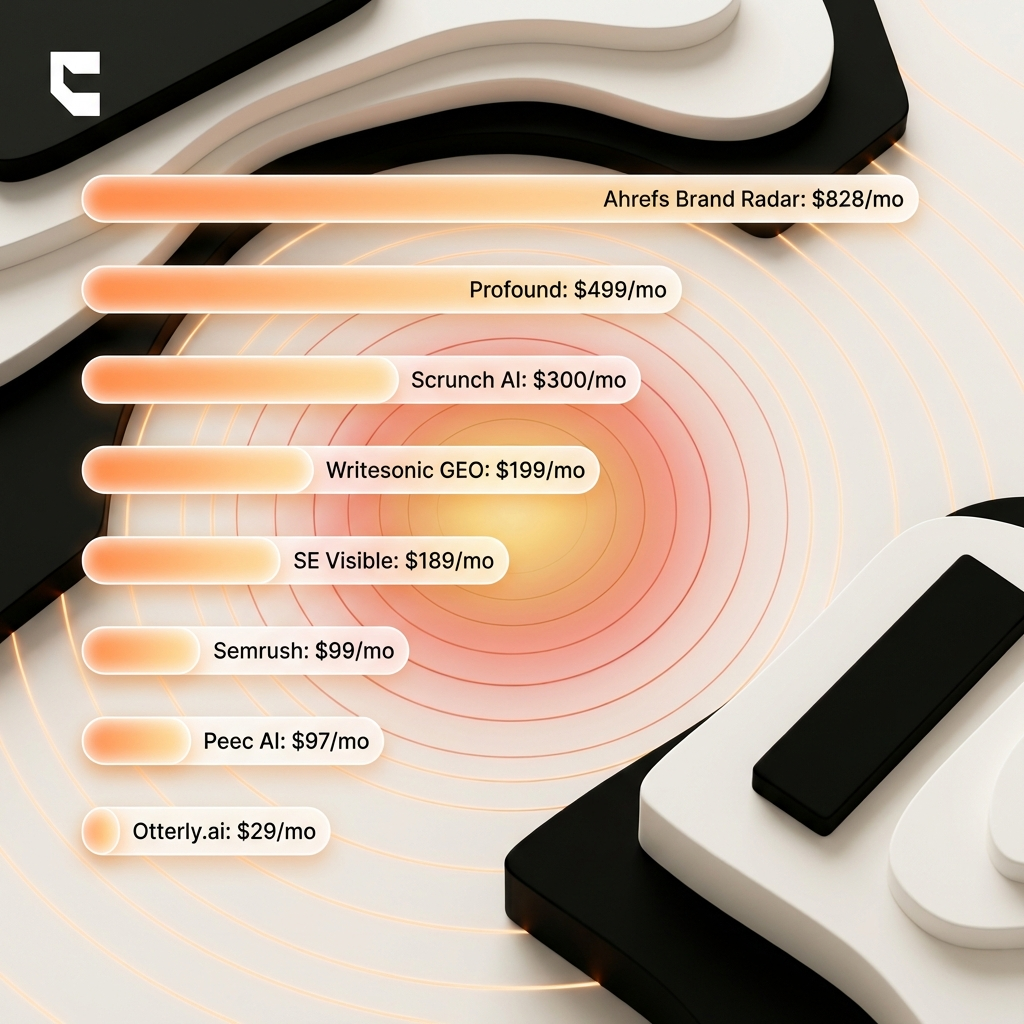
We've tested eight AI visibility tools over the past year. Pricing runs from $29/mo all the way to $828/mo, and the gap in what you get is just as wide.
| Tool | Starting Price | AI Platforms | Best For | Standout Feature |
|---|---|---|---|---|
| Peec AI | ~$97/mo | 3 base + 4 add-on | Agencies, multi-region brands | Multi-language, multi-brand |
| Semrush AI Visibility | $99/mo | 8 | Teams in Semrush ecosystem | Full SEO suite integration |
| Profound | ~$499/mo | 8+ | Enterprise, Fortune 500 | Profound Agents (automated optimization) |
| Otterly.ai | $29/mo | 6 | Startups, budget-conscious teams | Most affordable entry point |
| SE Visible | $189/mo | 5 | SEO professionals | Dual product (standalone + integrated) |
| Ahrefs Brand Radar | $828/mo total | 6 + YouTube/TikTok/Reddit | Enterprise SEO teams | 260M+ prompt dataset |
| Writesonic GEO | $199/mo (annual) | 9 | Content teams | Content creation + visibility |
| Scrunch AI | $300/mo | 7 | Brands wanting optimization | AXP (serves content to AI crawlers) |
Now let's dig into each tool individually.
What Did We Find Testing Each Tool?
Here is what we found after putting each of the eight platforms through real client workflows over the past year.
Peec AI
What works: Multi-brand monitoring is the strongest in the category. Sentiment tracking by region and language is useful for international brands. A EUR 21M Series A in November 2025 signals serious investment. Over 1,300 brands onboarded.
What doesn't: Add-on pricing gets expensive. Adding Claude, Gemini, or DeepSeek costs EUR 20 to 30 each per month. The base plan only covers three platforms.
Best for: Agencies managing multiple brands across regions. Verdict: Strong choice for agencies. The multi-brand architecture is purpose-built for client portfolios.
Semrush AI Visibility
What works: If you already use Semrush, adding AI visibility at $99/mo makes sense. Covers eight platforms including AI Mode. Deep integration with backlinks, keywords, and site audit tools. Semrush is publicly traded (NYSE: SEMR) and stable.
What doesn't: As a standalone product, it's just a visibility tracker. The value is in the ecosystem integration. The base tier limits you to 25 prompts per day, restricting competitive analysis.
Best for: Teams already paying for Semrush. Verdict: Best bolt-on option. Weak as a standalone purchase.
Profound
What works: Broadest LLM coverage with eight or more platforms. Profound Agents automate content drafting and knowledge-source updates. A $96M Series C at $1B valuation in February 2026. 700+ enterprise customers including 10% of the Fortune 500.
What doesn't: Lite plan starts around $499/mo. The platform is enterprise-focused. Small teams will find it overpowered and overpriced.
Best for: Enterprise brands with budget for comprehensive monitoring. Verdict: Market leader for enterprise. Overkill for most startups.
Otterly.ai
What works: Starting price of $29/mo is the lowest in the market. Clean interface, no bloat. Covers six platforms. Bootstrapped and profitable with $770K in revenue. No hidden upsells.
What doesn't: Only 15 prompts at the base tier. No competitive benchmarking at lower tiers. Small team of seven people, which may slow feature releases.
Best for: Startups and solo marketers new to AI visibility. Verdict: Best entry point. Start here if you've never tracked AI visibility before.
SE Visible
What works: Dual product strategy: standalone AI visibility for $189/mo or bundled with SE Ranking's full SEO platform starting at $65/mo. Well-designed feature comparison tables. The 2025 Planable acquisition adds social media context.
What doesn't: Fewer AI platforms than competitors (five, with more listed as "coming soon"). Standalone pricing is mid-range without clear differentiation.
Best for: SEO professionals wanting AI and traditional SEO in one tool. Verdict: Solid mid-tier option. The SE Ranking bundle is better value than standalone.
Ahrefs Brand Radar
What works: Massive dataset of over 260 million prompts per month. Prompt clustering and topic gap analysis are precise. Added YouTube, TikTok, and Reddit tracking in January 2026. Familiar Ahrefs UI.
What doesn't: Expensive. $199/mo per platform index. All six platforms cost $699/mo, plus the $129+ Ahrefs base subscription. Total minimum: $828/mo.
Best for: Enterprise SEO teams already invested in Ahrefs. Verdict: Deepest data, steepest price. Worth it only for existing Ahrefs customers.
Writesonic GEO
What works: Covers nine AI platforms, the most in the category. Combines content creation tools with visibility tracking. Professional plan starts from $199/mo on annual billing.
What doesn't: GEO monitoring is only available on Professional tier and above. Writesonic is primarily an AI writing tool. The visibility monitoring feels like an add-on, not the core product.
Best for: Content teams wanting writing and monitoring in one platform. Verdict: Interesting hybrid. Best if you also need AI writing tools. Weak as a pure visibility tracker.
Scrunch AI
What works: The Agent Experience Platform (AXP) is unique. It serves optimized content to AI crawlers without changing the human-facing website. Monitoring and optimization in one tool. $15M Series A in July 2025. Customers report a 40% boost in referral traffic.
What doesn't: Plans start at $300/mo. The AXP concept is newer and less proven at scale. Smaller customer base than Profound or Semrush.
Best for: Brands wanting to move beyond monitoring into active optimization. Verdict: Most differentiated architecture. Watch this one. AXP could become the category standard.
Do You Even Need a Tool Yet?
Manual auditing is enough to establish your baseline. Even the best AI visibility tools only add value when you need daily tracking, competitive benchmarking, or multi-brand monitoring at scale.
Before spending $99 to $828 per month, run a free DIY audit first. Manually query ChatGPT, Perplexity, and Google AI Overviews for 10 to 15 prompts relevant to your brand. Record what appears. Note the context and sentiment. This takes about two hours and gives you a solid baseline. We published a full guide on how to measure AI visibility that walks through the exact steps.
You need a paid tool when you're tracking more than 20 prompts, require daily or weekly monitoring, manage multiple brands, or need competitive share-of-voice data. Tools automate repetitive data collection and free your time for strategy.
You don't need a tool if you're just establishing a baseline, have fewer than five target prompts, or your total marketing budget is under $5,000 per month. Buying a tool without a strategy wastes money. Spend on creating better content first. Understanding generative engine optimization matters more than the dashboard you use to track it.
Which Tool Should You Pick? Recommendations by Use Case
The best AI visibility tools for your team depend on your type, budget, and existing marketing stack. There is no single best choice for everyone.
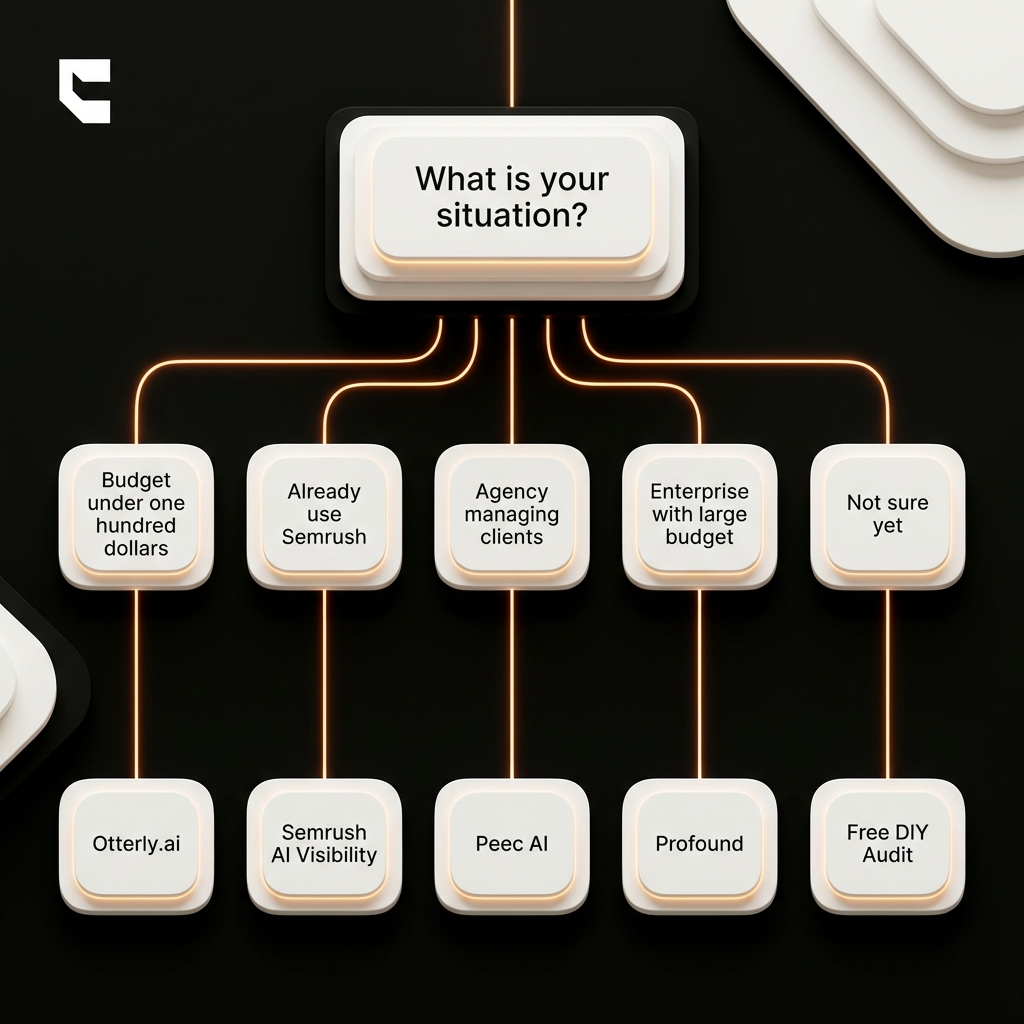
Best for agencies: Peec AI. Multi-brand architecture and regional tracking are built for managing client portfolios.
Best for in-house SaaS teams: Semrush AI Visibility if you already use Semrush. Profound if your budget allows enterprise-grade tooling.
Best for ecommerce: SE Visible bundled with SE Ranking. Affordable and connects traditional SEO with AI tracking.
Best for budget-conscious startups: Otterly.ai at $29/mo. Basic visibility data without draining runway.
Best for enterprise: Profound. Broadest coverage, automated agents, proven at Fortune 500 scale.
Best free option: A manual DIY audit using the framework in our measurement guide.
If you'd rather have an agency run this for you, using whichever tool fits your situation, that's what we do at Cintra. We manage the strategy, tools, and execution. See our pricing or read about the benefits of working with an AI visibility agency.
Frequently Asked Questions About AI Visibility Tools
These are the questions we hear most from brands searching for the best AI visibility tools for the first time.
How much should you spend on AI visibility tracking?
Most teams should budget $100 to $500 per month for AI visibility tracking, depending on the number of brands and prompts monitored.
Startups can begin at $29/mo with Otterly.ai. Enterprise teams with multiple brands typically invest $499 to $828/mo. The deciding factor is prompt volume and competitive benchmarking needs, not team size.
Can you track AI visibility for free?
Yes. Manual auditing with ChatGPT, Perplexity, and AI Overviews provides a useful baseline without any paid tool.
The DIY approach works for establishing where you stand. It breaks down when you need daily monitoring, historical trends, or competitive data. Review our guide on how to measure AI visibility for the manual framework.
What is the difference between an AI visibility tool and an agency?
A tool gives you charts. An agency gives you results. Tools track mentions. Agencies build the strategy, produce the content, and run the campaigns that move those numbers.
A tool shows you're mentioned in 12% of relevant AI responses. An agency figures out why, creates content to increase that number, and tracks progress. For more on this distinction, read our post on hiring an AI visibility agency.
Conclusion
Every vendor comparison out there is biased. Seek out reviews from practitioners who actually use these tools for client work, not vendors ranking themselves first.
The best AI visibility tools for your situation depend on team size, budget, and existing stack. There is no universal ranking. Manual auditing is enough to start. Tools add value at scale.
Run the free DIY audit first. Then decide if you need a tool.
If AI visibility is a priority but you'd rather have experts handle it, Cintra manages the strategy, tools, and execution. See our pricing and book a call today.