The AI Visibility Playbook: From Audit to Cited in 90 Days
AI visibility playbook with a proven 90-day plan. Weekly milestones, real client benchmarks (8.5x traffic, doubled orders), and the step-by-step GEO implementation roadmap.
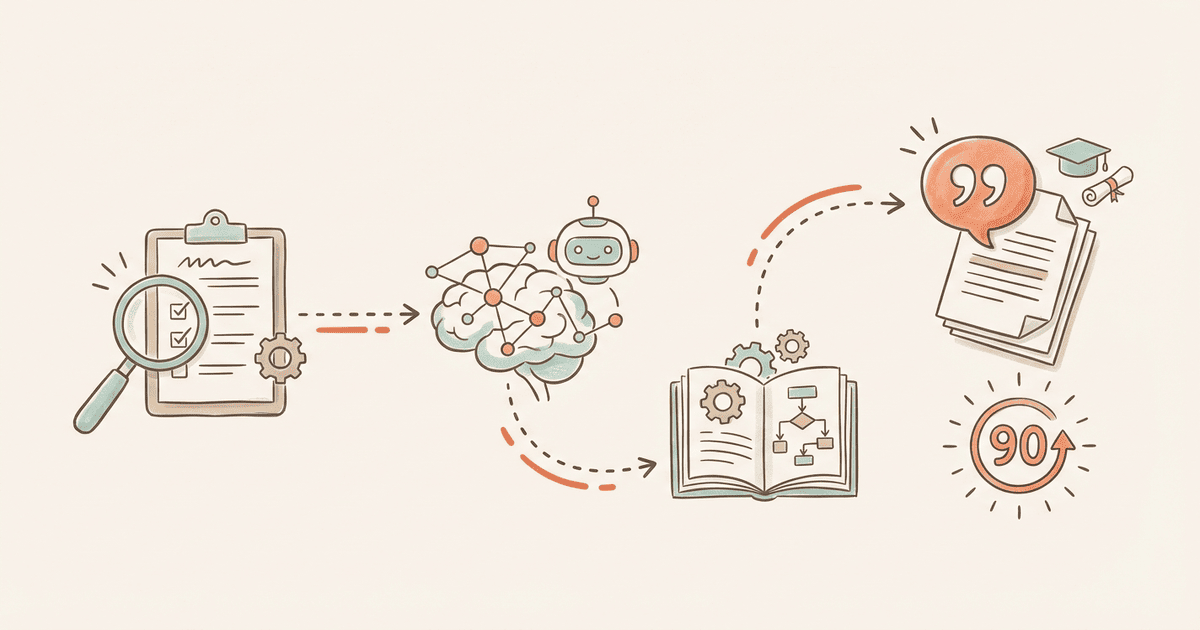
Forty to sixty percent of AI citations change every month. Generative engines don't maintain static answers like traditional search pages. When your competitor publishes a better answer, you disappear from ChatGPT. Many brands are paralyzed by this complexity or expect immediate results from a single optimization pass. You can't optimize your site once and expect to stay cited forever. Generic tactics promise overnight success without proof. That approach fails because it treats AI visibility like a simple code fix. It isn't.
You need a structured, 90-day system. The process moves from baseline auditing to content optimization, expands into third-party presence, and establishes a self-sustaining measurement flywheel. The goal isn't getting cited a single time. Your true goal is building a system that maintains and grows your citations across all major AI platforms.
We run this exact playbook for every client. Hamming.ai saw an 8.5x increase in organic traffic in 12 weeks. UV Blocker doubled their orders in about six weeks. Keywords.am achieved a 3% to 13% visibility lift in their first two weeks.
Here's the step-by-step 90-day roadmap.
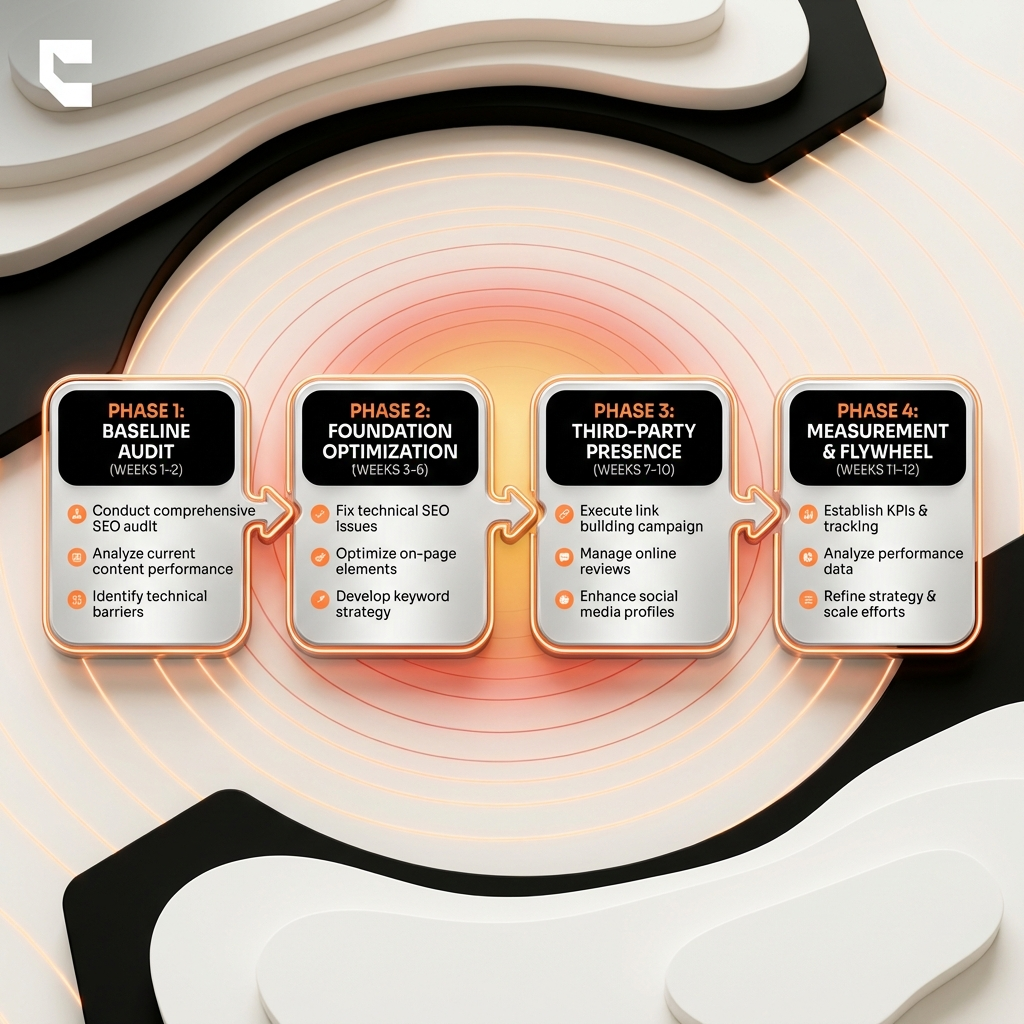
TL;DR: The 90-Day Implementation Roadmap
- Phase 1: Weeks 1-2 (Baseline Audit): Identify your current mention rate with a 15-20 prompt audit. Review technical readiness and score your top five revenue pages for AI citability. Keywords.am saw a 3% to 13% visibility lift in their first two weeks after this baseline work.
- Phase 2: Weeks 3-6 (Content Optimization): Tear apart your top five pages and rebuild them answer-first. Kill the JavaScript blockers. Ship two to three focused articles weekly. UV Blocker followed this exact rhythm and doubled their orders in roughly six weeks.
- Phase 3: Weeks 7-10 (Third-Party Presence): Build your authority on the platforms AI trusts most. Jump into relevant Reddit threads. Secure those placements on comparison sites. Hamming.ai generated 40% of their product demos through this exact community strategy.
- Phase 4: Weeks 11-12 (Measurement & Flywheel): Re-run your baseline audit to measure growth. Set up a monthly refresh cadence to protect your citations from the 40-60% monthly drift. Hamming.ai hit an 8.5x traffic multiple (from 200 to 1,900 daily visitors) at this milestone.
- The Honest Truth: Results scale with your starting authority. Not every brand sees an 8.5x jump in three months. Your exact timeline depends on your competitive landscape, content velocity, and execution consistency.
Why Does AI Visibility Take 90 Days (Not 9)?
See where you rank across all AI answer engines.
Enter your domain and we'll scan your citation rate across ChatGPT, Perplexity, and Google AI.
Prefer to talk? Book a free 30-min call
AI visibility requires 90 days because building citations, optimizing content, and establishing third-party presence takes systematic execution across multiple platforms simultaneously.
Instant results don't exist in generative search. AI platforms don't update their knowledge bases immediately like paid ad networks. They also don't require six to twelve months like traditional SEO projects. Based on our client data, the standard citation window takes four to twelve weeks to mature. You're building a repeatable system rather than making a one-time fix.
The generative landscape shifts constantly. According to Profound AI data, 40% to 60% of AI citations change every single month. This volatility destroys static optimization strategies. If you optimize a page today and never touch it again, you'll lose your citation next month. Your competitors will replace you in the answers. You need 90 days to establish the internal cadence required to fight this decay. We refer to this continuous process as the discipline behind generative engine optimization. For a quick primer on how GEO compares to traditional SEO, see what is generative engine optimization. For B2B companies, the volatility is compounded by a multi-platform buyer journey, the AI search for B2B guide maps each platform's role in enterprise buying decisions.
Your existing foundation matters immensely. A recent study by Seer Interactive found that 87% of ChatGPT citations match Bing's top 10 search results. Traditional authority still provides a massive advantage, but it's rarely enough on its own to secure direct AI citations. You have to bridge the gap between traditional tactics and generative requirements. Our detailed breakdown of SEO vs AI search optimization explains this overlap.
The 90-day timeline works precisely because every phase stacks on top of the previous work. You audit, optimize, expand, and measure in a calculated sequence. Here's exactly what you need to do in each phase.
What Should You Do in Weeks 1-2? (Baseline and Audit)
In weeks one and two, run a prompt audit across ChatGPT, Perplexity, and AI Overviews, then audit technical readiness and score your top revenue pages for AI citability.
You can't improve what you don't measure. Your first major task is establishing a completely honest baseline.
Fire up ChatGPT, Perplexity, and AI Overviews. Type in 15 to 20 buying-intent prompts that your customers actually ask. Things like "What's the best [product category] for [use case]?" and "Compare [Competitor A] vs [Competitor B]." Write down every time your brand shows up. Note which competitors appear instead. Record the source links each AI pulls from. This data is your battle plan for the next 10 weeks.
AI crawlers require unfettered access to your content. Check your site's robots.txt file immediately to ensure you aren't accidentally blocking them. Check your JavaScript rendering. Heavy client-side text loading often leaves AI bots staring at a blank page. So they move on. Roll out schema markup sitewide (especially FAQPage, Article, and Organization tags). These elements hand structured data directly to the engines. They trust that format. Read our full guide on how to measure AI visibility for the exact tracking methods.
Identify your top five revenue-critical pages. Score them based on their semantic density and entity clarity. Do they use an answer-first structure? This format drops the factual answer in sentence one. Right before adding any supporting details. If your pages bury the answer in the fourth paragraph, they'll fail.
Record your starting AI mention rate. Most brands start somewhere between 0% and 5%. Don't let a low starting number discourage you. When we ran this baseline protocol for Keywords.am and applied the initial round of targeted optimizations, we saw their visibility lift from 3% to 13% within the first two weeks.
With your baseline data secured, you know exactly which pages require immediate attention. Weeks three through six are where the real structural work begins.
What Should You Do in Weeks 3-6? (Foundation Optimization)
Weeks three through six focus on restructuring your top pages for AI citability, fixing technical barriers, and publishing two to three answer-first articles per week.
This phase is entirely about giving the AI exactly what it wants to cite. You need to restructure your top five revenue pages from top to bottom.
Start by rewriting your primary introductions. Use tight, answer-first paragraphs of 40 to 60 words. Follow this introductory text immediately with question-format headings. Support every single claim you make with hard data and include direct inline citations. If you want to know exactly how to get recommended by ChatGPT, this specific structural alignment is your primary blueprint.
Look at this introduction rewrite. The old version read: "Welcome to our comprehensive guide on sun protection products. People often ask if our umbrellas block the sun. They are made with special fabric." The updated version hits hard: "UV Blocker umbrellas block 99% of UVA and UVB rays. Solarteck fabric hits UPF 55+ protection, dropping the canopy temperature by up to 15 degrees."
The second version gives the generative engine concrete facts to extract and cite.
Fix your technical barriers immediately. If your site relies heavily on JavaScript, set up server-side rendering for your core content pages. Update your robots.txt file to explicitly allow GPTBot, ClaudeBot, and PerplexityBot. Clean up your HTML structure to remove unnecessary code bloat. The easier you make it for the bots to read your site, the faster they'll process your new content.
Content velocity becomes absolutely critical here. Publish two to three new answer-first articles every single week. Target the high-intent prompts from your week one audit where competitors currently beat you. Focus heavily on direct comparison content and categorical "best of" roundups. Generative engines constantly answer comparison queries. If you provide the most structured, objective comparison available, the AI will use your data.
This foundational work pays off very quickly. UV Blocker completely rebuilt their product pages and cranked up content output. Within four to six weeks, they snagged their first citations. Daily traffic spiked from 3,000 to 7,500. Total orders doubled in just a month and a half.
Optimized owned content is essential. But 85% of brand mentions come from third-party pages. You have to expand your footprint beyond your own domain. On the link-building side, backlinks for AI visibility behave differently than traditional SEO links, earned media and community links carry the most weight for AI citations.
What Should You Do in Weeks 7-10? (Third-Party Presence)
Weeks seven through ten focus on building third-party presence through Reddit engagement, comparison site mentions, and earned media the platforms AI cites most.
You can't rely entirely on your own domain to win visibility. Generative engines want consensus. They look actively for external validation to confirm the claims made on your website.
Reddit isn't optional. Get into relevant subreddits and niche forums. Give genuinely useful answers. Skip the link drops. When you answer tough questions well, people (and AI) notice. A huge study by Press Gazette analyzed 150,000 LLM responses, finding Reddit in 40% of all AI answers. Running a dedicated Reddit strategy for AI visibility isn't optional anymore.
Here's the part nobody expects. AirOps found that 85% of brand mentions in AI search come from third-party pages, not your own website. Your site alone won't get you there. Get listed on comparison sites. Earn spots on review platforms. Show up in trusted industry directories. The AI needs to see your name across many independent sources.
Scale your earned media efforts rapidly. Secure expert quotes in major industry publications. Distribute your brand presence across 50 or more different authoritative sources. When the AI sees your product mentioned positively across dozens of highly trusted, independent sites, your total citation rate skyrockets.
We applied this exact community and third-party strategy for Hamming.ai. The results shifted their entire customer acquisition model. A full 40% of their qualified product demos started coming directly from a combination of targeted Reddit threads and AI search recommendations.
With your owned content completely optimized and your third-party presence firmly established, you need to measure the final impact and build the ongoing engine.
What Should You Do in Weeks 11-12? (Measurement and Flywheel)
Weeks eleven and twelve are about measuring progress against baseline, establishing monthly refresh cadences, and building the repeatable system that sustains AI visibility.
You've put in massive effort across your site and the broader web. Now you close the loop and secure your gains.
Re-run your original week one prompt audit. Use the exact same 15 to 20 buying-intent prompts from your initial baseline. Compare your new mention rate directly against your starting point. Look closely at your new citation sources. Check your competitor positioning to see who you displaced. This literal before and after comparison proves the definitive value of your work. You can take this exact data to build a compelling AI visibility ROI business case, with revenue-tied case studies, to share with leadership.
Set up your ongoing monthly refresh cadence. Remember the 40% to 60% citation drift we mentioned earlier? You fight that specific decay by keeping your core content fresh. Update your primary pillar pages with new statistics every single month. Respond immediately when you notice you've lost a critical citation. This is a continuous operational process.
Four numbers matter now. Your AI mention rate (shoot for 20-30% on core prompts). Citation sentiment (is the AI saying nice things?). Referral traffic from AI platforms. And revenue you can tie back to those visits. That's your dashboard. Everything else is noise.
Build out the repeatable system for your team. Document exactly what gets measured every month. Define which specific pages get updated and assign clear ownership to your internal team members. This system is what separates a temporary visibility bump from permanent, sustained growth.
Here's a summary of what to expect at each milestone.
What Results Should You Expect at Each Milestone?
Results vary by starting authority and execution, but clients following this playbook typically see first citations by week six and measurable AI mention rate improvements by week twelve.
You want a perfectly clear picture of the expected timeline. The table below outlines the specific expected outcomes and provides real client benchmarks at each critical phase of the process.
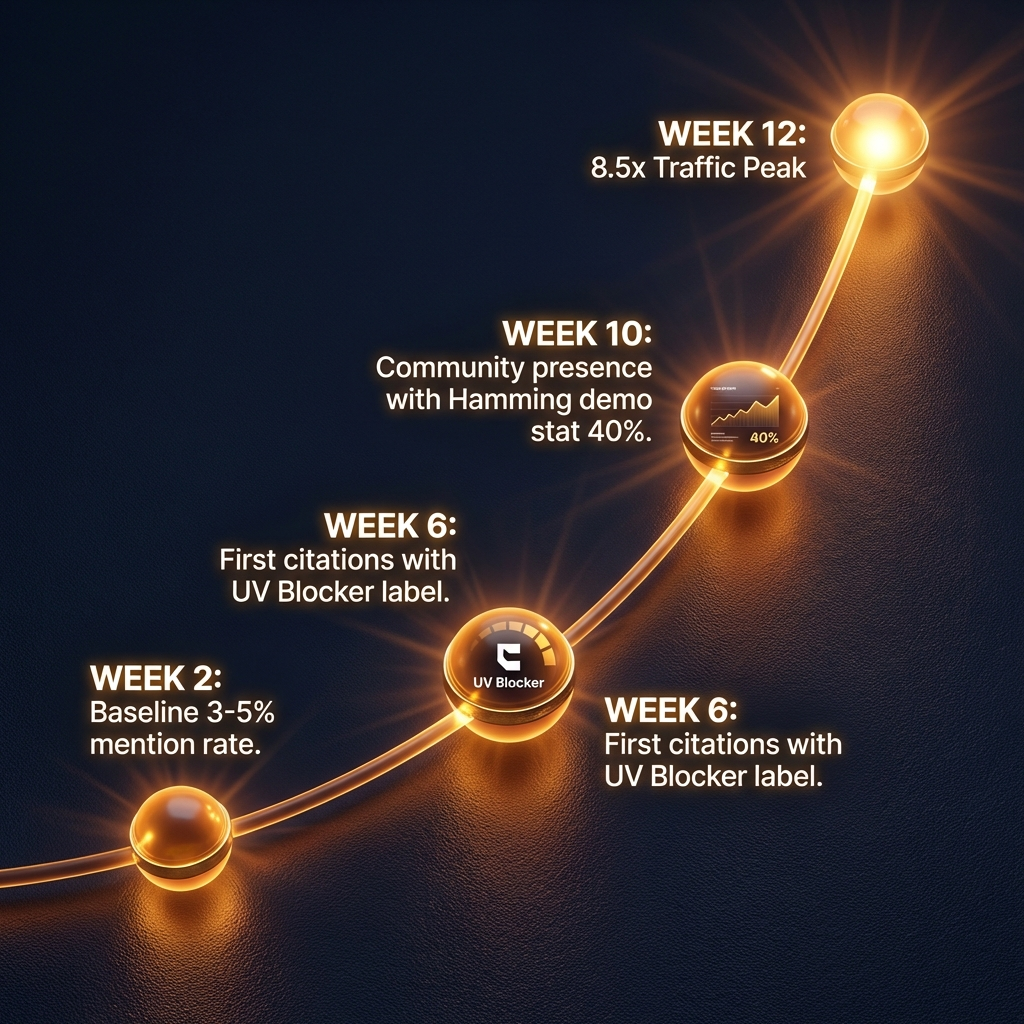
| Milestone | Expected Outcome | Client Benchmark |
|---|---|---|
| Week 2 | Clear baseline + prioritized action list | Keywords.am: 3% to 13% AI visibility in first 2 weeks |
| Week 6 | First AI citations for optimized pages | UV Blocker: initial citation pickups, traffic building |
| Week 10 | Community presence generating third-party mentions | Hamming.ai: 40% of demos from Reddit/AI search |
| Week 12 | Measurable AI mention rate improvement | Hamming.ai: 8.5x organic traffic (200 to 1,900/day) |
We need to be completely honest here. Not every single brand sees 8.5x organic traffic growth in 90 days. Your actual results depend heavily on your existing brand authority, the competitive landscape in your specific industry, your content production velocity, and your team's execution consistency. If you have a brand new domain, it'll naturally take longer to build the required trust compared to a massive established brand.
Frequently Asked Questions About the AI Visibility Playbook
These are the most common questions brands ask before starting a 90-day AI visibility playbook.
Can I run this AI visibility playbook without an agency?
Yes, if you have bandwidth for 15-20 buying-intent prompt audits, 2-3 new articles per week, and sustained Reddit engagement (roughly 20-30 hours per week of focused execution).
Many brands start DIY and bring in an agency at Week 3-6 when content velocity becomes the bottleneck. The playbook is the exact same either way. You just have to decide who does the heavy lifting.
What if I don't see results by week 6?
Check three things: are AI crawlers allowed in robots.txt, are your pages server-side rendered, and are you targeting prompts with buying intent rather than informational queries.
Most week-6 stalls trace to technical issues or targeting the wrong prompts entirely. The rigorous audit in Weeks 1-2 should catch these problems, but always re-audit if your progress stalls unexpectedly.
How much content do I need to publish per week?
Two to three answer-first articles per week during the optimization phase, scaling to broader distribution across platforms by weeks seven through ten.
One data-packed article generates more AI citations than five thin posts combined. Hard facts beat filler. Always.
Do I need special tools to track AI visibility?
You can start with manual prompt testing across ChatGPT, Perplexity, and Google AI Overviews (no paid tools required for the baseline audit).
For ongoing monitoring, tools like Otterly.ai or Peec.ai automate your tracking, but manual testing works perfectly fine for the first 90 days of the program.
Does this playbook work for both B2B and ecommerce?
Yes. Hamming.ai is B2B SaaS. UV Blocker is ecommerce. Both followed the same phased approach with results at similar milestones.
The specific tactics differ slightly in practice. B2B focuses more on deep expert content and Reddit engagement. Ecommerce focuses far more heavily on comparison pages and third-party review sites. But the underlying 90-day framework applies equally to both models.
Conclusion
The generative search landscape moves incredibly fast. You need a highly structured, 90-day system to audit your baseline, optimize your owned content, build out your third-party presence, and accurately measure your growth. This four-phase playbook creates a continuous operational flywheel that actively protects and expands your citations over time.
Your immediate action item is remarkably simple. Run the 15 to 20 prompt audit this week. The initial baseline is completely free and takes only about two hours to complete. You'll see exactly where you stand against your biggest competitors.
Don't want to run the 90-day playbook yourself? We execute the full playbook. You get the exact same methodology, 50x output scale, and the same results timeline. For a practical 5-tactic starting point, how to improve your brand's AI visibility breaks down the highest-leverage actions brands can take to increase citation frequency across all major AI platforms.
See where your brand appears in AI search
Scan ChatGPT, Perplexity, and Google AI across buyer-intent queries, instantly, no sign-up.
Find out if AI is sending buyers to your competitors.
We audit your AI visibility across ChatGPT, Perplexity, and Google AI –and show you exactly where you rank and what to fix.
“We went from 200 visitors/day to 1,900 visitors/day and 40% of demos are from AI search.”
Sumanyu Sharma · CEO, Hamming.ai
“Cintra helped me go from 3k to 7.5k daily traffic and doubled weekly orders in 1.5 months.”
Russ Coulon · Owner, UV Blocker
“We saw a lift from 3% to 13% visibility in the first 2 weeks, and organic traffic hit its highest ever.”
Ash Metry · Founder, Keywords.am
Related Articles
Google AI Mode Link Updates: What Five Changes Mean for Your Brand's AI Visibility
Google AI Mode link updates add five new outbound link features. We analyze what changed on May 6, how each up…
AI Visibility for Automotive: The Two-Layer Problem Dealerships Don't See
AI visibility for automotive is a two-layer problem. 84% of dealership websites are invisible to AI. Learn the…
How to Fix Wrong AI Answers Brand Owners Get (2026 Guide)
Fix wrong AI answers brand owners encounter with this 6-step playbook. Learn why ChatGPT, Perplexity, and AI M…