Google AI Overviews Optimization: How to Get Cited in 2026
Google AI Overviews optimization reduces CTR by 58% for non-cited pages but boosts cited pages by 35%. Learn the verified ranking factors, 5-step citation strategy, and how AI Overviews differ from ChatGPT and Perplexity.
Tanush Yadav
February 22, 2026 · 14 min read

In this article:
- Why AI Overviews matter
- How they differ from ChatGPT and Perplexity
- Key ranking factors for 2026
- 5 steps to get cited
- Common mistakes to avoid
- FAQ
AI Overviews reduce organic CTR by up to 58% for non-cited pages. But pages that earn citations see 35% more organic clicks and 91% more paid clicks. Most brands are losing traffic to AI Overviews without understanding that the solution isn't fighting them. It is getting cited by them.
This guide covers a complete Google AI Overviews optimization strategy: verified ranking factors, a 5-step citation process, and a cross-platform comparison with ChatGPT and Perplexity.
TL;DR
- AI Overviews reduce organic CTR by up to 58% for non-cited pages, based on an analysis of 300,000 keywords.
- Cited pages earn 35% more organic clicks and 91% more paid clicks, creating a clear dividing line between traffic winners and losers.
- 76% of AI Overview citations come from pages already in Google's top 10, meaning traditional SEO remains the critical foundation.
- AI Overviews differ from ChatGPT and Perplexity significantly in data sourcing, citation style, and reliance on Reddit.
- The 5-step optimization process involves identifying triggering queries, structuring answer-first content, adding schema markup, building topical authority, and maintaining freshness.
- Citations drift 59% monthly, requiring continuous monitoring and re-optimization rather than a one-time fix.
Why Do Google AI Overviews Matter for Your Brand?
AI Overviews reduce organic CTR by up to 58% for non-cited pages, but pages that earn citations gain 35% more organic clicks and 91% more paid clicks.
AI Overviews appeared on approximately 16% of Google searches as of late 2025, after peaking at around 25% mid-year. While the initial rollout saw fluctuations, the trigger rate continues to grow as Google expands the feature to more query types and regions. This shift represents a fundamental change in how users interact with search results, moving from a list of links to a synthesized answer engine.
The impact on click-through rates is stark. This data comes from an analysis of 300,000 keywords updated in December 2025. For a brand ranking in the top three organic positions, the appearance of an AI Overview can cut expected traffic by more than half if the page fails to earn a citation. The traditional "ten blue links" model no longer guarantees visibility or clicks.
However, the reverse is also true. Pages that succeed in earning a citation within the AI Overview see a 35% increase in organic clicks and a 91% increase in paid clicks. This data, drawn from 25.1 million organic impressions across 42 organizations, highlights a new paradox in search marketing: AI Overviews punish brands that ignore them and disproportionately reward those that adapt. The visibility gained from being a cited source often outweighs the traffic lost from the organic listing being pushed down the page.
Crucially, AI Overviews appear in 74% of problem-solving queries. These are the exact "how-to," "what is," and "best way to" queries where brands typically invest in educational content and guides. Any content strategy that relies on answering user questions to build trust and awareness is operating directly in the AI Overview blast zone. Ignoring this shift means ceding the most valuable informational queries to competitors who have optimized for the new format.
Getting cited in AI Overviews is not optional. It has become the primary dividing line between gaining and losing traffic on Google. But Google AI Overviews optimization requires a different approach than optimizing for other AI platforms.
Read more: SEO vs AI Search Optimization
How Are AI Overviews Different from ChatGPT and Perplexity?
AI Overviews pull from Google's search index and strongly favor pages already ranking in the top 10, unlike ChatGPT and Perplexity which rely more on Bing and real-time crawls.
Understanding the distinct mechanics of each platform is the first step toward a comprehensive AI visibility strategy. While all three function as answer engines, their underlying data sources and ranking algorithms vary significantly.
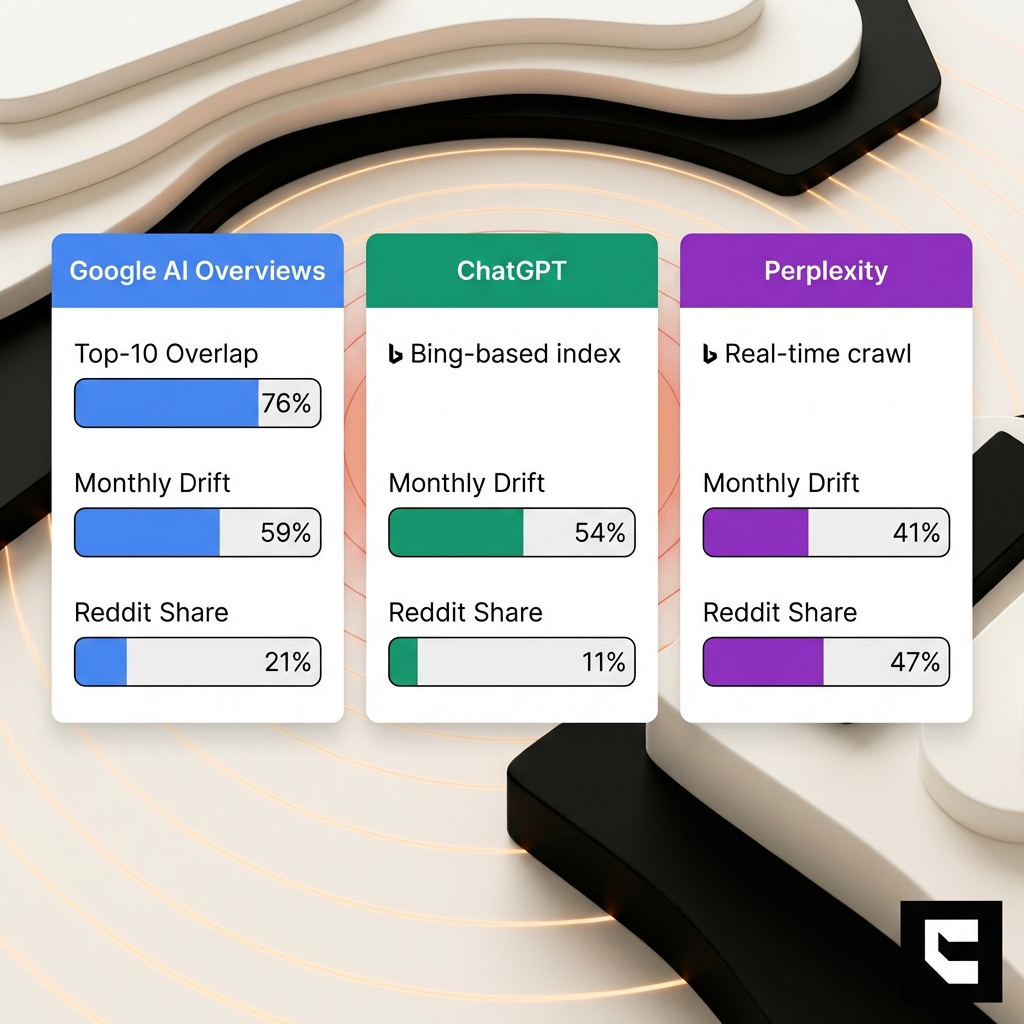
Cross-Platform Comparison
| Factor | Google AI Overviews | ChatGPT | Perplexity |
|---|---|---|---|
| Data source | Google's search index + generative layer | Bing index + training data | Real-time web crawl |
| Update speed | Near real-time (tied to search index) | Moderate (training lag + browsing) | Real-time |
| Citation style | Inline links within summary | Bottom-of-answer attribution | Numbered inline references |
| Reddit weight | ~21% of top-cited sources | ~11% of top-cited sources | ~47% of top-cited sources |
| Citation drift | 59% monthly | 54% monthly | 41% monthly |
| Key lever | Existing Google rankings (76% from top 10) | Broader training data + Bing rankings | Reddit/forum signals + recency |
The table above illustrates the unique ecosystem of each platform. Google AI Overviews are tightly integrated with the core Google Search index. Consequently, they reward existing SEO authority more than other platforms. Analysis of 1.9 million citations shows that 76% of AI Overview citations come from pages already ranking in Google's top 10 organic results. This makes AI Overviews the "lowest-hanging fruit" for brands with an established organic presence.
In contrast, Perplexity leans heavily on Reddit and forum discussions, with Reddit accounting for nearly half of its top-cited sources. ChatGPT, while increasingly real-time, still relies on a combination of its training data and Bing's index, often favoring different authoritative sources than Google.
The "citation drift" metric is particularly important. AI Overview citations change frequently: 59% of citations churn every month. This volatility is higher than both ChatGPT (54%) and Perplexity (41%), meaning that maintaining visibility on Google requires constant monitoring and content refreshment. A page cited today may be replaced next month if a competitor publishes more up-to-date or better-structured information.
Read more: How to Get Recommended by ChatGPT Read more: Generative Engine Optimization (GEO) Guide
What Are the Key Ranking Factors for AI Overviews in 2026?
The key Google AI Overviews ranking factors are content comprehensiveness, answer-first passage structure, E-E-A-T signals, structured data markup, and topical authority.
Effective Google AI Overviews optimization requires shifting from keywords to answers. These verified factors drive citations.
Content Comprehensiveness
AI Overviews strongly favor pages that cover a topic end-to-end. The generative model seeks to synthesize a complete answer, often pulling from sources that provide the most thorough context. A page that addresses a primary query like "CRM pricing" but also covers related subtopics (feature comparisons, implementation costs, hidden fees, and ROI calculations) will consistently outperform a narrower page that only lists price points. Breadth and depth signal to the AI that the source is capable of answering follow-up questions without requiring the user to click away.
Answer-First Passage Structure
Structure is as important as substance. Nearly 60% of AI Overviews are between 100 and 300 words in length. To align with this format, content should be structured in self-contained, answer-first paragraphs. This means leading each section with a direct answer in the first one or two sentences, followed by supporting evidence or data. This "inverted pyramid" style allows the AI to easily extract standalone passages that directly address user intent.
E-E-A-T Signals
Experience, Expertise, Authoritativeness, and Trustworthiness (E-E-A-T) signals remain strongly correlated with AI Overview citations. The AI prioritizes sources that demonstrate credibility. This includes clear author bylines with credentials, references to original research, and citations of primary sources. Phrasing such as "according to [Brand]'s analysis of [Data Set]" or linking to verified external studies helps establish the trust required for the algorithm to select a page as a definitive source.
Structured Data
Technical signals play a decisive role. Pages implementing structured data (specifically Article, FAQ, and HowTo schema) are significantly more likely to earn citations. FAQ schema helps the AI identify direct answers to common questions, while HowTo schema provides a clear, step-by-step framework that the AI can mirror in its own output.
Topical Authority
AI Overviews favor domains that demonstrate depth on a specific subject. This is achieved through content clusters: a central "pillar" page supported by a network of related articles. For example, a marketing agency might have a pillar page on "Email Marketing Strategy" linked to supporting articles on "Subject Line Best Practices," "Segmentation Guides," and "Deliverability Audits." Single, orphan pages that lack this contextual support rarely earn citations because they fail to demonstrate the domain-level authority the AI seeks.
The Top-10 Overlap
While 76% of citations come from the top 10 organic results, 24% come from outside the first page. This proves that while SEO is the foundation, high-quality content can override traditional ranking signals. A page ranking at position 15 that offers a superior, better-structured answer has a viable path to being cited above a position 1 ranking that is vague or poorly formatted.
What Are the 5 Steps to Get Cited in Google AI Overviews?
Getting cited in Google AI Overviews requires five steps: identify triggering queries, structure answer-first content, add schema markup, build topical authority, and maintain content freshness.
This actionable Google AI Overviews optimization process turns the ranking factors into a repeatable workflow.
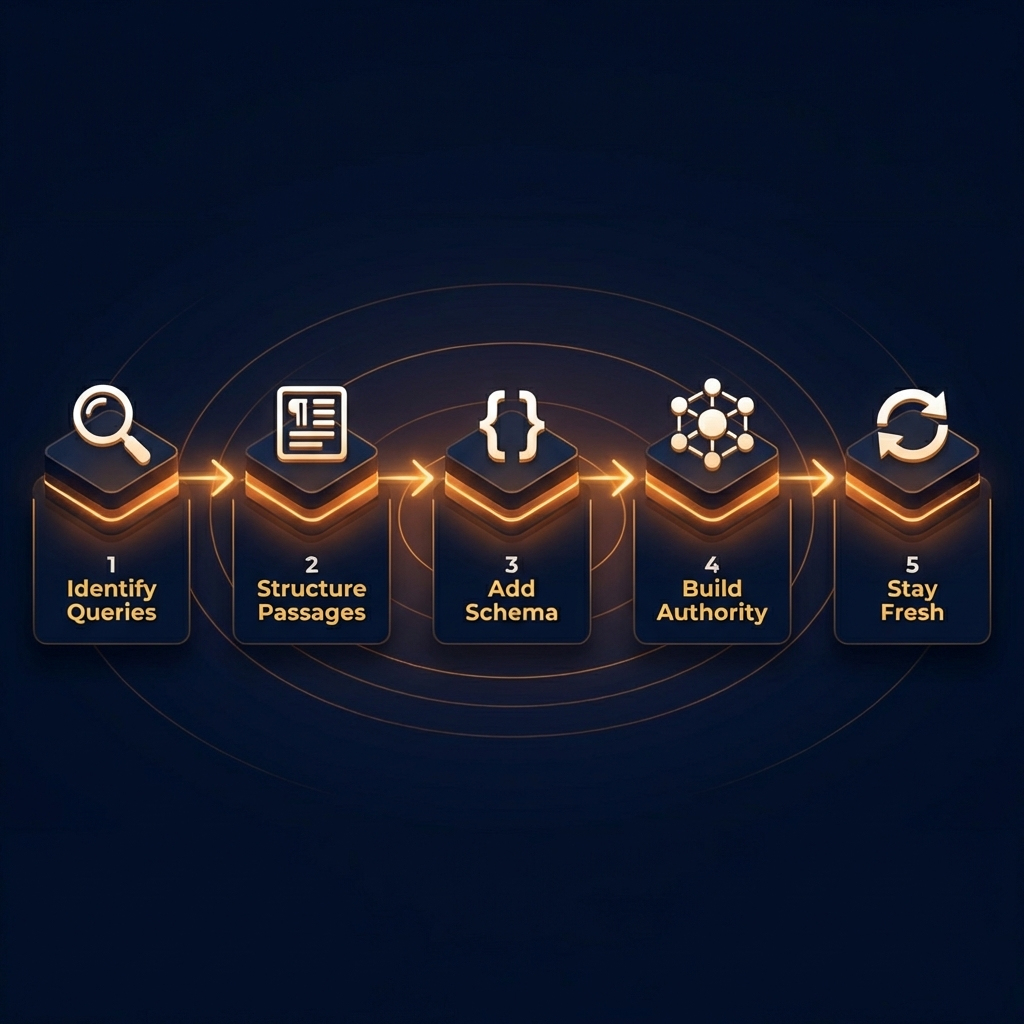
Step 1: Identify Which of Your Queries Trigger AI Overviews
The first step is diagnosis. Use the "AI Overviews" search appearance filter in Google Search Console to identify which queries are already triggering AI summaries for your domain. Given that 74% of problem-solving queries trigger these overviews, guide-style content should be the highest priority for analysis. Identify the queries where you rank but are not cited, as these represent the most immediate opportunities for optimization.
Step 2: Structure Content with Answer-First Paragraphs
Once target queries are identified, rewrite key sections of content to follow the answer-first model. A typical SEO paragraph might bury the lead after several sentences of fluff. An optimized paragraph states the answer immediately.
- Traditional: "When considering the cost of software, it is important to look at various factors. Many companies offer different tiers..."
- Optimized: "Enterprise software typically costs between $50 and $150 per user per month. The final price depends on three factors: seat count, feature tier, and contract length." Aim for self-contained paragraphs of 100-300 words that can stand alone if extracted.
Step 3: Add Comprehensive Structured Data
Implement schema markup to help Google's crawlers parse your content effectively. Add FAQ schema to every guide-style page to explicitly mark up questions and answers. Use HowTo schema for any content that includes steps or tutorials. Ensure Article schema is present on all blog posts to establish authorship and publication dates.
Step 4: Build Topical Authority Through Content Clusters
Don't let high-value pages stand alone. Build a content cluster around your priority topics. If you want to be cited for "enterprise SEO," ensure you have a comprehensive pillar page linked to detailed supporting articles covering specific aspects of that topic. This internal linking structure signals to Google that your domain is an authority on the entire subject, not just a single keyword.
Step 5: Maintain Freshness (AI Overviews Have 59% Monthly Citation Drift)
Optimization is not a one-time task. With 59% of citations changing every month, content must be kept fresh. Establish a quarterly audit cadence for your most valuable pages. Update statistics, refresh examples, and verify that your content reflects the latest industry data. Stale content is quickly replaced by newer sources in the AI's selection process.
Read more: How to Measure AI Visibility
What Mistakes Prevent AI Overview Citations?
The most common citation blockers are thin content, missing structured data, poor Core Web Vitals, misaligned query targeting, and blocking Googlebot-Extended in robots.txt.
Even with good intentions, certain technical or content flaws can disqualify a page from being cited.
Thin Content
Content that fails to comprehensively cover a topic is frequently ignored. "Length" is not just about word count; it is about the density of information. AI Overviews need deep, substantial content to synthesize an answer. A 500-word overview that touches on five points superficially will lose out to a 2,000-word guide that explores those points in detail.
Missing Structured Data
Pages lacking schema markup put themselves at a disadvantage. Without Article, FAQ, or HowTo schema, the AI must rely solely on text analysis to understand the page structure. Schema provides a clear roadmap, making it significantly easier for the algorithm to extract the correct information. Check pages using Google's Rich Results Test to ensure implementation is valid.
Slow Site Speed
Google uses performance signals for source selection. Poor Core Web Vitals (LCP, CLS) negatively impact citation chances. A fast page experience is a prerequisite.
Misaligned Query Targeting
AI Overviews match passages to queries with high precision. A common mistake is providing a general answer to a specific question. If the user query is "best CRM for startups," a page that broadly discusses "CRM features" without explicitly addressing the needs of startups is unlikely to be cited. Content must directly address the specific intent of the query.
Blocking Googlebot-Extended
Some sites inadvertently block the specific crawler used for AI training and retrieval. Check the robots.txt file to ensure that Googlebot-Extended is not disallowed. A directive like User-agent: Googlebot-Extended Disallow: / effectively removes a site from consideration for AI features. Removing this block is a quick and essential fix.
Frequently Asked Questions About Google AI Overviews Optimization
These are the questions marketers ask most often about Google AI Overviews optimization, based on search data and client conversations.
Can I track AI Overview impressions in Google Search Console?
Yes, Google Search Console includes an "AI Overviews" search appearance filter. This tool allows site owners to see specifically which queries triggered an AI Overview that included a link to their site. It is an essential metric for understanding current performance and identifying gaps in visibility.
Do AI Overviews affect my organic traffic?
Yes, the impact is significant. AI Overviews reduce organic CTR by up to 58% for pages that are not cited. However, they increase organic clicks by 35% for pages that are cited. The net effect on traffic depends entirely on whether a brand succeeds in earning citations.
Should I optimize for AI Overviews or traditional rankings first?
Start with traditional SEO. Data shows that 76% of AI Overview citations come from pages that already rank in Google's top 10 organic results. Strong organic rankings provide the necessary foundation of authority and relevance that AI Overviews build upon.
How often do AI Overview citations change?
Citations are highly volatile, with 59% drifting or changing every month. This is higher than the churn rate for ChatGPT or Perplexity. This high volatility necessitates a strategy of continuous content freshness and regular monitoring to maintain positions.
Conclusion
AI Overviews represent the most impactful shift in search because they are embedded directly into Google, the platform where the vast majority of searches still occur. The data presents a clear paradox: brands that are not cited lose nearly 60% of their potential clicks, while those that are cited see gains of 35%. Citation is no longer a bonus; it is the new table stakes for search visibility.
Unlike other AI platforms, Google rewards existing SEO authority. With 76% of citations coming from the top 10 results, this is the most accessible AI surface for brands that have already invested in organic search.
To start your own Google AI Overviews optimization, audit robots.txt for blocks on Googlebot-Extended and check Google Search Console for the AI Overviews appearance filter. These initial steps reveal the immediate opportunities and risks. For a complete strategy on how to capture visibility across all major answer engines, read the full Generative Engine Optimization (GEO) Guide.