How to Get Cited by Perplexity: The Tactical Playbook for 2026
Learn how to get cited by Perplexity with a 6-step framework covering freshness, source seeding, and technical setup. Actionable tactics for AI visibility in 2026.
TL;DR
Perplexity uses real-time web retrieval (not training data), drops citations by 40% after 30 days, and pulls 46.7% of sources from Reddit. Getting cited requires answer-first content, aggressive freshness, source-platform seeding, original data, schema markup, and crawler accessibility. These same tactics also lift visibility on ChatGPT and AI Overviews.
Here's a number worth paying attention to: 780 million monthly queries. That's Perplexity. 45 million active users, $18 billion valuation, and a public target of 1 billion weekly searches by late 2026. It's the fastest-growing AI search engine on the planet.
Most brands optimize for Google or ChatGPT. They assume Perplexity will just follow along. It won't. Perplexity runs on a completely different technical architecture. Think real-time retrieval instead of static training data. Add an extreme freshness bias. Throw in entirely different source pools. Applying traditional search tactics here guarantees failure.
This guide breaks down exactly how to get cited by Perplexity. It covers how the platform finds, evaluates, and cites sources. Then it provides a six-step framework for earning those citations. Consider this the companion to the ChatGPT optimization guide. Together they cover the two largest AI search engines using platform-specific tactics.
Why Does Perplexity Matter for Brand Visibility?
Perplexity processes over 780 million monthly queries. It also boasts an 85% user return rate. That makes it the fastest-growing AI search engine brands simply cannot afford to ignore.
These growth numbers demand serious attention. Monthly queries tripled from 230 million in mid-2024 to 780 million today. Current projections pointing to 1.2-1.5 billion by mid-2026 look completely realistic. The platform sustains 45 million monthly active users. It attracts 170 million global visitors with 66% year-over-year user growth.
This isn't some passing niche tool. $100 million in ARR and an $18 billion valuation confirm that. Smart money recognizes the shift from link-based search to direct answer synthesis.
Understanding the AI visibility ROI quickly reveals the real commercial value. Perplexity commands an 85% user return rate. These users stick around. They trust the answers they receive. And they come back for more. Earning citations here drives repeated, high-intent exposure over time. It builds brand authority at the exact moment of inquiry.
But Perplexity doesn't find its sources the same way ChatGPT does. That single technical difference changes absolutely everything about optimization strategy.
How Does Perplexity Find and Cite Sources?
See where you rank in Perplexity's answers.
Enter your domain and we'll scan your Perplexity citation rate across your highest-value queries.
Prefer to talk? Book a free 30-min call
Perplexity runs on real-time retrieval-augmented generation, or RAG. Each query triggers a fresh scan of the live web, pulling in whatever's most recent and best-structured.
Here's what actually happens: someone asks a question. Perplexity goes out, finds relevant pages across the web, and builds an answer with inline citations right there in the response. No reliance on a cached training snapshot. ChatGPT still depends on periodic data refreshes, Perplexity doesn't have that limitation.
Perplexity actually operates using two distinct crawlers. PerplexityBot pre-indexes content to build out a baseline knowledge base. Then Perplexity-User steps in. This second bot kicks in when someone actually asks a question, fetching pages in real time. Most guides don't mention this distinction at all. But both bots need access to the content, or it won't get cited.
The platform enforces an extreme freshness bias on source selection. Here's the number that should scare every content team: a 40% citation drop after just 30 days of inactivity. Three months without an update? Down 65%. A page from 2024, no matter how good it was, simply can't compete with something refreshed last Tuesday. That one fact should reshape how content teams prioritize updates.
Where does Perplexity pull its citations from? Mostly third-party platforms. Reddit sits at 46.7% of top sources, which is wild. YouTube's at 13.9% and climbing quickly as AI models get better at parsing video content.
A dedicated Reddit strategy for AI visibility is now non-negotiable for Perplexity optimization. Third-party platforms matter far more than direct brand content for initial query discovery.
Understanding the underlying mechanism is step one. But how does this compare to other platforms brands optimize for?
How Does Perplexity Compare to ChatGPT and AI Overviews?
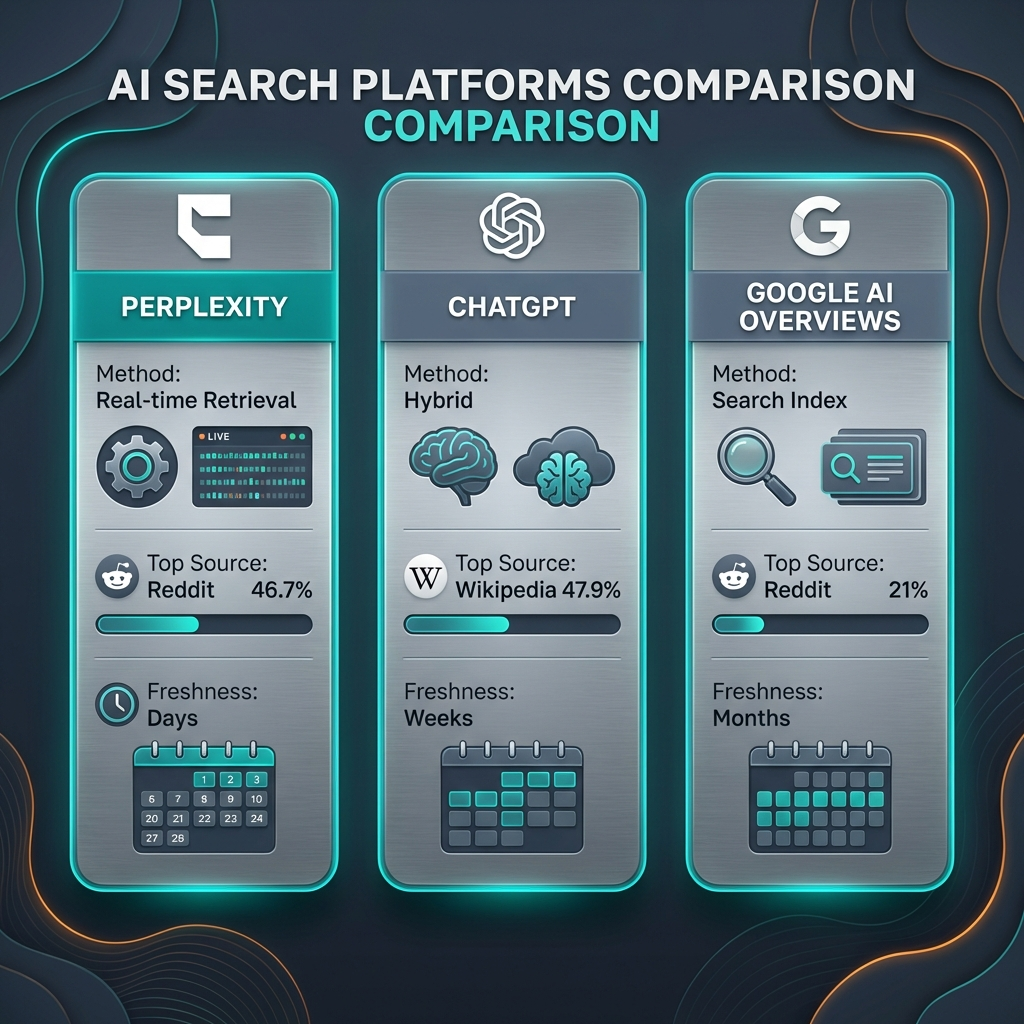
Three platforms, three completely different approaches. Perplexity chases the freshest Reddit-validated content. ChatGPT leans on Wikipedia and established authority. AI Overviews? Still largely a Google search index story.
| Factor | Perplexity | ChatGPT | Google AI Overviews |
|---|---|---|---|
| Citation mechanism | Real-time RAG (live web) | Hybrid (training data + Bing search) | Google search index |
| Freshness requirement | Days (40% decay at 30 days) | Weeks-months | Weeks-months |
| Top source #1 | Reddit (46.7%) | Wikipedia (47.9%) | Reddit (21%) |
| Top source #2 | YouTube (13.9%) | Reddit (11.3%) | YouTube (18.8%) |
| Time to first citation | Hours-days | Weeks | Weeks-months |
| Content format bias | Answer-first, structured | Long-form authority | Featured snippet-style |
| Schema impact | ~10% of ranking factors | Moderate | High |
Perplexity explicitly rewards speed, recency, and tight data structure. ChatGPT rewards deep domain authority alongside historical consensus. Google AI Overviews reward traditional Google ranking signals. These are three entirely different games. They require distinct playbooks.
The good news? Optimizing for Perplexity tends to lift visibility across the board. The ChatGPT optimization guide covers this tactical overlap in detail. Content that's fresh, structured, and backed by Reddit discussion? It tends to do well everywhere. A Perplexity-first strategy creates a rising tide for an entire AI visibility portfolio.
Now that those core differences are clear. Here is the exact framework for earning Perplexity citations.
How to Get Cited by Perplexity: The 6-Step Framework
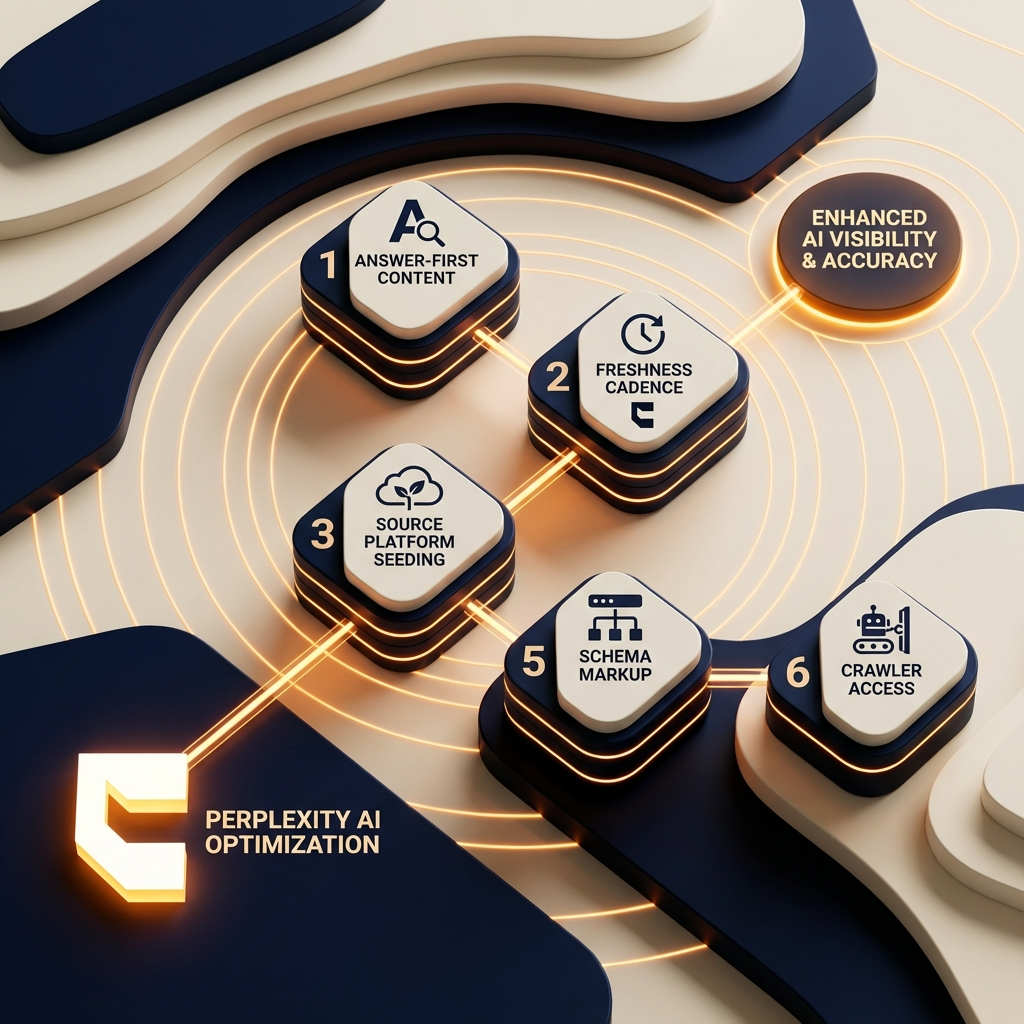
Earning Perplexity citations requires six coordinated steps. You need answer-first content, aggressive freshness, and source-platform seeding. Add original data, schema markup, and guaranteed crawler accessibility to that list.
Step 1: Lead with the answer, then explain
Perplexity extracts the first one or two sentences immediately following a heading. That forms its citation snippet. Bad content starts with long, rambling context. Good content starts with a direct answer. The system wants hard facts, not narrative build-ups.
Structure content using question-format headings. Follow them immediately with a direct answer capsule of 15 to 30 words. This provides the exact linguistic structure Perplexity needs for clean, simple extraction.
Step 2: Prioritize freshness above almost everything
High-value pages need a monthly refresh at minimum. And always add a visible "Last Updated" date. The 40% citation drop at the 30-day mark acts as the single biggest operational lever available. This step is not optional.
For highly competitive commercial topics, refresh pages every two weeks. Inject new data points. Adjust statistics. Add fresh examples to signal recency straight to PerplexityBot.
Step 3: Seed Perplexity's trust platforms
Reddit currently accounts for 46.7% of all Perplexity citations. Brands must build a genuine, helpful community presence in relevant industry subreddits. A dedicated Reddit strategy for AI visibility covers this full playbook.
YouTube drives another 13.9% of citations. Videos with transcripts and chapter markers? Perplexity's RAG system parses those directly. And LinkedIn is also emerging as a high-value citation source (especially for B2B topics).
Step 4: Publish original data and research
Content containing original statistics improves AI visibility by up to 40%. Why? Because first-party data is Perplexity's favorite thing to cite. The whole system is built to surface primary sources over secondhand summaries.
Run annual surveys. Publish benchmarks. Share proprietary analysis. Original research gets cited far more than pages that just rehash someone else's findings. This aligns perfectly with core generative engine optimization principles. Give the engine something it cannot find anywhere else.
Step 5: Implement schema markup strategically
Schema markup contributes approximately 10% to Perplexity's ranking factors. It gives Perplexity's real-time crawler a clear structural advantage when parsing page content.
Pages using FAQPage schema are 3.2x more likely to appear in AI search results. Yet only 12.4% of websites currently implement structured data correctly. That's a wide-open competitive gap. FAQ and HowTo schemas are the ones to prioritize. They're what Perplexity's extraction engine looks for first.
Step 6: Ensure PerplexityBot can access content
Check the robots.txt file. Both PerplexityBot and Perplexity-User need to be explicitly allowed. A surprising number of sites block one or both without realizing it, usually from outdated SEO templates.
Keep page load times under three seconds. Avoid heavy, client-side JavaScript rendering that blocks crawler parsing entirely. If a page can't load fast, it doesn't get fetched.
Perplexity has been documented using undeclared crawlers. These bots actually impersonate standard web browsers. So even with official bots blocked, content might still get accessed. The most sustainable strategy is to simply welcome the crawlers and optimize for their specific requirements.
Following the framework is only half the battle. Avoiding common mistakes is the other half.
What Mistakes Kill Perplexity Visibility?
The most common Perplexity visibility killers are stale content and blocked crawlers. Thin pages without specific data also hurt. Relying on Google rankings alone is another massive mistake.
Publish and forget is a guaranteed strategy for zero Perplexity citations. The 30-day decay cliff is real, punishing, and well-documented. Publish something and walk away? It'll vanish from Perplexity within weeks. Pages need regular updates or they decay fast.
Many enterprise websites block AI crawlers by default. Checking the robots.txt file for blanket AI bot blocks should be the first step. Ensure PerplexityBot and Perplexity-User have full, unrestricted access to the domain.
Content that buries a core answer down in paragraph three will never get extracted. Perplexity needs the answer right up front. Hiding the data simply means losing the citation entirely.
Thin content fails almost instantly. Pages lacking hard statistics, original research, or specific data points get passed over. Perplexity picks pages packed with original data every time. Dense, specific content wins. Vague marketing copy doesn't.
Ranking #1 on Google doesn't guarantee Perplexity citations. Perplexity deploys its own retrieval logic. Sure, 87% of ChatGPT citations match Bing's top 10. But Perplexity is far less dependent on traditional search rankings. An independent tracking baseline using a dedicated measurement framework makes all the difference here.
Frequently Asked Questions About Perplexity Citations
Here are the most common questions brands ask about how to get cited by Perplexity. These come up again and again in real optimization work.
How fast can content appear in Perplexity results?
Fast. Really fast. Perplexity can pull in new content within hours, sometimes a single day. That's wildly faster than ChatGPT or AI Overviews, which can take weeks.
PerplexityBot pre-indexes content on a regular basis. The Perplexity-User crawler also fetches live pages directly at query time. Fresh, well-structured content on high-authority domains can appear on the exact same day it gets published.
Does Perplexity cite the same sources as Google?
No. Perplexity clearly favors Reddit and YouTube. Meanwhile, Google AI Overviews rely more on Google's own search index and traditional authority signals.
Reddit is Perplexity's #1 source at 46.7%, versus just 21% for Google AIO. There's some overlap, sure. But the weighting couldn't be more different.
Is Perplexity optimization different from GEO?
Perplexity optimization operates as a specialized subset of GEO. GEO is the umbrella. Perplexity-specific tactics zoom in on freshness, real-time retrieval, and Reddit seeding.
For the broader playbook, the generative engine optimization guide has it all.
Can blocking PerplexityBot still allow citations?
Yes. Perplexity has been documented using undeclared user agents to access content. This happens even when PerplexityBot is explicitly blocked in robots.txt.
A recent Cloudflare report found Perplexity using generic browser user agents to bypass standard blocks. The best approach is to just allow full access. Then optimize content for clean citation extraction.
How do brands track Perplexity citations?
Track visibility via GA4 referral traffic straight from perplexity.ai. Combine this with manual prompt audits across key queries and dedicated AI visibility monitoring tools.
The how to measure AI visibility guide covers the full tracking setup in depth.
Conclusion
Understanding how to get cited by Perplexity starts with one fact: it isn't ChatGPT, and it isn't Google. It runs on real-time retrieval, which means different rules apply. Freshness is the #1 lever (40% citation drop at 30 days). Reddit and YouTube are the primary trust sources. The 6-step framework helps across all AI platforms, but Perplexity is where it has the biggest impact.
Two things to do right now: check the robots.txt for PerplexityBot access, and review content freshness on the top 5 pages that should show up in Perplexity. For brands that want this handled alongside ChatGPT and AI Overviews, Cintra runs the full multi-platform strategy.
See where your brand appears in AI search
Scan ChatGPT, Perplexity, and Google AI across buyer-intent queries, instantly, no sign-up.
Find out if AI is sending buyers to your competitors.
We audit your AI visibility across ChatGPT, Perplexity, and Google AI –and show you exactly where you rank and what to fix.
“We went from 200 visitors/day to 1,900 visitors/day and 40% of demos are from AI search.”
Sumanyu Sharma · CEO, Hamming.ai
“Cintra helped me go from 3k to 7.5k daily traffic and doubled weekly orders in 1.5 months.”
Russ Coulon · Owner, UV Blocker
“We saw a lift from 3% to 13% visibility in the first 2 weeks, and organic traffic hit its highest ever.”
Ash Metry · Founder, Keywords.am
Related Articles
Google AI Mode Optimization: How to Get Cited (2026 Guide)
Google AI Mode optimization needs a different approach than AI Overviews. Only 13.7% of sources overlap. Learn…
How to Get Cited by Grok: The xAI Platform Optimization Guide
Learn how to get cited by Grok with a 6-step framework covering the X co-citation mechanic, robots.txt setup,…
AI Search Optimization Ecommerce: The Proven 5-Step Playbook for Getting Products Best Recommended by ChatGPT
AI search optimization ecommerce brands need is here: ChatGPT Shopping, Perplexity, and AI visibility strategi…