Zero-Click Search Strategy: Why It's Your Biggest Opportunity
Zero-click search strategy isn't about surviving traffic loss — it's about winning the channel that converts 23x higher. Data, case studies, and a 5-step framework.
Tanush Yadav
March 14, 2026 · 10 min read
58.5% of U.S. searches now end without a click. Click-through rates dropped 47% when AI summaries appeared. One publisher lost 89% of their search click-through rate overnight.
Every competitor article frames this as a survival problem. They are wrong. A zero-click search strategy isn't about surviving traffic loss. It is about capturing the highest-converting channel you have never optimized for.
We will explore the conversion data nobody talks about. You will read a specific case study of a brand winning this channel. Then we will walk through a five-step framework for capturing these conversions.
Table of Contents
- Why Is Everyone Wrong About Zero-Click Search?
- How Did UV Blocker Double Orders Without Click-Through Traffic?
- Why Does AI Traffic Convert Better Than Traditional Search?
- What Should You Track Instead of Click-Through Rate?
- The 5-Step Zero-Click Search Strategy Framework
- How Does Zero-Click Search Affect Different Industries?
- Frequently Asked Questions About Zero-Click Search Strategy
- Conclusion
Why Is Everyone Wrong About Zero-Click Search?
Most marketers treat zero-click search as a traffic crisis, but the conversion data reveals it's actually the highest-performing acquisition channel available today.
Marketers have valid reasons to panic. SparkToro found 58.5% of searches result in zero clicks. A recent Bain-Dynata survey of 1,117 users shows 80% of consumers rely on zero-click results for 40% or more of their searches. McKinsey projects $750 billion in consumer spending will flow through AI search by 2028. You read these numbers and assume the worst.
Look closely at the articles declaring a zero-click apocalypse. They all miss a crucial detail. They measure traffic volume instead of revenue impact. Tracking sessions instead of sales creates a blind spot. Search volume is falling. Traffic metrics look terrible. But revenue tells a completely different story.
Our internal analysis confirms AI search converts 23x higher than traditional organic search. You lose top-of-funnel clicks but gain bottom-of-funnel buyers. For a deeper dive into this data, review these AI search statistics to see exactly how user behavior shifted.
The traditional search engine results page trained users to click ten blue links. The new generative answer page trains users to ask a question and leave immediately. They don't leave empty-handed. They leave with a brand recommendation locked in their mind. They bypass the research phase entirely.
How Did UV Blocker Double Orders Without Click-Through Traffic?
UV Blocker doubled weekly orders in 1.5 months by optimizing for AI recommendations instead of traditional search clicks, proving zero-click drives real revenue.
"Cintra helped me go from 3k to 7.5k daily traffic and doubled my weekly orders in 1.5 months in off-season," says Russ Coulon, owner of UV Blocker. This ecommerce brand doubled their weekly orders during their slow season. They did it without relying on traditional organic clicks.
The mechanics of this growth follow a specific pattern of reading, remembering, and returning. A user asks an AI platform for a sun protection umbrella recommendation. The AI mentions UV Blocker directly in its generated response. The user reads the answer and remembers the brand name. Later, they return via direct traffic or a branded search. The initial click never happens on the AI platform itself.
This pattern creates highly qualified visitors. Column Five's research shows AI-referred visitors spend three times longer on a page. They also convert at a 4.4x better rate than standard traffic. See the full breakdown of AI visibility ROI to understand the financial impact.
UV Blocker is not an anomaly. They went from zero to 38K clicks in six months using this exact strategy. They stopped competing for crowded keywords on Google. They started answering specific questions for AI engines. The results exceeded their previous revenue records.
Why Does AI Traffic Convert Better Than Traditional Search?
AI traffic converts better because users arrive with higher intent, trust the AI's endorsement as social proof, and skip the research phase that traditional search requires.
Someone typing "best CRM for a 10-person team" into ChatGPT wants a final decision. Someone browsing ten blue links on Google is just starting their research. AI users carry higher intent. They want a definitive answer rather than a list of options.
When an AI engine like Perplexity recommends a product, users treat it as an endorsement. This trust transfer mirrors getting a recommendation from an expert advisor. The AI acts as objective social proof at scale. Consumers know standard search results are manipulated by advertisers and aggressive marketers. They view generative answers as impartial judgments based on millions of data points.
This dynamic compresses the traditional marketing funnel. It takes the research, consideration, and decision phases and collapses them into a single interaction. A user goes from unaware to ready-to-buy in two minutes. Learn more about the mechanics in our guide on what is AI visibility and how it reshapes the buyer journey.
The conversion advantage is structural. You capture users at the exact moment they decide to purchase. The AI filters out the window-shoppers. It delivers only the buyers.
What Should You Track Instead of Click-Through Rate?
Track branded search volume lifts, direct traffic spikes correlated with AI mentions, and conversion rate segmented by traffic source instead of raw CTR.
Raw organic traffic volume is declining across the board. Tracking click-through rates from AI Overviews will only mislead you. The value of zero-click search rarely comes from a direct click. Measuring success by traditional clicks ensures you will optimize for the wrong outcomes.
You need new key performance indicators. Open Google Search Console immediately. Filter your data by branded terms. Compare your brand search volume month-over-month after launching an AI visibility campaign. Look at your direct traffic trends in Google Analytics. Measure your conversion rate by specific traffic sources.
We built a straightforward framework for tracking these new paths to purchase. Read our guide on how to measure AI visibility for the complete technical setup.
| Metric | What It Tells You | Tool |
|---|---|---|
| Branded search volume | AI mentions driving brand awareness | Google Search Console |
| Direct traffic trend | Users returning after AI discovery | GA4 |
| Conversion rate by source | AI-referred visitors convert higher | GA4 segments |
| AI share of voice | Visibility across ChatGPT, Perplexity, AI Overviews | AI visibility platform |
| Revenue per session (AI vs organic) | Business impact comparison | GA4 + CRM |
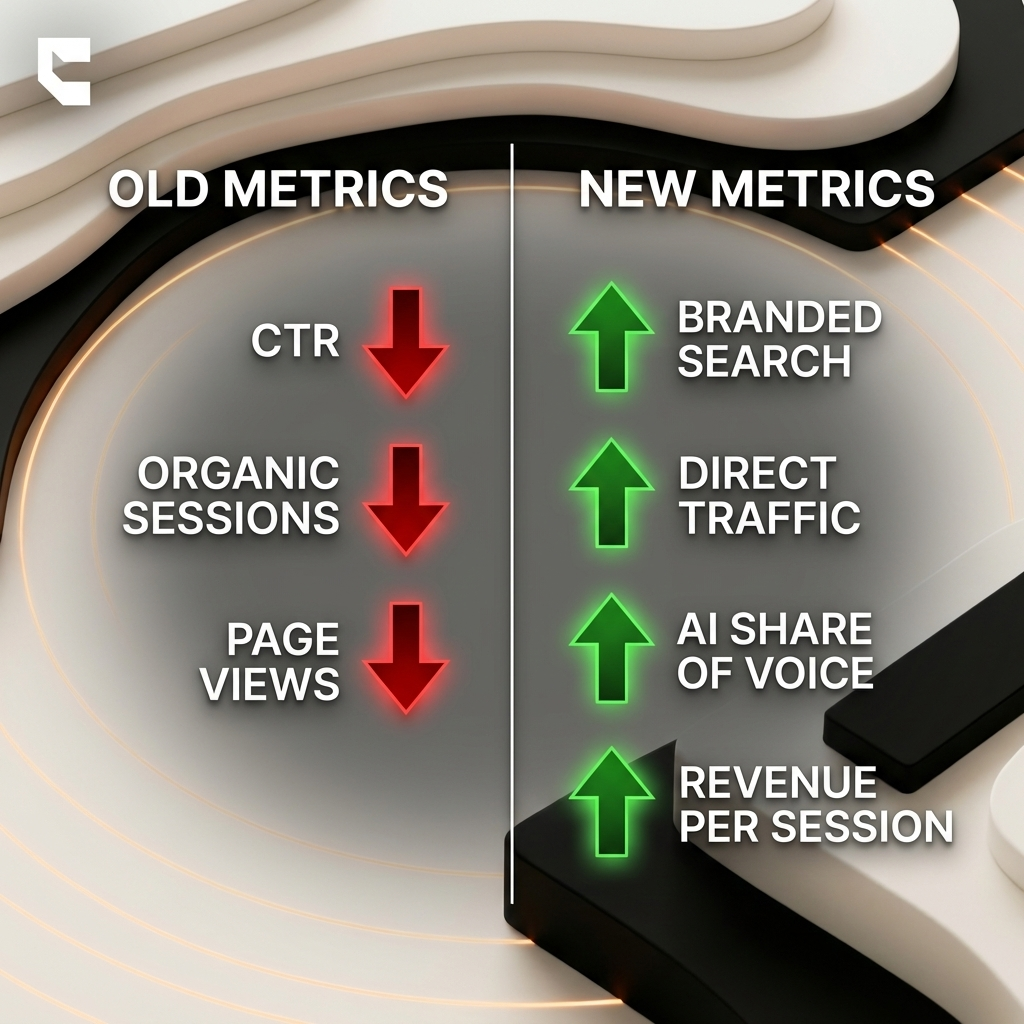
Stop reporting traffic drops to your leadership team. Start reporting the metrics that correlate directly with revenue growth.
The 5-Step Zero-Click Search Strategy Framework
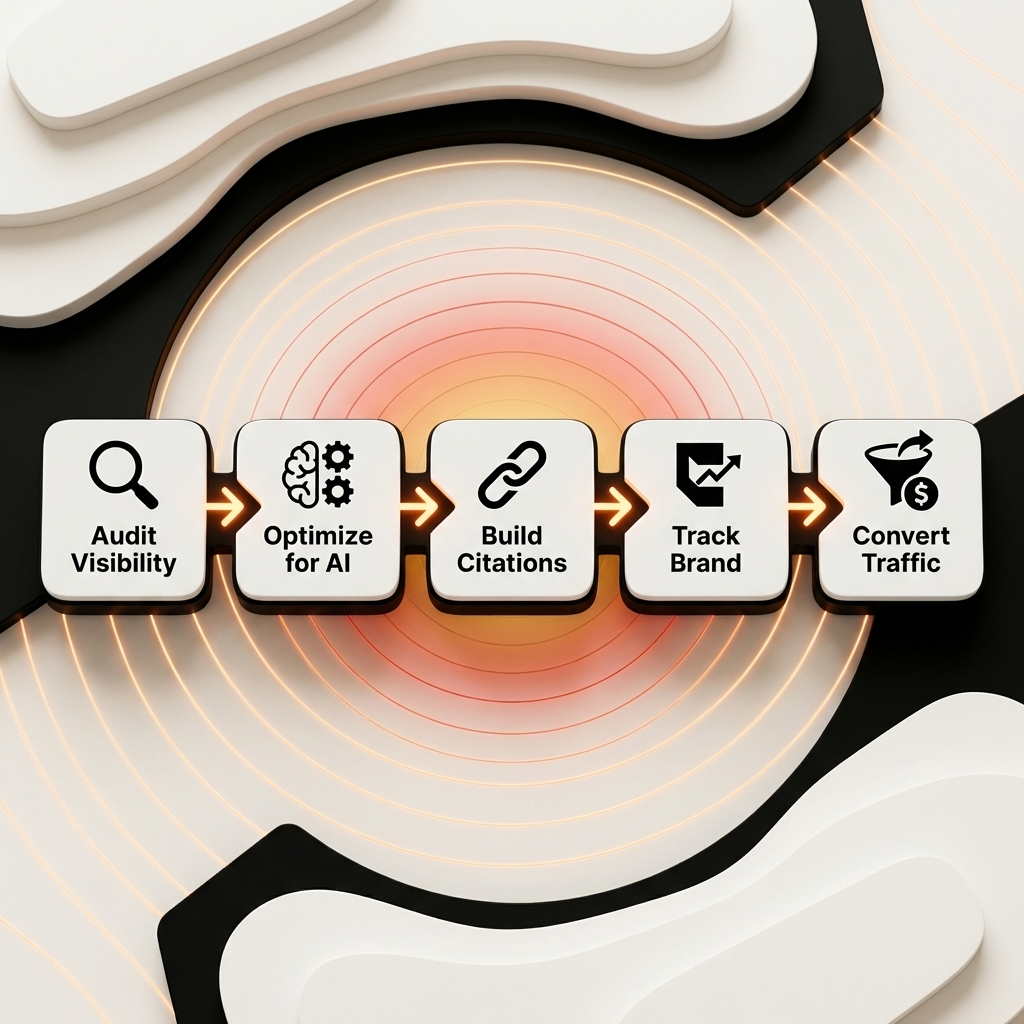
Win zero-click search by auditing AI visibility, optimizing for recommendations over rankings, building citation-worthy content, tracking brand metrics, and creating conversion paths.
1. Audit AI visibility across platforms Open ChatGPT and ask for the best tool in your category. If you aren't in the answer, you have a visibility gap. Check Perplexity and Google's AI Overviews for your core terms. Test negative queries about your competitors. Test broad category questions. Identify exactly where the AI ignores you.
2. Optimize for recommendations, not rankings Structure your content to be cited. Answer highly specific questions. Provide original data that language models can easily parse and reference. This follows core Generative Engine Optimization principles. Get the full process in our AI visibility playbook and see how to format your site architecture. Formatting matters. Use clear bullet points. Write direct, unambiguous sentences.
3. Build citation-worthy content with original data AI models prioritize sources that offer unique statistics. Publish original surveys. Share proprietary industry benchmarks. Create a unique methodology that other sites haven't covered. When you publish a survey of 500 executives, the AI must cite your brand when asked about executive priorities.
4. Track brand metrics, not click metrics Shift your focus to the measurement framework outlined in the previous section. Tie your reporting back to revenue, direct traffic, and branded search volume. Educate your executive team on the difference between a vanity metric and a conversion metric.
5. Create conversion paths for brand-aware visitors These users will arrive via branded search. Your site must convert them immediately. Build a dedicated landing page for visitors who heard about you from an AI. Streamline your demo booking process. Put your trust signals front and center. This is especially critical if you are implementing AI visibility for new brands to capture early adopters.
How Does Zero-Click Search Affect Different Industries?
Zero-click search affects SaaS through demo pipeline shifts, ecommerce through product recommendation placement, and B2B through vendor shortlist positioning in AI responses.
SaaS companies now see their demo pipeline coming directly from AI recommendations. Hamming.ai reported that 40% of their demos originated from Reddit or AI search platforms. Buyers ask AI for the best software and book a call with the winning recommendation. The cost of customer acquisition drops when AI handles the qualification process.
Ecommerce brands face a similar reality. Product recommendations in an AI response act as prime digital shelf placement. The UV Blocker results prove this playbook works for physical goods. A consumer asking for a durable travel umbrella doesn't want to browse twenty Amazon listings. They want one authoritative answer.
B2B purchasing is changing too. AI-generated vendor shortlists are replacing expensive analyst reports. When a VP of Operations asks ChatGPT for the best enterprise logistics vendors, your absence means you are excluded from the consideration set. You don't get an RFP. You don't get a phone call. The buyer never knows you exist.
Frequently Asked Questions About Zero-Click Search Strategy
These are the most common questions marketers ask about zero-click search strategy and how to adapt.
What percentage of searches are zero-click in 2026?
58.5% of U.S. Google searches end without a click, according to SparkToro research, and this rate increases with AI-generated summaries.
The Bain-Dynata survey found 80% of consumers rely on zero-click results for 40% or more of their searches. AI Overviews and featured snippets accelerate this trend. The transition away from click-based browsing is permanent.
How do you measure ROI from zero-click search?
Measure ROI through branded search volume lifts, direct traffic growth, and conversion rate differences between AI-referred and organic visitors.
Traditional CTR metrics are misleading for zero-click. Track the indirect revenue path from AI mention to brand awareness to branded search or direct visit to conversion. Your CRM and Google Analytics data will show this correlation clearly.
Can small brands compete in zero-click search?
Small brands can compete effectively because AI models prioritize authoritative, specific content over domain authority or ad spend.
UV Blocker, a new ecommerce brand, went from zero to 38K clicks in six months. AI search rewards expertise and original data, not brand size. You can outmaneuver legacy competitors by publishing unique proprietary data and answering specific questions.
Is SEO dead because of zero-click search?
SEO is not dead but its success metrics are evolving from click-through rates toward brand visibility, AI citations, and conversion quality.
Traditional ranking still matters for non-AI queries. But the highest-value searches increasingly flow through AI channels. This makes AI visibility optimization essential alongside SEO. You need both to capture the complete spectrum of modern search intent.
Conclusion
Zero-click search isn't something you simply survive. It is the biggest opportunity in digital marketing right now. The brands winning today stopped chasing clicks and started chasing recommendations.
The proof is undeniable. AI-referred traffic converts 23x higher. UV Blocker doubled their orders. Visitors from AI spend more time and convert 4.4x better. The old playbook of optimizing for a top-of-funnel click is obsolete.
Open ChatGPT right now. Ask it to recommend the best tool in your category. If you aren't in the answer, you've found your biggest growth opportunity.
Ready to turn zero-click into your competitive advantage? Review our pricing and start your AI visibility audit today.