AI Overviews Optimization: How to Get Your Brand Cited in Google's AI Answers
AI Overviews optimization determines whether your brand gets cited in Google's AI answers. Learn the 5 ranking factors, audit steps, and proven tactics to earn AIO citations in 2026.
Tanush Yadav
February 26, 2026 · 14 min read
- What Are AI Overviews and Why Do They Matter for Brand Visibility?
- What Are the 5 Ranking Factors That Determine AI Overview Citations?
- How Does AI Overviews Optimization Differ Across AI Platforms?
- How Do You Audit Your Current AI Overview Presence?
- What Mistakes Hurt AI Overview Visibility Most?
- Frequently Asked Questions About AI Overviews Optimization
- Conclusion
TL;DR: AI Overviews appear in 30-60% of Google searches, and pages cited in them earn 35% more organic clicks. Uncited pages lose up to 61% of their click-through rate. This guide covers the 5 ranking factors that determine AI Overview citations, a step-by-step audit process, and the common mistakes that destroy visibility.
In 2026, brands face a new reality. Organic click-through rates can plummet by up to 61% when AI Overviews show up in Google search results. That happens even if traditional rankings stay stable. The upside for cited brands is huge, though: pages featured in AI Overviews earn 35% more organic clicks. They also get a remarkable 91% increase in paid clicks. Today, these AI-generated answers appear in 30-60% of Google searches, eating up 75.7% of mobile screen space. The problem is clear: your Google rankings might hold steady, but traffic still drops because Google answers the query before users even scroll.
This guide offers a clear path forward. It spells out the five ranking factors that influence AI Overview citations. It walks through a step-by-step audit process to check current brand visibility, and explains the critical formatting changes needed so Google's AI can actually extract your content. Unlike many resources focused purely on SEO and traffic, this article sees AI Overviews optimization as a vital part of a wider brand visibility strategy. It's one that compounds advantages across all AI search surfaces.
What Are AI Overviews and Why Do They Matter for Brand Visibility?
AI Overviews are Google's AI-generated answer boxes. They pull information from 3-8 sources, showing up right above organic results and grabbing most user attention on the search page.
Google's AI Overviews use a retrieval-augmented generation (RAG) pipeline. Google first pulls potential pages from its huge index. Then, its large language model (LLM) synthesizes a coherent answer from three to eight chosen sources. The tech is complex, but the takeaway is simple: content needs to be both findable and easy to digest.
Recent analysis brings up a critical fact: 99.5% of AI Overview sources come from the top 10 organic results. This makes organic rank a must-have, but it doesn't guarantee citation. Brands must both rank well and format their content effectively. When Google's AI extracts information, it prefers passages between 134 and 167 words. This content has to pass the "island test." That means the passage can stand alone as a complete, coherent answer without needing surrounding context. This idea shows up throughout the article.
The stakes are high. Organic click-through rates can drop by 61% when AI Overviews are present, Seer Interactive noted. On the flip side, pages cited in AI Overviews get a 35% boost in organic clicks and a 91% surge in paid clicks. These numbers highlight a clear reality: being cited means traffic growth, while not being cited means big traffic loss. Understanding the details of AI Overviews, especially compared to traditional search engine optimization (SEO), is key for keeping and growing your digital presence. The differences between traditional SEO and AI search optimization are explored deeply in SEO vs AI search optimization.
Understanding what AI Overviews are brings up the next question: what decides which sources get cited?
What Are the 5 Ranking Factors That Determine AI Overview Citations?
Five factors determine AI Overview citations: semantic completeness, answer-first structure, E-E-A-T authority, schema markup, and content freshness. Semantic completeness correlates strongest with selection.
Factor 1: Semantic Completeness. Content must fully answer the user's query within a single, extractable passage. Wellows.com research, which analyzed over 15,000 search results, shows pages with a vector alignment greater than 0.88 to the query achieve 7.3 times higher selection rates. Practically, that means Google's AI favors content that fully covers a topic in a self-contained way. This is the "island test" in action: does a passage offer a complete answer without needing outside information? Brands need to focus on creating very relevant, focused content blocks.
Factor 2: Answer-First Structure. Between 40% and 61% of AI Overviews use lists or bullet points. This clearly shows a preference for structured content. Present the answer first, then give more context. Google's AI extracts information much more efficiently from clearly organized passages than from dense, single-block paragraphs. For instance, instead of hiding an answer in a long introduction, start a section with a short summary or a direct answer in bullet points, followed by details. That makes content instantly consumable for both users and AI.
Factor 3: E-E-A-T Authority Signals. Verified E-E-A-T (Experience, Expertise, Authoritativeness, Trustworthiness) sources make up 96% of AI Overview citations. For AI Overviews, E-E-A-T means more than just traditional Google ranking signals. This means including detailed author bios, citing expert opinions, adding original research or data, and building a cluster of content with topical authority. These elements together boost the chance of content being picked as an authoritative source by Google's AI.
Factor 4: Schema Markup and Multi-Modal Content. Pages correctly set up with schema markup are three times more likely to get AI citations. Multi-modal content, which mixes text with images, video, and the right schema, achieves 317% higher selection rates. Specific schema types like FAQ, HowTo, Article, Product, and Organization are especially valuable. These give explicit structural signals to Google's AI, making it easier to read and pull out relevant information.
Factor 5: Content Freshness. AI Overviews naturally prefer current information. Articles with old stats or data from past years get pushed down. For competitive queries, updating content monthly is recommended. Keeping content updated with the latest info and trends makes it relevant and boosts its chances of citation.
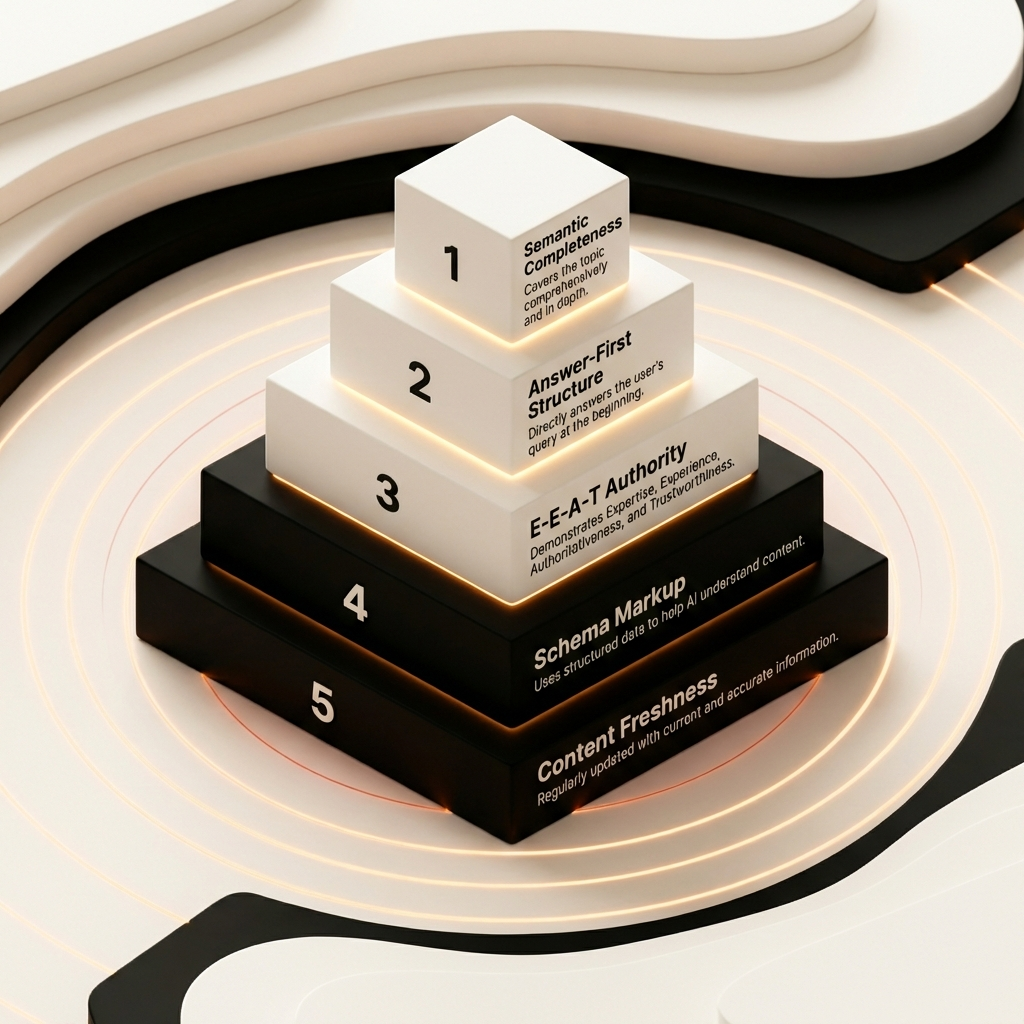
These five factors are the core of AI Overviews optimization. It's part of the wider field of generative engine optimization (GEO). The same ideas apply across all AI search surfaces.
These five factors apply universally, but brands and publishers need different ways to optimize.
How Does AI Overviews Optimization Differ Across AI Platforms?
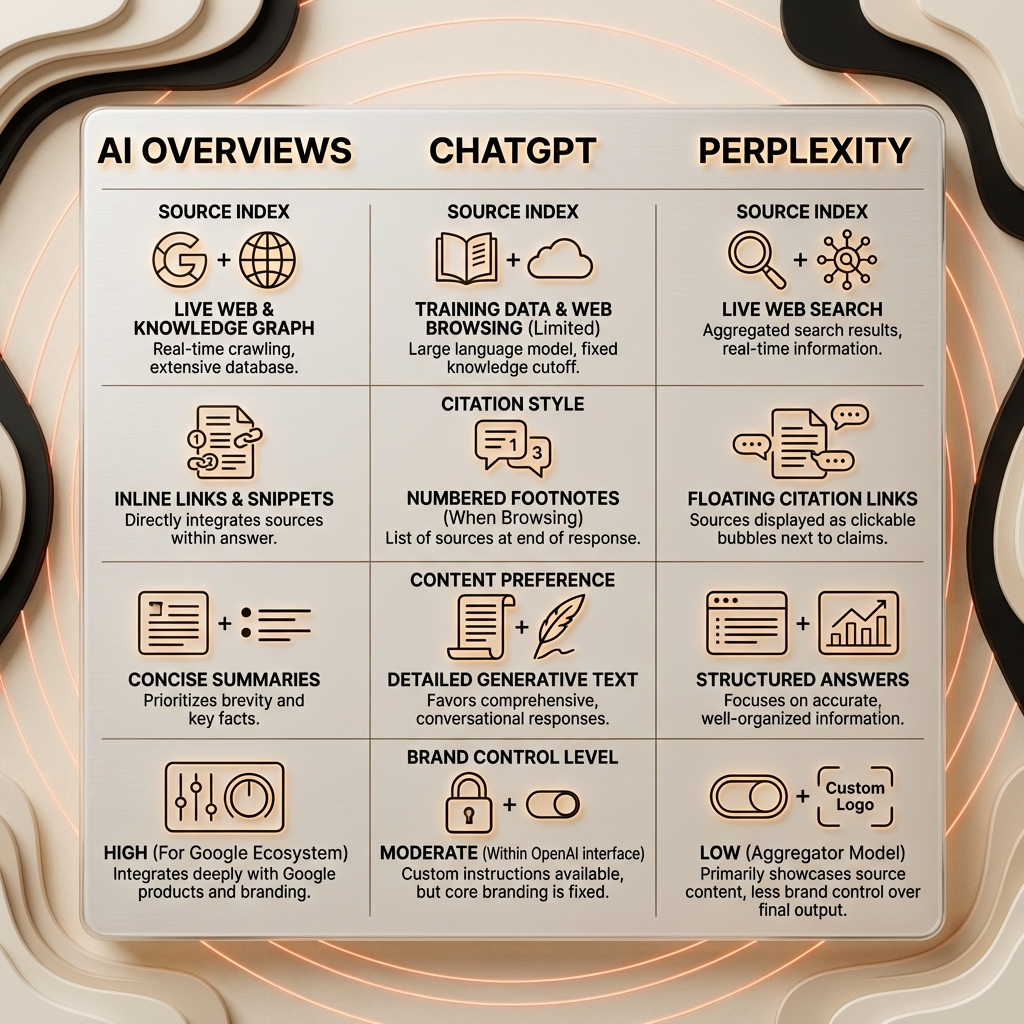
AI Overviews, ChatGPT, and Perplexity each pick and cite sources differently, requiring platform-specific optimization strategies for maximum visibility.
AI Overviews pulls from Google's index, ChatGPT from Bing, and Perplexity uses its own crawler.
AI Overviews are the highest-volume AI search surface, showing up in 30-60% of Google searches. But it gives the least direct control over content submission. Brands can only optimize existing indexed pages. This is different from platforms like Perplexity, where pages can be submitted for crawling.
Observations from Cintra client campaigns show distinct content preferences across platforms. ChatGPT citations often lean towards Reddit threads, forums, and editorial content. AI Overviews, conversely, prioritize authoritative domain pages. Perplexity, using its own crawler along with Bing, cites the most diverse range of source types. This detailed behavior demands a multi-faceted approach to AI visibility.
Good news: cross-platform optimization adds up. Content structured smartly for AI Overview extraction also tends to do better in ChatGPT and Perplexity citations. One well-done optimization effort can bring benefits across all three platforms. For a deep dive into ChatGPT-specific tactics, check out the article on how to get recommended by ChatGPT.
| Dimension | AI Overviews | ChatGPT | Perplexity |
|---|---|---|---|
| Source Index | Google index | Bing + partnerships | Own crawler + Bing |
| Trigger Rate | 30-60% of searches | On-demand (chat) | On-demand (search) |
| Sources Per Answer | 3-8 | 3-6 | 5-15 |
| Citation Style | Inline links below answer | Numbered footnotes | Numbered inline citations |
| Content Preference | Authoritative domains, structured content | Reddit, editorial, forums | Diverse: blogs, docs, forums |
| Update Speed | Days-weeks (index dependent) | Varies by partnership | Hours (own crawler) |
| Brand Control | Low (index-dependent) | Medium (Bing submission) | High (page submission) |
Knowing the factors and platform differences, the next step is auditing where a brand currently stands.
How Do You Audit Your Current AI Overview Presence?
Audit your AI Overview presence by searching your top-traffic keywords in incognito mode and documenting which queries trigger overviews citing your brand.
Search 20-30 of your highest-click keywords. For each, record whether an AI Overview appears and whether your brand is among the cited sources.
Step 1: Export the top 50 keywords from Google Search Console. Filter by clicks, not impressions. That's because these are the queries where traffic loss from AI Overviews will be felt most sharply. Focus on where actual user engagement is happening.
Step 2: Search each keyword using an incognito Chrome browser. For each search, write down three things: (a) does an AI Overview appear? (b) which sources are cited in that overview? and (c) is your brand cited as one of those sources? A simple spreadsheet can track keyword, AI Overview triggered (Y/N), sources cited, and brand cited (Y/N).
Step 3: For any queries where an AI Overview appears but your brand isn't cited, analyze the sources that are cited. What do these competing pages offer that your content doesn't? This is where the five ranking factors become useful. Look for clear answer-first structures, complete meaning in specific passages, and thorough schema use.
Step 4: Prioritize fixes based on traffic impact. Start with the highest-click queries where AI Overviews are prominent and your brand is missing. This approach focuses on fixing the biggest problems first, getting the most return on your optimization efforts. For big brands, tools like Cintra's AI visibility audit can automate this process across hundreds of keywords, giving a full picture.
For a complete audit framework and more advanced techniques, see the full guide on how to measure AI visibility.
The audit points out gaps. Now, let's focus on the mistakes that most often stop AI Overview citations.
What Mistakes Hurt AI Overview Visibility Most?
The most damaging mistakes include blocking Google's AI crawler, publishing thin content without standalone answer passages, missing schema markup, and letting statistics go stale.
Blocking crawlers: Some websites wrongly block Google-Extended (Google's AI training crawler), thinking it stops AI from using their content. This can accidentally reduce AI Overview visibility. Check your robots.txt for commands like "User-agent: Google-Extended / Disallow: /", and remove them if you find them. Letting Google's AI access your site is crucial for citation.
Thin content without semantic completeness: Content that makes users click through multiple pages to find a full answer fails the critical "island test." AI Overviews need a single, self-contained passage that fully answers a query. Don't create many shallow "hub-and-spoke" pages. Instead, put information into comprehensive answer passages that stand alone.
Missing schema markup: FAQ, HowTo, and Article schema make content machine-readable, giving clear signals to Google's AI. Without proper schema, AI Overviews have to guess your content structure, which can cut selection probability by as much as three times. Prioritize using these three impactful schema types: FAQ (for question-and-answer sections), HowTo (for step-by-step instructions), and Article (for general content).
Outdated statistics and data: AI Overviews consistently put content with old data lower in priority. Articles talking about 2023 statistics in 2026, for instance, will be skipped for newer sources. For queries in competitive areas, updating data quarterly ensures all statistics stay current and relevant.
Dense paragraphs without structure: Big blocks of text without clear headers, lists, or tables are tough for AI to read and pull info from. Even very authoritative content can miss out on citations if its formatting makes it hard for AI to read. A quick tip: aim for key answer sections to be within the 134-167 word passage length. That's best for AI extraction.
Avoiding these mistakes and using the 5 ranking factors systematically is what separates brands that appear in AI Overviews from those that don't.
Frequently Asked Questions About AI Overviews Optimization
These are the most common questions brands ask when they start optimizing for AI Overviews. Here are direct answers based on current data and campaign experience.
Do AI Overviews replace organic search results?
No, they don't. AI Overviews show up above organic results but don't replace them. But they do grab a lot of clicks, cutting CTR for uncited organic listings by up to 61%.
Organic results still appear below the AI Overview. The big change is that users who find a good enough answer in the AI Overview might not scroll down to organic results at all, affecting overall traffic.
How fast can a brand start appearing in AI Overviews?
Brands already ranking in the top 10 can earn AI Overview citations within 2-4 weeks. That's after optimizing content structure, schema markup, and answer formatting.
The timing really depends on current organic rankings. If a brand doesn't already rank in the top 10 for a specific query, just optimizing for AI Overviews won't be enough. Organic rank is still a basic requirement for citation.
Does paid search (Google Ads) affect AI Overview citations?
No. Google Ads and AI Overview citations are separate systems. Paid search doesn't influence which organic sources AI Overviews cite, though cited pages do see 91% more paid click-through.
The 91% paid CTR boost for cited pages suggests AI Overview citations build significant brand familiarity. This familiarity makes users more likely to click on branded ads when they appear.
Can small brands compete with large publishers in AI Overviews?
Yes, they can. AI Overviews prefer complete meaning and answer structure over raw domain authority. This lets smaller brands with well-structured content get cited alongside major publishers.
The five ranking factors (semantic completeness, answer-first structure, E-E-A-T, schema, and freshness) are all achievable for smaller brands. Niche topical authority often gives them an edge over broad domain authority for very specific queries.
How does AI Overviews optimization relate to GEO?
AI Overviews optimization is part of generative engine optimization (GEO). GEO covers all AI search surfaces, including ChatGPT and Perplexity, while AIO optimization focuses only on Google's AI answers.
Brands should see AI Overviews optimization as a key part of a broader GEO strategy. The optimization tactics mostly work together; content structured well for AI Overview extraction will also do better across ChatGPT and Perplexity. For a full grasp of this framework, check out the generative engine optimization guide.
Conclusion
AI Overviews optimization requires strong organic rankings plus structured, extractable content to earn citations in Google's AI answers.
AI Overviews are the biggest, most impactful AI search surface. They show up in 30-60% of Google searches. Success in this new world depends on two things: keeping strong organic rankings (a must-have for 99.5% of AI Overview sources) and smartly optimizing content for AI extraction (what makes you stand out). The five actionable ranking factors (semantic completeness, answer-first structure, E-E-A-T, schema, and content freshness) are all things brands can control. Crucially, content optimized for AI Overviews gives compound returns, boosting visibility and performance across ChatGPT and Perplexity at the same time. Brands that adopt this strategy now will gain a significant edge through 2026 and beyond.
Your immediate action: run the 4-step AI Overview audit on your top 10 keywords this week. Knowing exactly where your brand stands is the crucial first step before any optimization can begin. For a full implementation roadmap, see the AI visibility playbook.
For brands looking to speed up this process, Cintra offers full AI visibility audits. These map AI Overview presence across hundreds of keywords and create detailed optimization roadmaps. Book a free audit.