AI Visibility for Finance: The Compliance-First Playbook
AI visibility for finance gives regulated brands a citation advantage. Learn the 5-step framework to get banks, fintechs, and wealth managers cited by AI search.
March 22, 2026 · 13 min read
- Why Is Finance Facing an AI Search Reckoning?
- What Makes AI Visibility Different for Financial Services?
- How Does Compliance Become an AI Visibility Advantage?
- The Finance AI Visibility Framework
- How Does AI Visibility Differ Across Financial Segments?
- What Results Can Financial Brands Expect from AI Visibility?
- Frequently Asked Questions About AI Visibility for Finance
TL;DR: Finance organic traffic is falling as consumers shift to AI platforms for advice. Affiliate publishers currently dominate AI citations for financial products. But regulated content has a hidden advantage: AI models prefer verified, credentialed, disclosure-rich institutional sources. Financial brands that adopt a compliance-first AI visibility framework can reclaim that lost traffic.
Organic search traffic is declining across financial services as AI platforms absorb more queries. In the same period, AI-generated referrals to websites surged 357% year over year.
Over 51% of consumers now use AI for financial advice. But most financial brands are invisible in those answers. Affiliate publishers like NerdWallet and Bankrate capture over 60% of AI citations for financial queries. Your competitors' content is being cited while your institution doesn't appear.
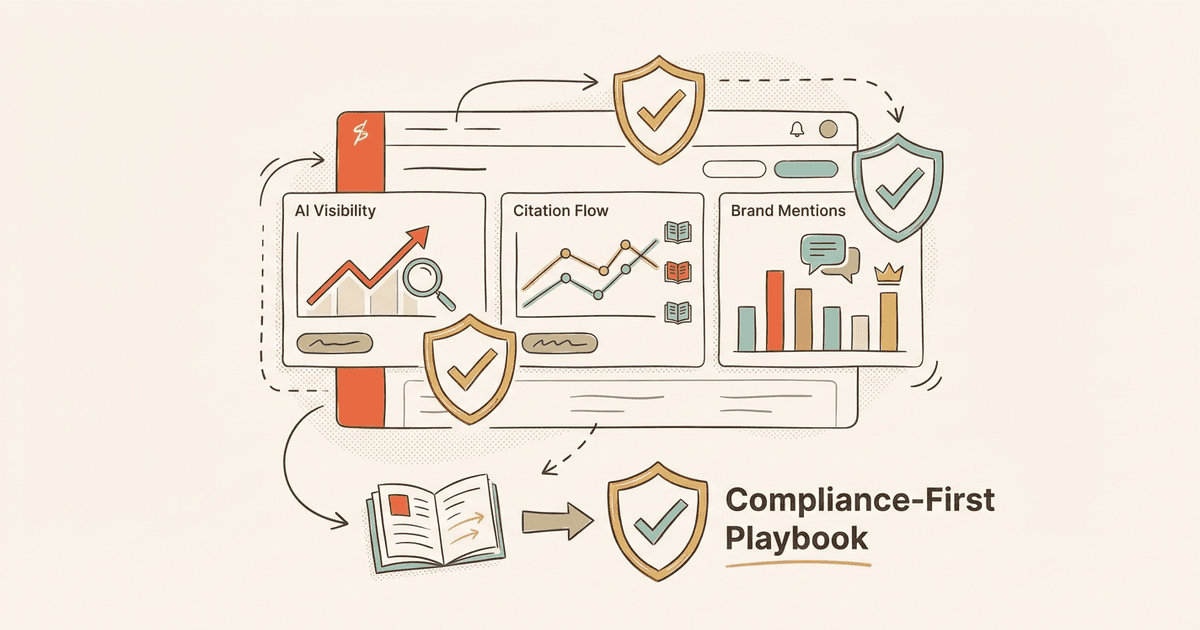
This guide provides a compliance-first framework that turns regulatory constraints into a permanent competitive moat for AI citations.
Why Is Finance Facing an AI Search Reckoning?
Financial services faces a perfect storm: organic search traffic declining while AI referrals surge 357% and consumers shift financial research to AI platforms.
The numbers tell a stark story. Organic search traffic across top US websites dropped 2.5% year over year, with financial services hit harder than most verticals. In that same period, AI referrals exploded by 357%. The audience has moved. They aren't typing fragmented keywords into a search bar and scrolling past sponsored ads anymore.
When someone asks ChatGPT for the best savings account, whose answer shows up? JD Power found that 51% of consumers now rely on AI for financial advice. A user who once searched Google for "best mortgage rates" and opened six tabs now tells an AI model their credit score, zip code, and income, asking for a customized lending strategy. The AI synthesizes the answer instantly.
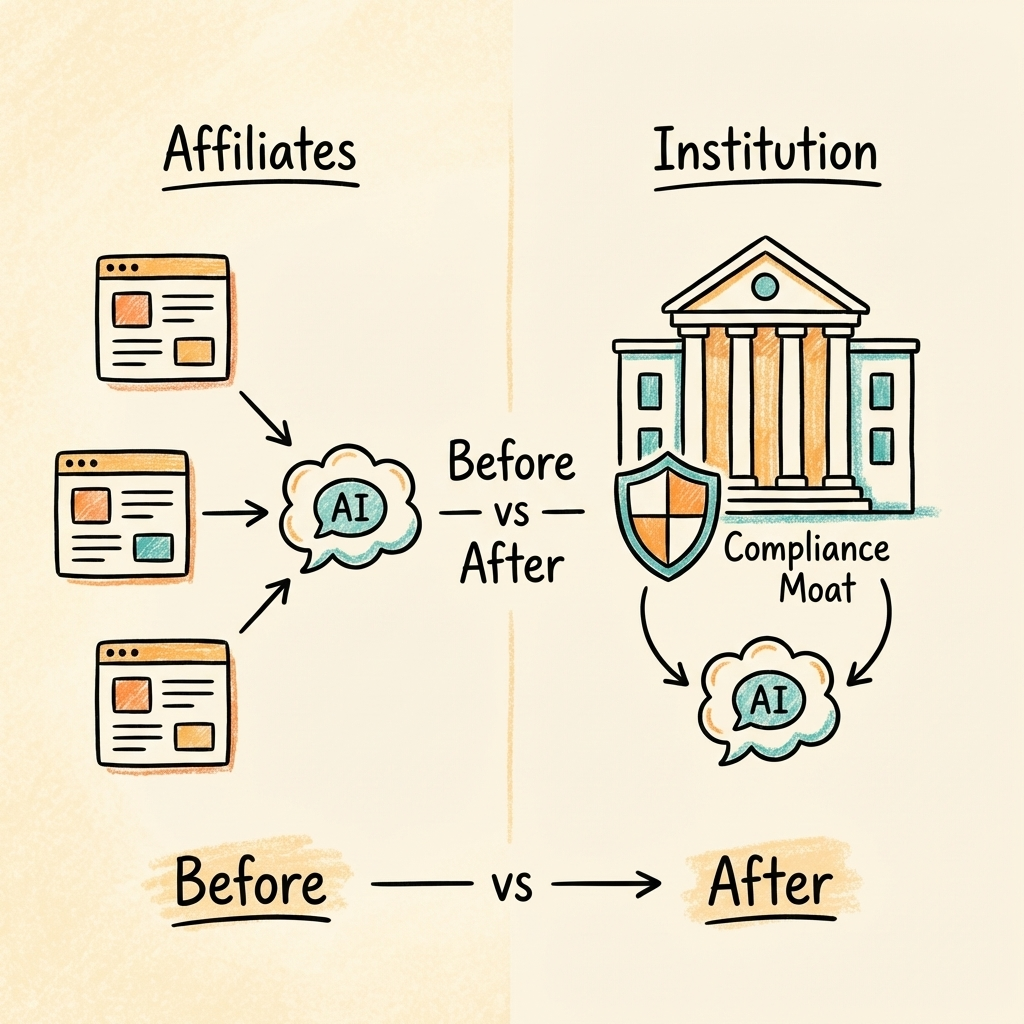
This behavioral shift created the affiliate gatekeeper problem. Publishers like NerdWallet, Bankrate, and Forbes Advisor capture over 60% of AI citations for financial queries. Financial brands possess the actual product expertise and the underlying financial vehicles. But affiliates get cited because they've structured content for AI extraction. You own the financial product, but they own the AI visibility.
Different platforms handle these queries differently too. Gemini favors institution pages and primary sources. ChatGPT and Perplexity lean toward publisher content and comparison reviews. This platform divergence means standard search optimization tactics no longer apply.
What Makes AI Visibility Different for Financial Services?
Financial content faces triple barriers in AI search: YMYL classification demands higher trust signals, compliance limits content flexibility, and affiliates dominate citation share.
Google and AI models classify finance as Your Money or Your Life (YMYL). This classification triggers strict trust thresholds. A generative engine will synthesize a recipe for banana bread from an unverified blog without hesitation. But it restricts its outputs when a user asks about 401k allocations or tax-loss harvesting. AI models require a higher bar for sourcing and factual accuracy before surfacing a financial answer. Proving E-E-A-T for AI search through verifiable trust signals becomes non-negotiable.
Compliance constraints compound this challenge. FINRA and SEC disclosure requirements make financial brands slower to publish. Marketing teams often view compliance as the enemy of content velocity. They hesitate to make firm claims or publish detailed comparisons. This caution leaves an information vacuum that unregulated affiliates gladly fill.
The affiliate gatekeeper problem thrives in this regulatory vacuum. Comparison sites build entire business models around intercepting financial queries. Understanding how different AI platforms select their sources is critical to breaking through.
| AI Platform | Preferred Source Type | Citation Pattern | Finance Implication |
|---|---|---|---|
| ChatGPT | Publisher reviews, comparison articles | Cites NerdWallet, Bankrate, Forbes Advisor | Affiliates dominate |
| Perplexity | Diverse (publishers + institutions) | Multi-source with inline citations | Best opportunity for institutions |
| Google AI Overviews | Mix of institution + publisher | Favors entities with strong E-E-A-T | Compliance content wins here |
| Gemini | Institution pages, official docs | Prefers primary sources | Natural fit for banks and fintechs |
These barriers look like disadvantages to traditional marketing teams. They're actually the opposite. Financial institutions possess assets that affiliates can't replicate. A strategy centered on generative engine optimization lets you leverage those unique assets to reclaim your visibility.
How Does Compliance Become an AI Visibility Advantage?
Regulated financial content with proper disclosures, verified data, and credentialed authors is what AI models prioritize for citations. Compliance is a moat, not an obstacle.
AI models trust content built on verified data sources. They look for credentialed authors. They scan for proper disclosures and regulatory citations. Compliant financial content already has all of these elements. Your compliance teams produce what AI models want to extract.
This flips the standard narrative. Your compliance-approved content already passes the strict trust bar that competitors spend months trying to build. You don't need to invent authority or manufacture trust signals. You need to expose your existing institutional authority to the right language models.
Regulators are paying close attention to this shift. FINRA's 2026 Annual Regulatory Oversight Report flagged GenAI as a priority area. Financial brands that build compliant, AI-visible content now get ahead of both competitors and regulators. Proactive positioning creates a real first-mover advantage while competitors wait for clarity.
Credentialed author bylines act as immediate, verifiable trust signals. A Chartered Financial Analyst (CFA) or Certified Financial Planner (CFP) carries significant weight. A Series 7 license proves deep expertise. AI models can verify these credentials by cross-referencing public databases. They prefer to cite credentialed authors over anonymous ghostwriters on affiliate blogs. Your internal experts are your greatest AI asset.
Proper disclaimers don't hurt citability either. They increase trust signals. A detailed fee disclosure or specific risk warning tells the AI model that your page is a primary, authoritative source. Compliance gives you the raw ingredients. Our framework shows you how to assemble them.
The Finance AI Visibility Framework
Our five-step finance AI visibility framework covers citation auditing, golden record creation, structured data, compliance-first content, and cross-platform monitoring.
We developed this approach to help regulated brands capture AI citations predictably. The process structures your existing institutional authority so language models can parse and extract your data.
Step 1: Audit AI Citations Across Platforms
Map which queries surface affiliates versus your institution. Open an incognito window. Ask ChatGPT, Perplexity, and Gemini target questions like, "What is the best high-yield savings account right now?" Track who gets cited. This baseline audit reveals your citation deficit and shows where affiliates are intercepting your potential customers.
Step 2: Build the Golden Record
A golden record is the single authoritative source that AI should cite for your institution. Ensure your official disclosures, ADV filings, and rate sheets serve as the canonical reference points. When you centralize these documents and link them logically, AI models recognize your domain as the primary source of truth. They stop relying on third-party aggregators to explain your products.
Step 3: Structure Financial Content for Extraction
Language models need structural help reading complex financial documents. Implement schema markup for AI visibility to highlight rate tables, fee comparisons, and product terms. Structured data translates dense compliance documents into machine-readable format that AI engines extract for direct answers. Use proper JSON-LD formatting for all financial products.
Step 4: Create Compliance-First Expert Content
Deploy content authored by credentialed experts. A CFA writing a detailed guide about portfolio allocation beats a generic NerdWallet article in AI trust signals. Ensure every claim is verifiable and accompanied by necessary disclaimers. Don't hide compliance text at the bottom of the page in tiny font. Format it clearly so AI engines recognize the regulatory rigor of your content.
Step 5: Monitor Per-Platform Visibility
Citation rates fluctuate as models update their training data. Track your citations across all major platforms. The financial sector sees significant platform divergence. A strategy working well on Gemini might fall flat on ChatGPT. Consistent monitoring of how to measure AI visibility lets you adapt to these shifts.

The framework applies across the financial sector. But each segment requires different tactical emphasis.
How Does AI Visibility Differ Across Financial Segments?
Each financial segment faces different AI visibility dynamics: retail banking competes with rate aggregators, wealth management needs thought leadership, and fintech wins with product comparisons.
Financial services isn't a single monolith. The strategy you deploy depends on your vertical and the types of questions your audience asks AI models. We segment our approach to match the unique citation patterns of each sub-industry.
Retail Banking
Retail banking faces the steepest competition from established rate aggregators. Queries center on interest rates, account maintenance fees, and local branch access. Focus on product-specific structured data. Organize rate tables and fee schedules so models can extract the numbers cleanly. Local authority signals also help regional banks capture high-intent "near me" AI queries.
Wealth Management
AI queries in wealth management trend toward complex, educational content. High-net-worth individuals ask Perplexity about tax-loss harvesting rules or trust structures. Wealth managers should publish credential-heavy thought leadership. Content authored by verified CFAs and CFPs gets cited because AI models require maximum trust signals for complex wealth preservation queries.
Fintech
Fintech remains the most competitive segment for AI citations. Users constantly ask AI models to compare new financial apps against legacy systems. Product comparison content drives the majority of citations here. Deep, technical integration documentation and clear feature matrices are essential. Ensure your API documentation and security protocols are readable by language models.
Insurance
Quote-comparison queries dominate the insurance landscape. Users want AI to tell them who offers the cheapest premium for specific coverage needs. Structured policy comparison content wins these citations. Break down coverage limits, exclusions, and deductibles into clean, machine-readable tables.
| Financial Segment | Core Query Intent | Primary Competitors | Required Content Structure |
|---|---|---|---|
| Retail Banking | Rate and fee comparisons | Aggregators (Bankrate) | Structured rate tables, local schema |
| Wealth Management | Strategic advice, tax info | Financial news publishers | Credentialed thought leadership |
| Fintech | Tool comparison, integrations | Software review sites | Feature matrices, API documentation |
| Insurance | Policy quotes, coverage limits | Comparison engines | Structured coverage breakdowns |
These strategies aren't theoretical. Here's what the data shows when financial brands invest in AI visibility.
What Results Can Financial Brands Expect from AI Visibility?
AI-referred visitors convert at 14.2% for fintech versus 2.8% for Google organic, and ChatGPT drives 78% of all AI referral visits to financial sites.
The business case for capturing AI citations is strong. UpGrowth data shows AI referral traffic converts at 14.2% in the fintech space. Standard Google organic traffic converts at 2.8%. That's a 5x conversion advantage. Users arrive from AI citations with a direct, personalized recommendation from a source they trust. Every citation your competitors get is high-intent revenue you're losing.
Volume is also consolidating. ChatGPT accounts for 77.97% of all AI referral traffic according to SE Ranking's analysis of nearly 64,000 websites. Optimizing for ChatGPT's specific citation preferences is no longer optional for financial growth teams.
We see these results consistently across regulated industries. The AI visibility ROI compounds quickly once foundational trust signals are in place. We helped Hamming.ai achieve 8.5x organic traffic in 12 weeks using this methodology. The same framework that scales AI visibility for SaaS applies to financial services when you add the compliance layer.
Sales velocity improves rapidly too. UV Blocker doubled their weekly orders in 1.5 months after deploying our visibility framework. The underlying principles remain identical. Whether we're optimizing AI visibility for healthcare or wealth management, structuring verified data for language models drives outsized returns.
Ready to capture AI visibility for your financial brand?
Frequently Asked Questions About AI Visibility for Finance
Financial marketers have specific questions about applying AI visibility in a regulated environment. Here are the most common ones.
Does FINRA Regulate AI-Optimized Content?
FINRA doesn't specifically regulate AI-optimized content, but its advertising rules apply to any customer-facing financial communication regardless of channel.
Any content designed for AI extraction still falls under FINRA Rule 2210 regarding communications with the public. Consult your compliance team when structuring new digital assets. They can ensure disclosures remain intact while optimizing for extraction.
Which AI Platform Matters Most for Financial Services?
ChatGPT drives 78% of AI referral visits, but Perplexity and Gemini offer better opportunities for institutional citations in financial queries.
Different stages of the buyer journey require different platforms. ChatGPT wins on consumer volume, but Gemini's preference for primary sources makes it a critical target for established banks and credit unions.
How Do Financial Brands Compete with NerdWallet in AI Citations?
Financial institutions compete by deploying assets that affiliates can't replicate: credentialed authors, official regulatory filings, proprietary rate data, and verified institutional authority.
Building a proper golden record ensures AI models see your domain as the primary source of truth. This strategy bypasses the affiliate middlemen.
How Long Does AI Visibility Take for Regulated Industries?
Initial citation improvements appear within 4-8 weeks, but the compliance-first approach compounds over time as AI models increasingly prioritize verified institutional sources.
Our cross-vertical data supports this timeline. We helped Hamming.ai see 8.5x traffic results in 12 weeks. The compounding effect of trust signals accelerates growth over time.
Can Wealth Management Firms Use AI Visibility?
Wealth management firms benefit significantly from AI visibility because high-intent queries like "best wealth management strategies" increasingly route through AI platforms.
These firms possess the type of credentialed experts (CFAs, CFPs) that AI models actively seek out. They're well-positioned to capture complex financial queries.
Conclusion
The search landscape has changed for financial services. Brands face a critical choice as organic traffic declines and AI referrals surge.
- Finance organic traffic is falling while high-converting AI referrals increase across every segment.
- Compliance is a structural moat. Regulated content is what AI models prefer to cite.
- The five-step framework (audit, golden record, structured data, expert content, monitoring) works across all financial segments.
- First movers capture the 14.2% conversion advantage while competitors remain invisible.
Audit your AI citations today. Ask ChatGPT, Perplexity, and Gemini about your product category and see who gets cited. The results will reveal your immediate revenue gaps.
See how Cintra helps financial brands capture AI visibility across every platform.