Schema Markup for AI Visibility: The Technical Guide Most Agencies Get Wrong
Schema markup for AI visibility works through indirect pathways, not direct parsing. Learn the 6 schema types, JSON-LD code examples, and platform-specific strategies that drive AI citations.
Tanush Yadav
March 9, 2026 · 13 min read

Table of Contents
- Why Does Schema Markup Matter for AI Visibility?
- How Does AI Actually Use Your Structured Data? (The Schema Paradox)
- Which Schema Types Drive the Most AI Citations?
- How Do ChatGPT, Perplexity, and AI Overviews Handle Schema Differently?
- Why Does Visible Text Plus Schema Outperform Either Alone?
- How Do You Add AI-Optimized Schema to Your Site?
- What Schema Mistakes Kill AI Visibility?
- Frequently Asked Questions About Schema Markup for AI Visibility
- Conclusion
Pages with proper schema markup get cited 50% more often by AI systems, according to research analyzing 500+ intercepted AI sessions. But not for the reason most people think. Most guides say to add JSON-LD so AI can read your data. That assumption is wrong.
This guide explains how schema markup for AI visibility actually works — through indirect pathways feeding AI systems. We provide the six highest-impact schema types with copy-paste JSON-LD code. You'll also get platform-specific implementation steps for WordPress, Shopify, and custom sites.
We address the Schema Paradox head-on. Understanding this mechanism is what separates effective implementation from cargo-cult SEO.
For the foundations, check our AI visibility primer. The broader framework lives in our generative engine optimization guide, where schema is one of many GEO tactics — this article is the deep dive.
Why Does Schema Markup Matter for AI Visibility?
Schema markup matters for AI visibility because it improves how search engines index, categorize, and surface your content to AI systems generating answers.
Pages with schema get cited 42% of the time by AI platforms. Pages without? Just 28%, per the same Dev.to research. That gap compounds over thousands of queries. Structured data gives your content a 2.5x higher chance of appearing in AI-generated answers.
BrightEdge found a 44% increase in AI search citations when sites combined structured data with FAQ blocks. And 72% of first-page results already use schema. If your site lacks it, you're behind the baseline — not ahead of it.
Schema evolved from a rich snippet enhancer into core AI citation infrastructure. The shift happened as AI systems began pulling from Knowledge Graphs built on structured data.
These numbers make a strong case for implementation. But the mechanism behind them isn't what you've been told.
How Does AI Actually Use Your Structured Data? (The Schema Paradox)

Here's the thing nobody talks about: ChatGPT, Perplexity, and Claude don't actually read your JSON-LD when they visit a page. The citation boost from schema comes through a back door — better indexing feeds Knowledge Graph inclusion, which feeds the AI.
SearchVIU dropped a bombshell in October 2025 that rewrites everything you thought about schema and AI. When they tested it, AI chatbots flat-out ignored JSON-LD during page visits. They grabbed text from what's visible on screen — nothing else. Mark Williams-Cook took this further. He stuffed fake, nonsensical data into a page's schema. What happened? ChatGPT and Perplexity pulled the fake info straight from the visible page text, never even glancing at the structured markup.
So why does schema still drive results? The indirect pathway:
- Schema improves indexing quality (search engines understand your content better)
- Better indexing leads to Knowledge Graph inclusion
- Knowledge Graph entities feed AI training data and retrieval systems
- Your content ends up in the AI's knowledge base
For more on this Knowledge Graph connection, see our Google AI Overviews optimization guide.
Gartner reports that Knowledge Graphs improve LLM output quality by 300%. Google's Knowledge Graph holds over 500 billion facts — largely fed by structured data. Your JSON-LD isn't a direct message to ChatGPT. It's a long-term deposit into the foundational databases powering generative models.
Now that we understand the real mechanism, which schema types should you prioritize?
Which Schema Types Drive the Most AI Citations?
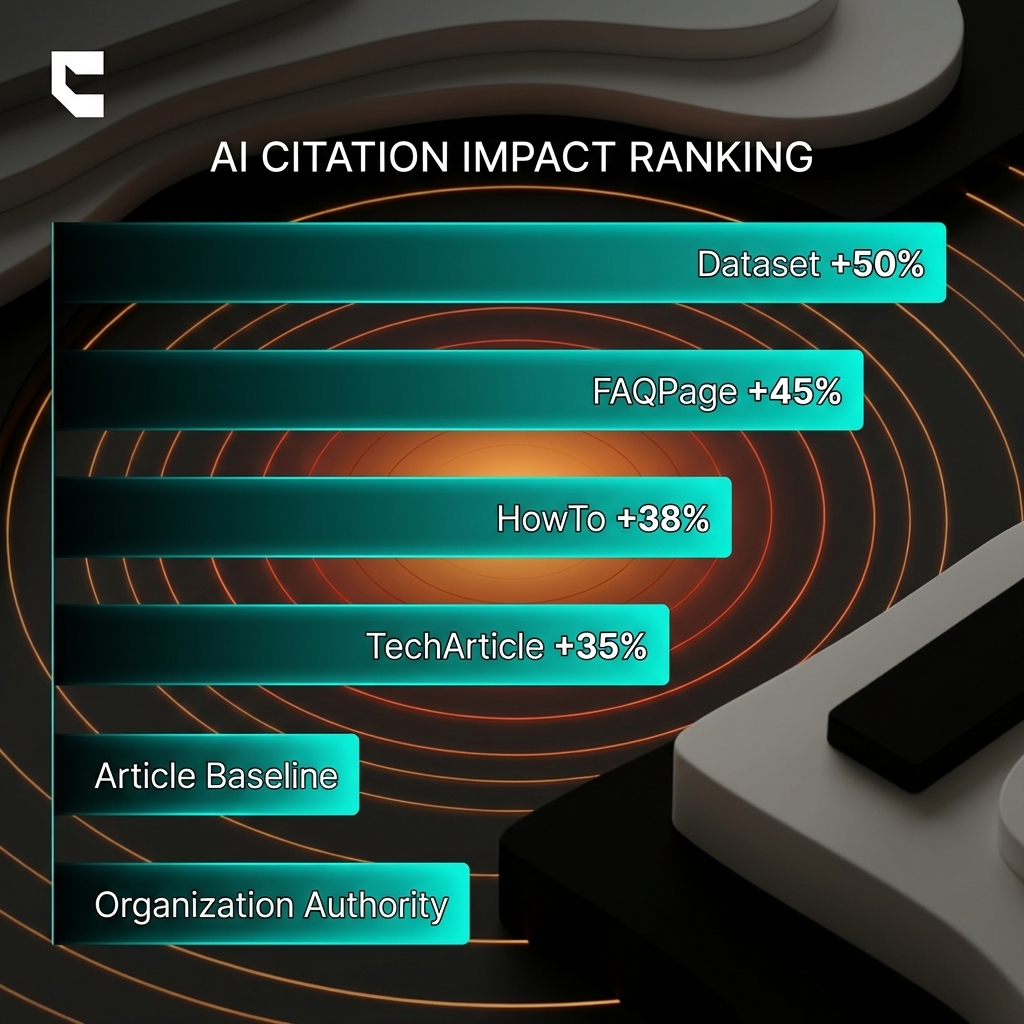
Six schema types have the highest measured impact on AI citations: Dataset, FAQPage, HowTo, TechArticle, Article, and Organization, each with distinct benefits.
William C. dug into 500+ intercepted AI sessions and published the findings on Dev.to. The ranking is clear:
1. Dataset (+50% citation rate) If you publish original data or research, this one's for you. Biggest citation lift in the entire study.
{
  "@context": "https://schema.org",
  "@type": "Dataset",
  "name": "Global AI Adoption Statistics 2026",
  "description": "Enterprise AI integration rates across industries.",
  "creator": {
    "@type": "Organization",
    "name": "TechResearch Inc"
  },
  "distribution": {
    "@type": "DataDownload",
    "encodingFormat": "CSV"
  },
  "license": "https://creativecommons.org/licenses/by/4.0/"
}
2. FAQPage (+45% citation rate) You're giving AI a ready-made answer to a ready-made question. Hard to beat that.
{
  "@context": "https://schema.org",
  "@type": "FAQPage",
  "mainEntity": [{
    "@type": "Question",
    "name": "What is AI visibility?",
    "acceptedAnswer": {
      "@type": "Answer",
      "text": "AI visibility measures how often a brand gets cited by AI systems in generated responses."
    }
  }]
}
3. HowTo (+38% citation rate) Tutorials and process content do well here — AI pulls step sequences naturally.
{
  "@context": "https://schema.org",
  "@type": "HowTo",
  "name": "How to Implement JSON-LD Schema",
  "step": [{
    "@type": "HowToStep",
    "name": "Generate Code",
    "text": "Write the JSON-LD script block with required properties."
  }]
}
4. TechArticle (+35% citation rate) Tells search engines "this is written by someone who knows what they're talking about."
{
  "@context": "https://schema.org",
  "@type": "TechArticle",
  "headline": "Advanced Schema Implementation",
  "author": {"@type": "Person", "name": "Jane Doe"},
  "datePublished": "2026-03-09",
  "proficiencyLevel": "Expert",
  "dependencies": "JSON-LD knowledge"
}
5. Article (Baseline) Everyone has this one, but most people leave it half-filled. The difference is in completing every field.
{
  "@context": "https://schema.org",
  "@type": "Article",
  "headline": "The Future of AI Search",
  "author": {"@type": "Person", "name": "John Smith"},
  "datePublished": "2026-03-09",
  "publisher": {"@type": "Organization", "name": "Search News Hub"}
}
6. Organization (Authority) This is how Google connects your content to your brand as a known entity.
{
  "@context": "https://schema.org",
  "@type": "Organization",
  "name": "Cintra",
  "url": "https://cintra.run",
  "sameAs": [
    "https://twitter.com/cintra",
    "https://linkedin.com/company/cintra"
  ]
}
| Schema Type | Citation Lift | Best For | Implementation Difficulty |
|---|---|---|---|
| Dataset | +50% | Research, data-heavy content | Medium |
| FAQPage | +45% | Any page with Q&A | Easy |
| HowTo | +38% | Tutorials, guides | Easy |
| TechArticle | +35% | Technical documentation | Medium |
| Article | Baseline | Blog posts, news | Easy |
| Organization | Authority | About pages, homepage | Easy |
The schema you choose matters — but so does which AI platform you're targeting.
How Do ChatGPT, Perplexity, and AI Overviews Handle Schema Differently?
Not all AI platforms treat your schema the same way. Google AI Overviews leans hard on the Knowledge Graph, ChatGPT gets a boost from better indexing, and Perplexity's crawl-first model makes indexing quality the bottleneck.
Google AI Overviews uses Knowledge Graph data extensively — and schema feeds this graph directly. Search Engine Land ran a controlled experiment: only the page with well-implemented schema appeared in AI Overviews, ranking as high as Position 3.
ChatGPT reads visible text during live retrieval (confirmed by the Williams-Cook experiment). It benefits from schema through improved indexing and Knowledge Graph inclusion that feeds training data over time. More on this in our guide to getting recommended by ChatGPT.
Perplexity relies on an index-first approach with just a 12.5% extraction rate without proper indexing. Schema improves your indexing quality, making Perplexity far more likely to find and cite your content.
| Platform | Schema Parsing | Primary Benefit | Priority Schema Types |
|---|---|---|---|
| Google AI Overviews | Via Knowledge Graph | Direct entity recognition | Organization, Article, FAQPage |
| ChatGPT | Indirect (training) | Better indexed content in training data | Article, FAQPage, TechArticle |
| Perplexity | Indirect (indexing) | Improved crawl and extraction | Article, HowTo, Dataset |
Platform targeting matters. But regardless of which AI system you're optimizing for, one strategy consistently outperforms everything else.
Why Does Visible Text Plus Schema Outperform Either Alone?
Combining schema markup with matching visible text content outperforms either approach alone because AI reads your text while search engines read your schema.
Here's the principle from SearchVIU's research: AI chatbots read visible HTML text, not your hidden JSON-LD. Search engines read both. The dual approach covers both pathways simultaneously.
Practical example: don't just add FAQPage schema to your header. Also display the FAQ visibly on the page. Before: FAQ schema hidden in the head, no visible FAQ section. After: FAQ schema AND a visible FAQ section with identical question-answer pairs. The schema feeds the Knowledge Graph. The visible text feeds AI retrieval.
This same principle applies across every schema type. Pair HowTo schema with a visible step-by-step tutorial on the page. Pair Article schema with a visible author bio and clear publish date. Pair Organization schema with a visible about section.
Many sites implement perfect schema but see zero AI citation improvement. The reason? They add the markup but hide the equivalent information from the visible page. The dual strategy isn't optional — it's the whole game.
How Do You Add AI-Optimized Schema to Your Site?
Add AI-optimized schema through CMS plugins (Yoast or Rank Math for WordPress), Shopify apps or theme.liquid injection, or manual JSON-LD in the head section for custom sites.
WordPress (Rank Math / Yoast): Rank Math handles Article, Organization, and FAQ schema out of the box — you just flip it on. Head to settings, turn on the schema module, pick your default types, and start using Gutenberg's built-in FAQ block. That block wires up FAQPage schema for you. Done in about ten minutes.
Shopify: Out of the box, Shopify gives you Product and Breadcrumb — bare minimum. Grab JSON-LD for SEO or Smart SEO from the app store if you want real coverage. Prefer doing it yourself? Open theme.liquid and paste your JSON-LD right before </head>. Either way, you'll need extra work for FAQPage and HowTo since Shopify doesn't include those natively.
Custom Sites: Drop your JSON-LD <script> tags into the <head> and you're off. Google's structured data docs are the best reference for getting properties right, and Schema.org has the full spec if you want to go deeper.
Validation (all platforms): Once you've added your markup, plug each URL into the Google Rich Results Test to confirm eligibility, then run it through the Schema Markup Validator to catch any syntax issues before they cost you.
Here's the honest truth: getting schema right on one page isn't hard. Getting it right across an entire site — multiple CMS platforms, hundreds of pages, ongoing validation as pages change — that's where internal teams burn out. It's the kind of work we do for clients every week. If you want the broader strategy, our AI visibility playbook lays it all out. And when you're ready to stop doing it yourself, we'll take it from here.
What Schema Mistakes Kill AI Visibility?
The most common schema mistakes include hidden-only markup without visible text equivalents, missing author signals, invalid syntax, and JavaScript-only rendering that crawlers can't parse.
Schema in the code but nothing on the page. We see this constantly. A site has beautiful FAQPage markup in the <head>, but there's no FAQ anywhere visitors can actually read. That's only feeding half the pipeline — the Knowledge Graph gets it, but the AI reading your page during retrieval gets nothing.
Stale or broken markup. Deprecated properties, incorrect nesting, properties that no longer exist in the spec — they confuse crawlers and quietly tank your indexing quality. Validate after every edit. Seriously.
No author, no authority. Article schema without author info is like publishing a newspaper article without a byline. Search engines use that entity data to build trust signals. Leave it empty and you're weakening your own case.
JavaScript-only rendering. Some crawlers skip JS entirely. If your schema only exists after client-side rendering fires, bots might never see it. Server-side is the safe bet.
Half-filled schema. A bare-bones Article type with just a headline? That's barely worth the code. Fill in author, date, publisher, and mainEntity. Every empty property is a signal you're choosing not to send.
Frequently Asked Questions About Schema Markup for AI Visibility
These are the questions technical marketers and developers ask most about schema markup for AI visibility and citation performance.
Does schema markup guarantee AI citations?
Not even close. Schema boosts your odds by feeding the Knowledge Graph pipeline, but if your content isn't strong and authoritative on the topic, no amount of markup will save you.
Which CMS makes schema implementation easiest?
WordPress with Rank Math offers the most comprehensive built-in schema support, including automatic Article, FAQ, and HowTo schema generation from native Gutenberg blocks.
How do you measure schema's impact on AI visibility?
Track AI citation rates before and after implementation using tools like Peec.ai, monitor Knowledge Graph panel appearances, and measure AI Overviews inclusion rates. Our full guide on measuring AI visibility covers the complete framework.
Do all AI platforms use schema the same way?
They really don't. AI Overviews taps Knowledge Graph data that schema feeds directly. ChatGPT and Perplexity pick up the benefits through better indexing — a less direct but still meaningful path. You'll want a slightly different emphasis for each.
Is schema worth implementing for small sites?
Absolutely. FAQPage and Article schema take maybe an hour to implement and they punch above their weight for both traditional rich results and AI citation rates. Site size doesn't matter here.
Conclusion
Schema markup for AI visibility requires understanding the real mechanism — not the oversimplified version most agencies repeat.
- Think of schema like a deposit slip at a bank. You're not handing cash to ChatGPT — you're putting structured info into search indexes, which feed Knowledge Graphs, which eventually show up in AI training. Roundabout? Yes. Effective? The data says so.
- Having schema without matching visible content is like writing a check and forgetting to sign it. You need both halves.
- Of all the types we tested and reviewed, FAQPage, HowTo, and Dataset come out on top. Consistently. Across every study.
- Don't treat AI platforms as one monolithic thing. AI Overviews, ChatGPT, and Perplexity each have their quirks with structured data. Tailor accordingly.
Start today: audit your schema with Google Rich Results Test and add FAQPage schema to your top five pages.
For the complete GEO framework, read our generative engine optimization guide. And if you'd rather have experts handle the technical implementation across your entire site — that's what we do.