AI Visibility for Law Firms: Get Cited Without Breaking Bar Rules
AI visibility for law firms demands navigating bar ethics, YMYL standards, and the disclaimer paradox. Here's a compliance-first framework for earning AI citations.
March 23, 2026 · 13 min read
- Why Are Law Firms Losing Visibility in AI Search?
- What Makes Legal AI Visibility Different from Other Industries?
- How Do ChatGPT, Perplexity, and AI Overviews Handle Legal Queries?
- The Law Firm AI Visibility Framework
- Which Practice Areas Benefit Most from AI Visibility?
- How Does the Attorney Byline Affect AI Citations?
- Frequently Asked Questions About AI Visibility for Law Firms
TL;DR
- 92.4% of legal consumers research before contacting an attorney, and AI is increasingly where they start
- Law firms saw a median 42% drop in search impressions after AI Overview expansion
- YMYL classification means AI platforms apply stricter E-E-A-T standards to legal content
- The disclaimer-citability paradox: ethics requires disclaimers, but AI deprioritizes hedged content
- Attorney bylines with credentials boost citation likelihood in YMYL categories
- Practice areas have distinct dynamics: personal injury and family law are local-first, IP and corporate are national
- A compliance-first framework turns bar ethics from constraint into competitive moat
92.4% of legal consumers research their issue before contacting an attorney, according to Martindale-Avvo's 2024 Legal Consumer Report. Increasingly, that research happens inside ChatGPT and AI Overviews. Not Google's blue links.
Law firms saw a median 42% drop in search impressions after AI Overview expansion in September 2025, per QS Digital's analysis of the legal sector. The firms AI cites get the calls. The rest? Invisible.
AI visibility for law firms isn't just harder than other verticals. It's structurally different. Bar advertising rules, YMYL classification, and mandatory disclaimers create constraints that make generic AEO advice dangerous. But those same constraints create a moat for firms willing to solve the puzzle.
Why Are Law Firms Losing Visibility in AI Search?
Law firms are losing AI search visibility because AI Overviews now appear in 60% of Google searches, absorbing clicks that previously went to organic results and firm websites.
AI Overviews show up in 6 of 10 Google searches. For legal queries like "do I need a lawyer for a car accident" or "how to file for divorce," the proportion runs even higher. When someone gets their answer from an AI summary, they don't click through to your website. You lose the prospect entirely.
58.5% of U.S. searches now end without a click. Legal consumers who once visited firm websites to read practice-area pages now get AI-synthesized answers instead. Visibility no longer means ranking on page one. It means being the source the AI model cites.
ChatGPT dominates AI referral traffic at 87.4% share, according to the Conductor 2026 AEO/GEO Benchmarks Report. When a potential client asks "do I need a personal injury lawyer," ChatGPT's answer determines whether your firm makes the consideration set. Understanding what AI visibility actually means is the first step toward reclaiming that ground.
The median law firm saw a 42% drop in search impressions after September 2025. That's not a projection. That's what already happened.
What Makes Legal AI Visibility Different from Other Industries?
Legal AI visibility is different because YMYL classification, bar advertising regulations, and mandatory disclaimers create constraints that generic AI optimization strategies can't address.
YMYL classification is the first structural constraint. Google and AI platforms classify legal content as "Your Money or Your Life," which triggers higher E-E-A-T scrutiny. Content needs demonstrated expertise from credentialed professionals, not just keyword optimization. We've covered the mechanics of E-E-A-T for AI search in depth. For legal content, every signal gets amplified.
Bar advertising rules are the second constraint. Every state bar has regulations governing how firms can market services online. Claims about outcomes, specializations, and testimonials face compliance requirements that SaaS companies and ecommerce brands never deal with. Consult your state bar association for specific rules.
The disclaimer-citability paradox is the third, and the one nobody talks about. Legal ethics require disclaimers: "this is not legal advice," "results may vary," "past results don't guarantee future outcomes." But AI systems deprioritize hedged, disclaimer-heavy language when selecting content to cite.
The solution isn't removing disclaimers. It's structuring content so disclaimers live in designated footer or sidebar sections while the answer capsule (the first paragraph after each heading) stays clean and authoritative. AI models extract from that first paragraph. Disclaimers belong elsewhere. We call this the disclaimer-citability bridge, and it's one of the biggest competitive advantages a firm can build.
These constraints aren't disadvantages. They're a moat. Firms that navigate them build AI visibility that generic content producers can't replicate.
How Do ChatGPT, Perplexity, and AI Overviews Handle Legal Queries?
Each AI platform handles legal queries differently: ChatGPT synthesizes from training data and web search, Perplexity cites sources inline, and AI Overviews pull from Google's index with heightened YMYL scrutiny.
ChatGPT dominates at 87.4% of all AI referral traffic. It synthesizes answers from training data plus real-time web search. The citation rate is low (just 0.7%), which means firms that do get cited earn outsized trust. Here's what matters: 72% of ChatGPT-cited content includes a clear answer capsule — a direct, factual paragraph answering the query right at the top. We've written a full guide on how to get recommended by ChatGPT that breaks down the mechanics.
Google AI Overviews appear in 60% of searches. Initially, 76% of AI Overview citations came from pages already ranking in Google's top 10. That figure has dropped to roughly 38%, per Ahrefs' 2026 analysis. Existing SEO authority helps, but it's no longer sufficient on its own. New citation paths are opening up for firms that structure content specifically for AI extraction.
Perplexity cites sources inline, making attribution visible to users. It favors structured, well-sourced content with primary references, making it a natural fit for legal content that cites statutes and case law.
| Platform | Traffic Share | Citation Style | Key for Law Firms |
|---|---|---|---|
| ChatGPT | 87.4% of AI referral | Synthesized, rarely links | Answer capsules, authority signals |
| AI Overviews | 60% of Google searches | Inline citations, cards | Top-10 SEO + structured content |
| Perplexity | Growing, citation-heavy | Inline source links | Well-sourced, verifiable content |
The Law Firm AI Visibility Framework
The framework has five steps: audit current AI citations, create jurisdiction-specific expert content, structure for extraction, bridge disclaimers and citability, and monitor per-platform visibility.
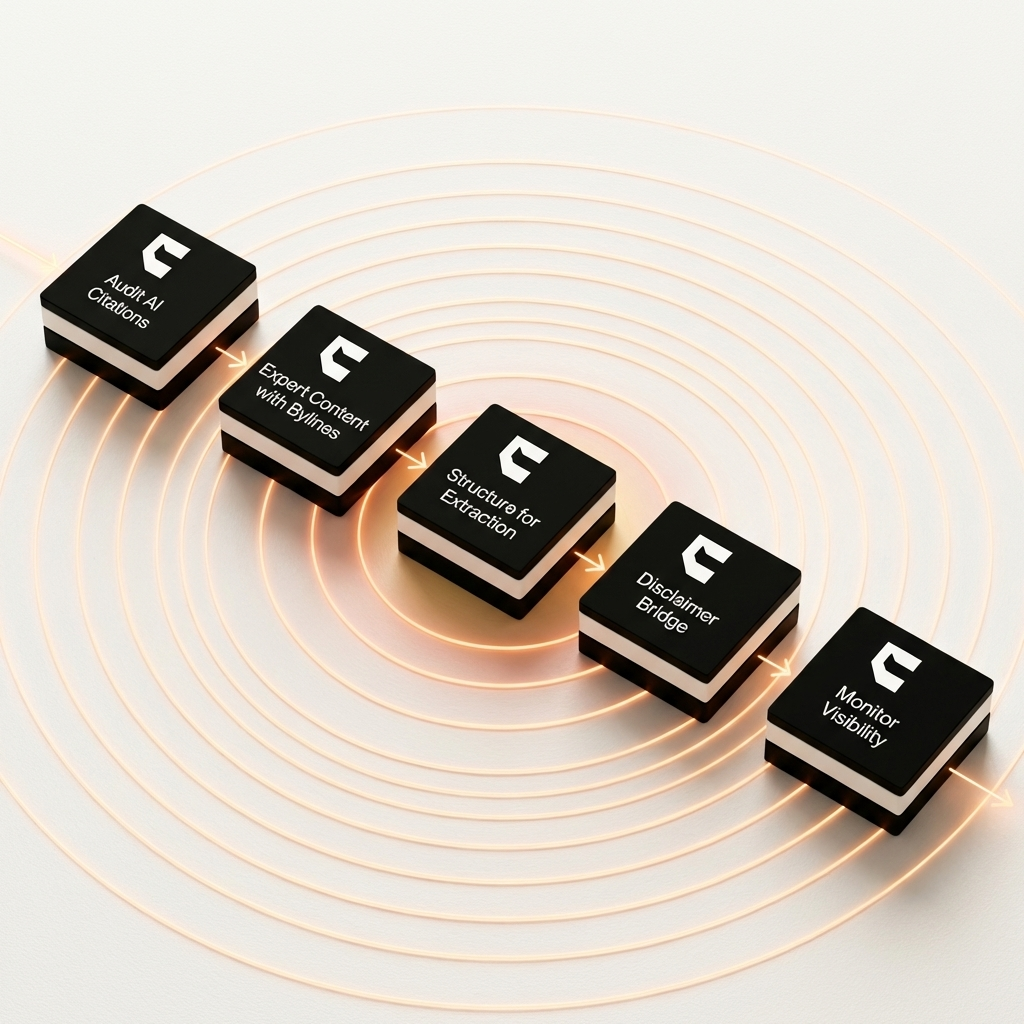
Step 1: Audit AI citations per practice area. Don't just search your firm name. Search the queries potential clients actually ask: "best personal injury lawyer in [city]," "how to file for divorce in [state]," "what to do after a car accident in [state]." Document which firms appear in ChatGPT, Perplexity, and AI Overviews for each query. We run this exact audit to establish baselines for clients.
Step 2: Create jurisdiction-specific expert content with attorney bylines. AI systems verify expertise aggressively for legal content. A page authored by "Sarah Chen, J.D., Board Certified in Family Law" carries more authority signals than one credited to "Staff." Publish state-specific guides, not generic national overviews.
Step 3: Structure content for extraction. Every practice-area page needs an answer capsule (15-30 words, direct answer, no links) immediately after the heading. Add FAQ schema and practice-area schema markup to define entities clearly. This is what AI models look for when deciding which content deserves citation.
Step 4: Build the disclaimer-citability bridge. Place mandatory disclaimers in a designated section (footer, sidebar, or end-of-article notice). Keep the answer capsule and opening paragraphs clean, direct, and authoritative. AI models extract from the first 1-2 paragraphs. Disclaimers below the fold don't hurt citability. Disclaimers in the opening paragraph absolutely do.
Step 5: Monitor per-platform and per-practice-area visibility. Track which queries trigger citations, across all three platforms separately. Legal queries vary significantly by practice area. We've covered how to measure AI visibility with specific metrics and tools to track.
Legal AI visibility starts with this framework. But each practice area has distinct dynamics that affect which steps matter most.
Which Practice Areas Benefit Most from AI Visibility?
Personal injury and family law see the highest AI query volume with strong local intent, while corporate and IP law compete nationally with lower volume but higher case values.
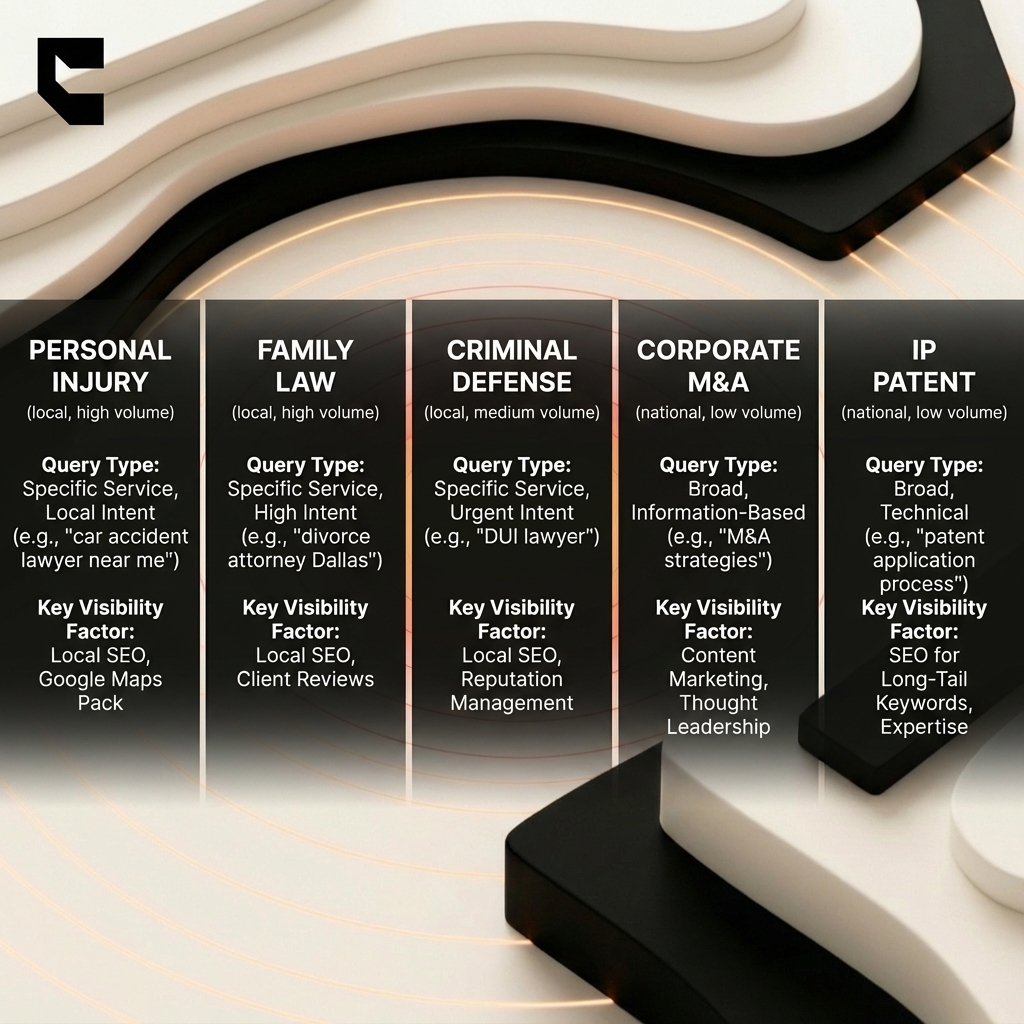
Personal injury drives the highest AI query volume for legal topics. Queries like "what to do after a car accident" and "how much is my injury claim worth" trigger AI Overviews constantly. Google Business Profile optimization, NAP consistency, and city-specific content are essential. AI search visibility for personal injury is a local game.
Family law sees high emotional-intent queries. "How to file for divorce in [state]" and "what are my custody rights" demand jurisdiction-specific answers. Firms publishing state-specific guides with attorney bylines win citations over generic national content.
Criminal defense involves time-sensitive queries. When someone searches "what to do if arrested for DUI," they need a direct fifteen-word answer, not a thousand-word essay on DUI history. Speed and directness outperform depth here.
| Practice Area | Query Type | AI Query Volume | Key Visibility Factor |
|---|---|---|---|
| Personal Injury | Local | High | GBP optimization, localized content |
| Family Law | Local | High | Jurisdiction-specific legal statutes |
| Criminal Defense | Local | Medium | Immediate, actionable answers |
| Corporate / M&A | National | Low | Published thought leadership |
| IP / Patent | National | Low | Technical depth, primary sources |
Corporate and M&A operate on a national scope with lower query volume but higher case values. AI platforms cite attorneys who publish in recognized legal journals and demonstrate transactional expertise. Thought leadership drives citations here, not keyword volume.
IP and Patent law demands technical depth. When users ask about patent infringement or licensing structures, AI prioritizes technical precision and primary source references. Patent bar membership is a strong authority signal.
Most legal queries carry local intent. Google Business Profile, consistent NAP data, jurisdiction-specific content, and local entity markup all feed AI systems' understanding of geographic relevance. We recommend running an AI content audit to identify your specific practice-area gaps. Corporate and IP law are the exceptions where national strategies win.
How Does the Attorney Byline Affect AI Citations?
Attorney bylines with credentials significantly boost AI citation rates because AI platforms verify expertise more aggressively for YMYL legal content, deprioritizing generic "by staff" pages.
AI systems cross-reference author credentials for YMYL content. "John Martinez, J.D., Board Certified in Personal Injury Trial Law, Texas Bar #12345" is an entity the model can verify. "By Staff" is not. The verification happens against external databases, bar registries, and academic records.
This creates a structural advantage for firms willing to put attorney names on content. Most firms still publish under generic bylines. That's a gap you can exploit today.
We see this exact dynamic in healthcare, where physician bylines outperform generic authorship across every AI platform. You can see the parallels in our guide on AI visibility for healthcare. The principle is consistent across YMYL categories: credentialed authors get cited more.
ABA competency duties add another dimension. Attorneys have a professional responsibility to understand how AI-optimized content representing their expertise will be surfaced and cited. This isn't just a marketing tactic. It's an evolving area of professional responsibility.
Frequently Asked Questions About AI Visibility for Law Firms
These are the questions legal marketers and managing partners ask most about AI visibility for law firms.
Do bar advertising rules apply to AI-optimized content?
Bar advertising rules apply to any content a law firm publishes that could attract clients, including AI-optimized blog posts and practice-area pages.
AI optimization is a content strategy, not a separate advertising channel. Your content still needs to comply with the same rules governing firm websites and online marketing materials. Specific rules vary by state. Consult your state bar association for requirements in your jurisdiction.
How do I get my law firm cited by ChatGPT?
Getting cited by ChatGPT requires authoritative, well-structured content with clear answer capsules, credentialed authorship, and strong E-E-A-T signals.
72% of ChatGPT-cited posts include a clear answer capsule at the top of the page. Focus on direct, expert answers to practice-area questions. We've broken down the full playbook in our guide on how to get recommended by ChatGPT.
Which practice areas benefit most from AI visibility?
Personal injury and family law benefit from high AI query volume with local intent, while corporate and IP law benefit from lower-volume, higher-value national queries.
Every practice area has opportunity. The strategy differs. Local practices need GBP optimization and jurisdiction-specific content. National practices need thought leadership and publications. There's no single playbook that works across all legal verticals.
How long does AI visibility take for law firms?
Initial AI citation improvements typically appear within 8-12 weeks for firms with existing domain authority, with compounding results over 6-12 months.
Firms with established SEO authority see faster results because AI systems already trust their domain. New or low-authority sites need to build foundational signals first. The legal AI market is projected to reach $10.82 billion by 2030, per MarketsandMarkets. Early movers gain compounding advantages.
Can small firms compete with AmLaw 100 in AI search?
Small firms can outperform larger competitors in AI search by focusing on local, practice-specific queries where jurisdiction expertise and attorney credentials outweigh brand size.
AI systems evaluate content quality and expertise signals, not firm size. A solo practitioner publishing credentialed, jurisdiction-specific family law content for one state can outrank a national firm publishing generic overviews. The moat is expertise, not budget.
Conclusion
AI search is reshaping how legal consumers find attorneys. 92.4% research first, and AI is increasingly where that research starts. The firms that AI cites get the calls. The ones it doesn't are invisible.
Bar ethics constraints aren't a barrier. They're a moat. Firms that solve the compliance puzzle (structuring disclaimers separately from answer capsules, publishing under credentialed bylines, building jurisdiction-specific authority) gain durable AI visibility that generic competitors can't copy.
Start here: search five queries your potential clients ask about your practice areas in ChatGPT and AI Overviews. Document which firms appear, and which don't. That ten-minute audit reveals exactly where you stand.
We run a comprehensive version of this audit for every client we work with. Check out our pricing to see how we integrate AI visibility into your growth strategy, or try our free AI visibility scanner to see your baseline today.