AI Visibility for Insurance: The Compliance-First Playbook
AI visibility for insurance turns compliance into a citation advantage. Learn the framework to get carriers and agencies cited by ChatGPT, Perplexity, and AI Overviews.
March 27, 2026 · 11 min read
- Why Are Insurance Brands Disappearing from AI Search Results?
- What Makes AI Visibility Uniquely Challenging for Insurance?
- How Does the Compliance-First AI Visibility Framework Work?
- How Does AI Visibility Strategy Differ for Carriers vs. Agencies?
- What Happens When AI Gets Your Policy Details Wrong?
- What Can Insurance Learn from Healthcare and Legal AI Visibility?
- Frequently Asked Questions About AI Visibility for Insurance
- Conclusion
TL;DR: State Farm and Progressive dominate AI-generated insurance answers while most carriers are invisible. Insurance faces a unique compliance-citability paradox — NAIC advertising rules demand precise legal language that AI models struggle to extract. But compliance data, restructured for AI, becomes a citation moat that affiliates can't replicate. This playbook covers the framework for carriers and agencies.
State Farm and Progressive appear in nearly 40% of all AI-generated insurance answers. Most carriers and agencies don't appear at all.
That gap matters because 37% of consumers now start searches with AI instead of Google. When someone asks ChatGPT for the best car insurance for young drivers, they don't want ten blue links. They want a synthesized recommendation. The brands cited in that answer win the policy.
We've published playbooks for healthcare, law firms, and finance. Insurance shares the YMYL classification with those verticals but adds distinct friction: NAIC advertising guidelines, state insurance commission rules, the carrier-agency distribution split, and underwriting content that AI models struggle to parse.
This playbook introduces a compliance-first AI visibility framework built for insurance brands — turning regulatory constraints into citation advantages.
Why Are Insurance Brands Disappearing from AI Search Results?
Most insurance brands are invisible in AI-generated answers because AI platforms favor structured, comparison-friendly content that affiliates produce better than carriers.
AI Overviews now appear in roughly 63% of insurance-related SERPs, up from 17% a year ago. Insurance has one of the highest AI penetration rates of any commercial vertical. But the benchmark data exposes a steep visibility gap.
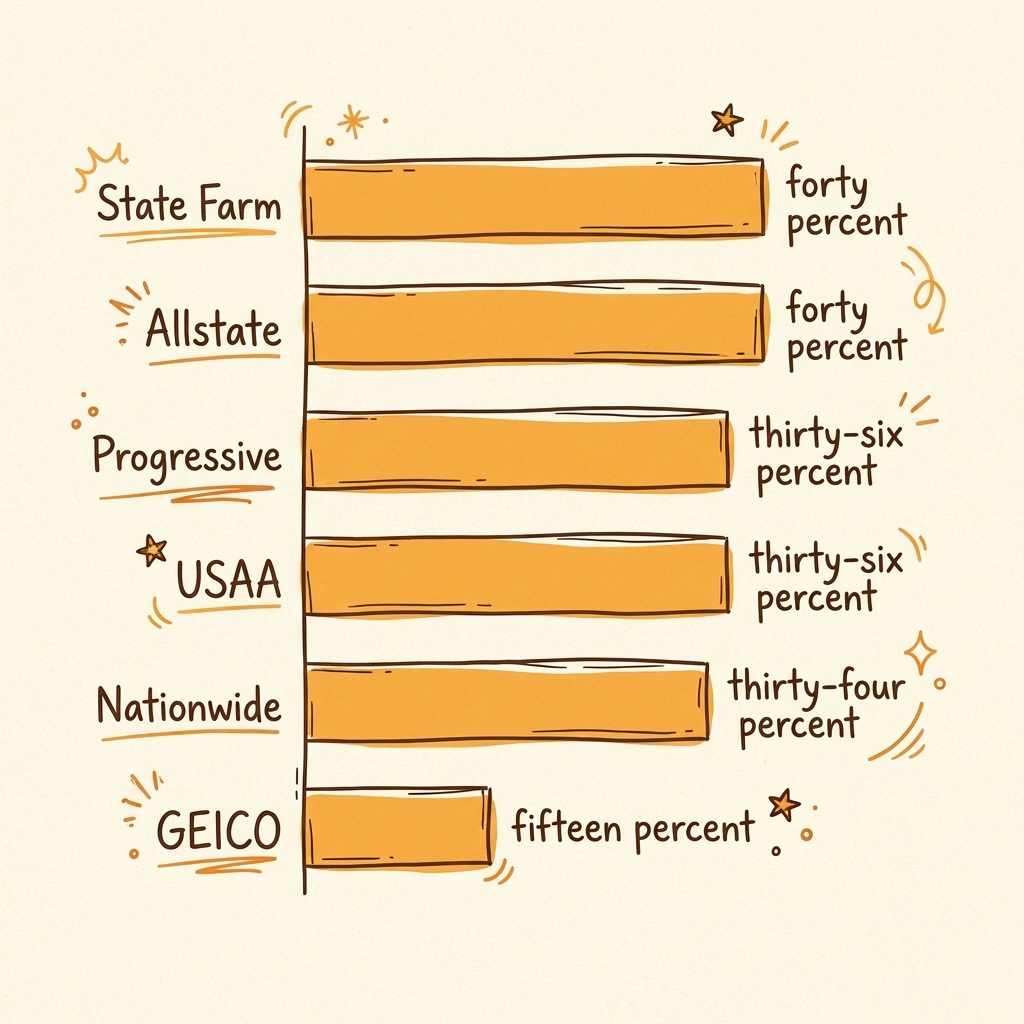
Across 373 insurance queries tested on ChatGPT and Perplexity, only a handful of brands show up consistently:
| Brand | AI Visibility Score |
|---|---|
| State Farm | 40% |
| Allstate | 40% |
| Progressive | 36% |
| USAA | 36% |
| Nationwide | 34% |
| GEICO | 15% |
Affiliate publishers fill the rest. NerdWallet, Bankrate, and Policygenius dominate because they format policy comparisons in ways AI models extract cleanly — dense comparison tables, state-by-state coverage breakdowns, and FAQ-rich content hubs. Carriers often bury this same data in PDFs or fragmented landing pages.
The revenue stakes are real. AI search traffic converts at 14.2% compared to Google's 2.8%. When you lose an AI citation to an affiliate, you're paying a premium to buy back that same lead through paid search.
What Makes AI Visibility Uniquely Challenging for Insurance?
Insurance faces a compliance-citability paradox: NAIC advertising guidelines and state regulations demand precise legal language that AI models find harder to extract and cite.
AI models apply the highest trust thresholds to insurance content. They treat policy information with the same scrutiny applied to healthcare and finance. Proving E-E-A-T for AI search through verifiable credentials isn't optional. But trust signals alone don't solve the extraction problem.
The Compliance-Citability Paradox
The NAIC Model Bulletin requires disclosure-heavy, legally precise advertising language. Twenty-four states have adopted these guidelines. A compliant policy description includes specific disclaimers, peril exclusions, and legal caveats. Your compliance team requires this phrasing.
But AI platforms prefer concise text, structured tables, and clean definitions. A legally compliant description reads as dense and conditional. An AI-friendly version reads as brief and scannable. Your legal team demands precision. ChatGPT demands simplicity. The more compliant your content becomes, the less likely AI models cite it.
State-by-State Fragmentation
Advertising rules vary by state insurance commission. Content that's compliant in Texas may violate statutes in New York. Finance brands deal with unified federal SEC/FINRA regulations. Insurance brands navigate fifty different regulatory environments simultaneously.
The Carrier-Agency Content Split
Carriers produce product data — rates, coverage details, policy terms. Independent agencies produce advisory content — market guidance, claims advocacy, multi-carrier comparisons. AI models need both to build complete answers, but they scrape completely different domains to find it.
Compliance looks like a barrier. But the brands winning AI citations have figured out how to make it work in their favor.
How Does the Compliance-First AI Visibility Framework Work?
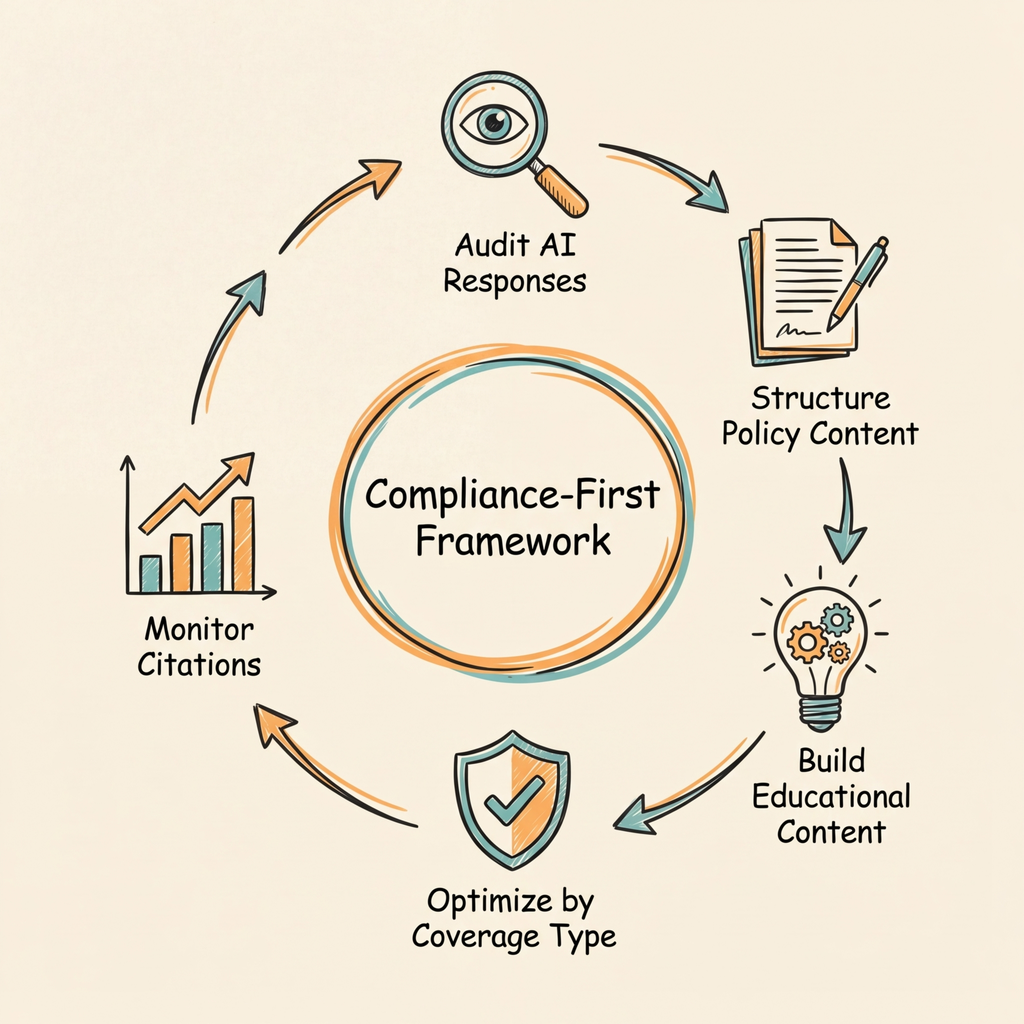
The compliance-first framework has five steps: audit AI responses, structure policy content for extraction, build educational authority, optimize by coverage type, and monitor citations for accuracy.
Step 1: Audit AI responses for your brand and competitors. Test what ChatGPT, Perplexity, Gemini, and AI Overviews say about your policies. Build a list of 20–30 high-intent queries. Ask models to compare your auto policy against a major rival. Map the results. You can learn how to measure AI visibility to establish your baseline.
Step 2: Structure policy content for AI extraction. Implement schema markup for AI visibility — InsuranceProduct schema and FAQ markup across your domain. Build coverage comparison tables with standardized columns: coverage type, deductible range, premium range, exclusions. Don't dumb down compliance language. Restructure it. Place legal text into structured HTML tables that AI engines parse while you maintain full regulatory compliance.
Step 3: Build educational content around high-intent questions. Target what consumers actually ask AI: "What does renters insurance cover?", "How much car insurance do I need in Florida?", "Is umbrella insurance worth it?" Each direct answer creates a citation opportunity.
Step 4: Optimize by coverage type. Auto insurance queries center on price comparisons and discount matrices. Home insurance queries focus on coverage scope and peril definitions. Life insurance queries involve needs-based calculators. Health insurance queries require plan comparison logic. Business insurance queries need liability scenarios. Match your content format to the AI query pattern for each product line.
Step 5: Monitor citations and flag misrepresentations. Set up regular monitoring across AI platforms. Generative models make frequent mistakes on policy specifics. You need a documented process to catch errors before they influence buyers. More on this in the hallucination section below.
How Does AI Visibility Strategy Differ for Carriers vs. Agencies?
Carriers need product-level AI visibility through policy comparisons and rate transparency, while independent agencies need local expertise visibility through multi-carrier comparison authority.
Carrier Strategy
Carriers control the product data AI models need. Build definitive policy comparison pages. Publish coverage breakdowns by state. Create rate transparency content that explains pricing mechanics. Progressive earns consistent citations for its Snapshot program because the content clearly explains usage-based pricing. Carriers should build digital coverage hubs that AI models treat as primary sources.
Agency Strategy
Agencies win by being the trusted recommendation layer between carriers and consumers. Publish local market expertise. Share claims advocacy content. Build unbiased multi-carrier comparison guides. Position yourself as the AI's local insurance advisor — capturing queries for "best insurance agent in [city]" and "independent vs. captive agent."
| Priority | Carriers | Independent Agencies |
|---|---|---|
| Content focus | Policy specs, rate comparisons, coverage tables | Market guides, claims advocacy, multi-carrier comparisons |
| Schema markup | InsuranceProduct, FAQPage | LocalBusiness, FAQPage, Review |
| Query targets | "Best auto insurance", "What does umbrella cover" | "Best insurance agent in Chicago", "Independent vs captive agent" |
| Trust signals | AM Best ratings, regulatory filings | Google Business reviews, local credentials |
| AI platform priority | ChatGPT, Perplexity (national queries) | Google AI Overviews (local queries) |
Both models face the same vulnerability when it comes to AI accuracy.
What Happens When AI Gets Your Policy Details Wrong?
When AI models misrepresent policy details, coverage limits, or premium rates, it creates compliance liability and reputational damage that insurance brands must monitor and correct.
AI hallucination in insurance isn't just a PR problem — it's a compliance issue. Picture ChatGPT telling a consumer your homeowner's policy covers flood damage at a $1,000 deductible when flood is explicitly excluded. The consumer expects coverage. The carrier faces potential E&O claims. State insurance commission scrutiny follows.
The NAIC AI Model Bulletin requires insurers to maintain formal AI governance programs. Twenty-four states have adopted this standard. While it focuses on internal AI use for underwriting and claims, the principles extend to monitoring how external AI represents your products. Regulators increasingly expect you to manage your complete digital footprint across generative models.
The Correction Framework
- Weekly AI monitoring — Track your brand across ChatGPT, Perplexity, Gemini, and AI Overviews using product-specific queries
- Document inaccuracies — Take timestamped screenshots to build a regulatory audit trail
- Publish authoritative corrections — State the facts on your domain using structured data formats
- Submit platform corrections — Use each AI platform's feedback channels with links to your source content
- Quarterly compliance review — Review external AI representations with your legal and compliance teams
Don't wait for a consumer complaint to reach the state insurance commission. Find the errors first.
What Can Insurance Learn from Healthcare and Legal AI Visibility?
Insurance shares YMYL classification with healthcare and legal services, and the citation strategies that increased visibility in those verticals translate directly to insurance.
From healthcare: Credential-rich content earns AI trust. Models look for board certifications, peer-reviewed citations, and clinical guidelines. We detail this in our healthcare playbook. The insurance equivalent: surface your AM Best ratings, NAIC compliance filings, and state licensing credentials in plain text near the top of key pages — not buried in footer graphics.
From law firms: Jurisdiction-specific content wins local AI queries. Firms that publish state-by-state guides dominate localized questions. We mapped this in our law firm playbook. Insurance brands need the same approach: state-specific auto coverage guides, local regulatory explainers. A generic national page on auto insurance minimums won't beat a state-specific page in an AI answer.
The cross-industry pattern: Regulated content that structures compliance data for AI extraction outperforms generic marketing content. AI models prefer verified facts over persuasive copy, structured tables over long paragraphs, and legal precision over vague promises. Your compliance burden becomes your citation moat.
Frequently Asked Questions About AI Visibility for Insurance
Insurance marketers commonly ask these questions when evaluating AI visibility strategies for carriers and agencies.
Can AI cite specific insurance rates?
AI models avoid citing specific rates because they change frequently, but they do cite rate comparison frameworks and coverage tier structures that influence purchasing decisions.
Structure content around rate ranges and comparison factors rather than exact dollar amounts. Highlight the variables that raise or lower premiums. AI models extract and cite these frameworks to help users understand pricing.
How do compliance rules affect AI visibility?
Compliance rules raise the authority bar for AI citations, creating an advantage for brands that restructure regulatory content for AI extraction rather than simplifying it.
NAIC advertising guidelines require specific disclosures. Build those disclosures into structured data that AI models can parse. When a model can read and verify your compliance text, it flags your domain as authoritative for YMYL topics.
What schema markup should insurance companies use?
Insurance brands should implement InsuranceProduct schema, FAQPage markup, and LocalBusiness schema (for agencies) to help AI models extract structured policy data.
Schema serves as a translation layer for AI engines, mapping complex policy details into machine-readable fields. See our schema markup guide for implementation details.
How do I track what AI says about my brand?
Run weekly query audits across ChatGPT, Perplexity, Gemini, and Google AI Overviews using 20–30 high-intent insurance queries specific to your coverage types.
Traditional SEO rank trackers don't measure AI visibility. You need to test the platforms directly, document your prompt phrasing, and record which competitors appear. Our measurement guide covers the full tracking framework.
Is AI visibility different for carriers vs. agencies?
Carriers need product-level AI visibility through policy comparison content, while agencies need local expertise visibility through multi-carrier advisory content.
Carriers own the product data and must publish accurate, exhaustive coverage definitions. Agencies own the client relationship and must publish localized market guidance. AI models require both layers to form complete answers.
Conclusion
Insurance brands face a clear choice. View compliance as a permanent limitation and stay invisible in AI search. Or treat compliance as a structural citation advantage and own the answers AI gives to policy shoppers.
Start with a focused 30-minute AI visibility audit. Ask ChatGPT, Perplexity, and Gemini ten high-intent insurance questions about your brand. Document where you appear, where competitors appear, and where affiliates appear instead. That exercise reveals your baseline.
We work with regulated brands across healthcare, legal, and financial services — building data-backed playbooks for environments where compliance and visibility must coexist. Book a free audit and we'll show you where you stand.
Related Articles
AI Visibility for Real Estate: The Complete Agent and Brokerage Playbook
AI visibility for real estate determines which agents get recommended by ChatGPT and Perplexity. Learn the 6-step framew...
AI Visibility for Law Firms: Get Cited Without Breaking Bar Rules
AI visibility for law firms means navigating bar ethics, YMYL standards, and the disclaimer paradox. A compliance-first...
AI Visibility for Finance: The Compliance-First Playbook
AI visibility for finance gives regulated brands a citation advantage. Learn the 5-step framework to get banks, fintechs...