AI Visibility for Real Estate: The Complete Agent and Brokerage Playbook
AI visibility for real estate determines which agents get recommended by ChatGPT and Perplexity. Learn the 6-step framework brokerages and agents use to show up in AI answers.
March 26, 2026 · 10 min read
- How Does AI Search Work for Real Estate?
- Why Are Most Real Estate Agents Invisible in AI Answers?
- What's the Difference Between Brokerage and Agent AI Strategy?
- The 6-Step AI Visibility Framework for Real Estate
- What Can Real Estate Learn From Other Industries?
- Frequently Asked Questions About AI Visibility for Real Estate
TL;DR: AI search engines prioritize educational market guides and buyer FAQs over property listings. Most brokerages lack the schema markup AI needs to extract and cite their content. Individual agents can dominate local AI search with deep neighborhood guides and optimized Google Business Profiles. The proven formula across industries: Authority + Structure + Freshness = AI citations.
Ask ChatGPT "best real estate agent in Austin" or "how to buy a house in Denver." Who gets recommended? For most agents, the answer is nobody — they're invisible.
Only two of twelve major brokerages scored above 70 on a recent AI visibility benchmark analysis. Real estate professionals spend billions on Zillow, Google Ads, and SEO, but AI search is a discovery channel they haven't optimized for. 76% of commercial real estate organizations are researching, piloting, or in early-stage AI implementation, according to Deloitte's 2025 CRE Outlook.
This playbook covers how AI search works for real estate, why most agents are invisible, and a six-step framework for brokerages and individual agents alike. We bring cross-industry data — what we've learned optimizing AI visibility for SaaS and ecommerce applies directly to an industry with almost no established playbooks.
How Does AI Search Work for Real Estate?
AI search engines pull real estate recommendations from educational content, Google Business Profiles, review sentiment, and structured data — not paid listings or Zillow rankings.
Each platform handles real estate queries differently. ChatGPT synthesizes review data and web authority to recommend agents. Perplexity cites specific articles with direct links when you ask for a neighborhood breakdown. Gemini generates location-based insights using local business data.
Local signals matter more in real estate than in most verticals. According to Yext's AI Citations Study (6.8 million citations analyzed), first-party websites account for 44% of AI citation signals, business listings represent another 42%, and reviews plus social citations make up the remaining share. This distribution shifts how you need to present your brand online for AI visibility for real estate.
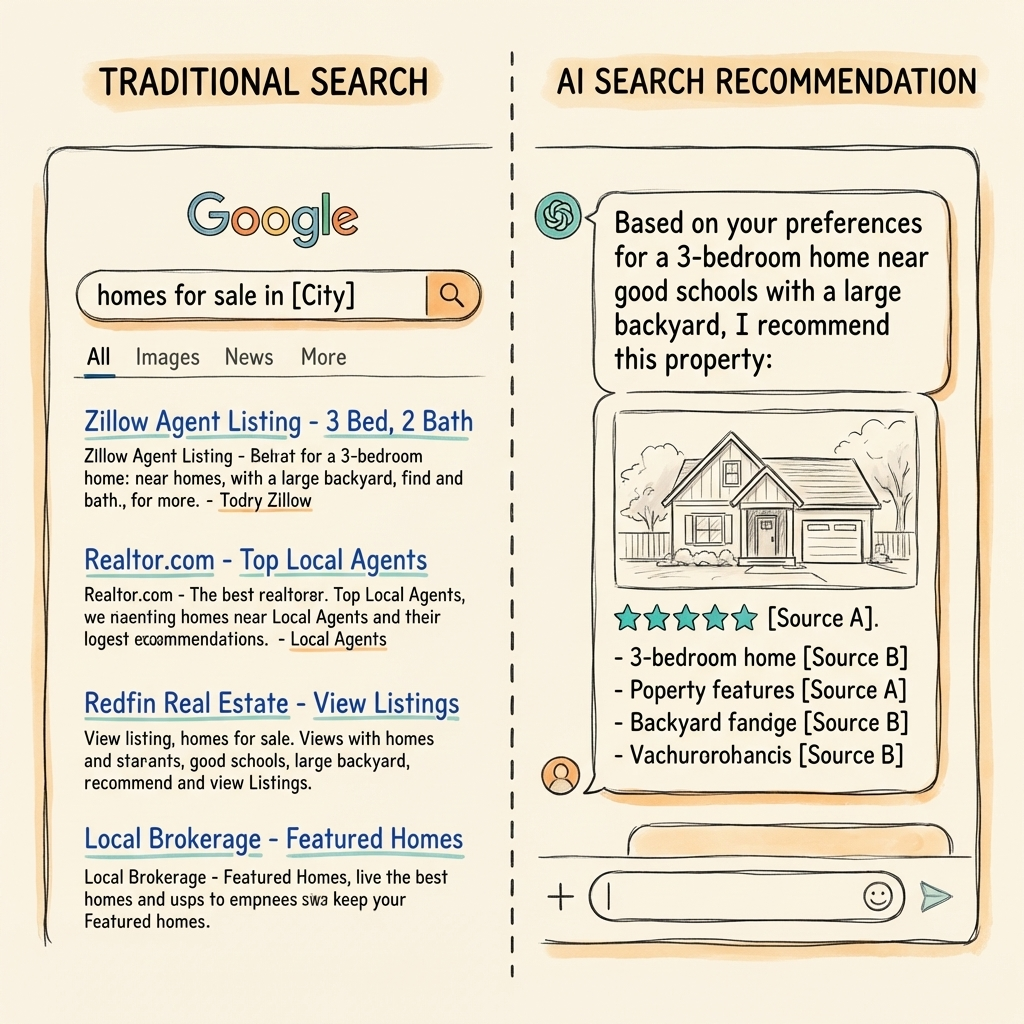
Think of AI search as an additional front door for your business — it doesn't replace Google. Buyers are turning to conversational interfaces for complex questions about market timing, school districts, and neighborhood dynamics. Traditional search returns blue links. Generative AI delivers synthesized advice. Agents who answer these questions well become the trusted authority before a buyer even views a property.
Why Are Most Real Estate Agents Invisible in AI Answers?
Most agents are invisible because their websites prioritize listings over educational content, lack structured data, and don't build the authority signals AI models rely on.
Educational content outperforms promotional content. Brokerages with educational hubs scored higher on AI readiness benchmarks than those with listing-heavy sites. Most agent websites also have a schema markup gap — they lack RealEstateAgent, LocalBusiness, and FAQPage schema that helps AI systems extract and cite information.
The thin content problem
IDX listing feeds don't count as original content. AI models reward original analysis, market commentary, and buyer guides. When an agent publishes a list of homes for sale, AI finds nothing to synthesize. When that same agent publishes a guide on navigating multi-offer scenarios in a specific zip code, AI has a rich source to draw from.
You need schema markup for AI visibility to bridge the gap between human readability and machine extraction. Your content must translate into verifiable data points for effective AI search optimization in real estate.
| Signal | Traditional SEO | AI Visibility |
|---|---|---|
| Content focus | Listing pages, property descriptions | Market guides, buyer education, neighborhood analysis |
| Authority signals | Backlinks, domain authority | Citations across AI platforms, review sentiment, entity recognition |
| Technical optimization | Meta tags, page speed, mobile-first | Schema markup (RealEstateAgent, FAQ), structured data |
| Local signals | Google Maps ranking, NAP consistency | GBP completeness, review volume and sentiment, local content depth |
| Content freshness | Quarterly blog posts | Weekly market updates, seasonal guides |
| Measurement | Google Search Console rankings | AI mention tracking across ChatGPT, Perplexity, Gemini |
The right strategy depends on whether you're a national brokerage or an individual agent.
What's the Difference Between Brokerage and Agent AI Strategy?
Brokerages need brand-level entity recognition and content authority, while individual agents need local AI visibility through GBP optimization and neighborhood expertise.
Brokerage-level strategy
Brokerages focus on broad entity recognition. They need comprehensive schema across hundreds of local pages, brand authority content that drives visibility across regions, and multi-market educational hubs. Think macroeconomic market reports, first-time buyer guides, and regional investment analysis. These organizations build structural trust through E-E-A-T for AI search to establish credibility at scale.
Agent-level strategy
Agents run a different playbook focused on localized depth. They optimize Google Business Profiles for AI extraction, write hyperlocal neighborhood guides, and manage review sentiment actively. An agent might publish a walkthrough of a specific subdivision, answer first-time buyer questions about local property taxes, or release a market snapshot with recent sales velocity data.
Can agents compete with brokerages in AI? Yes. AI rewards specificity. A hyperlocal agent with deep neighborhood content will outrank a national brokerage for local queries every time.
The 6-Step AI Visibility Framework for Real Estate
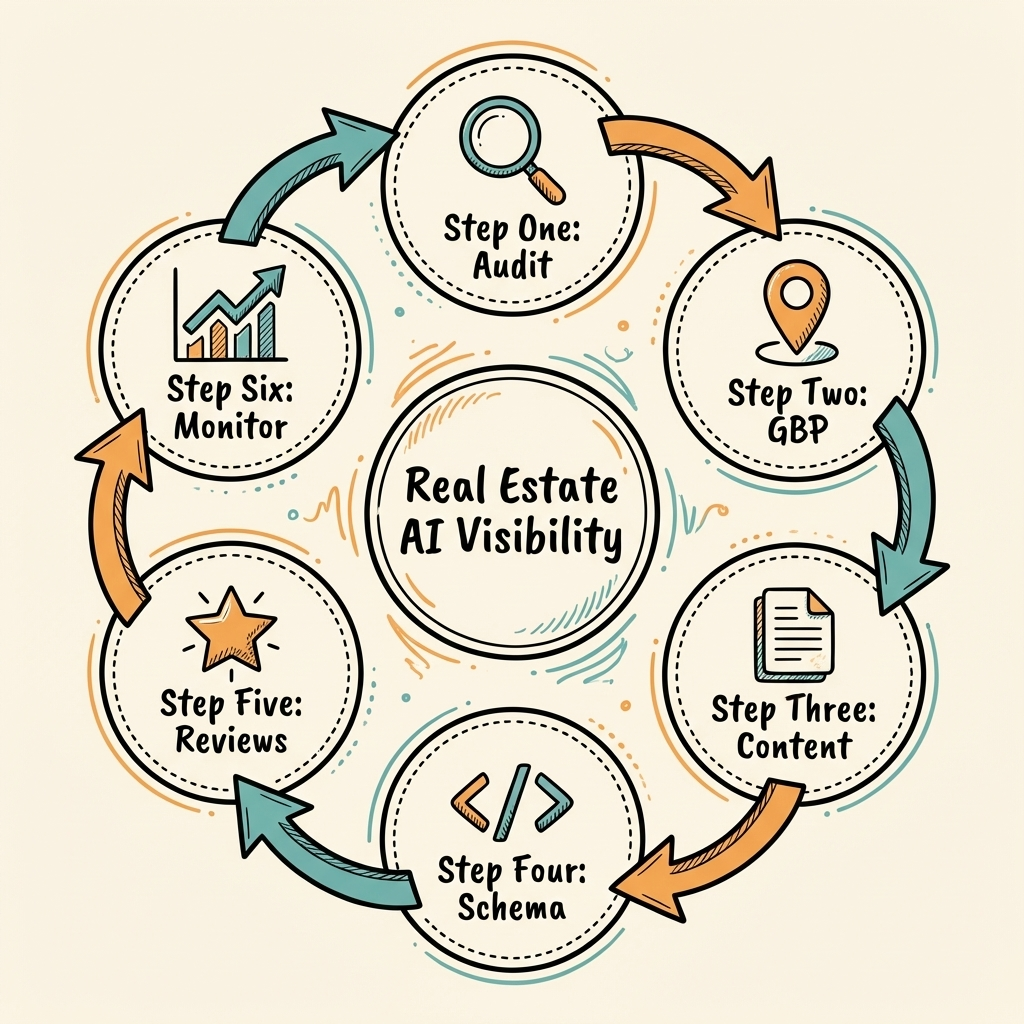
The framework covers six steps: audit your AI presence, optimize your GBP, build educational content, implement schema markup, manage review sentiment, and monitor results.
Step 1: Audit your AI presence
Search your name, your brokerage, and top service queries in ChatGPT, Perplexity, Gemini, and Google AI Overviews. Test these five queries:
- "Best real estate agent in [your city]"
- "How to buy a house in [your market]"
- "[Your brokerage name] reviews"
- "Real estate agent for [your neighborhood]"
- "How much house can I afford in [your state]"
This establishes your baseline. You can't fix what you don't measure. A thorough AI content audit reveals where you stand and what's missing from the AI index.
Step 2: Optimize Google Business Profile for AI extraction
Complete every GBP field — AI models treat it as a structured data source. The business description allows 750 characters; use all of them to detail your expertise. List every service you offer, from staging consultation to investment property analysis. Seed the Q&A section with real questions from past clients. Post localized market updates regularly and upload photos of neighborhoods, community events, and recent closings.
Step 3: Build educational content
Create content around buyer and seller questions, not listing descriptions:
- Market guides covering local trends and pricing
- Neighborhood analyses with school ratings, walkability, and lifestyle details
- First-time buyer FAQs addressing down payments, inspections, and timelines
- Selling process walkthroughs with step-by-step documentation
- Monthly market data reports with recent sales figures
- Seasonal buying guides covering the best times to list in your area
Follow a proven AI visibility playbook to scale content production without sacrificing quality. This forms the foundation of GEO for real estate.
Step 4: Implement real estate schema markup
Add RealEstateAgent, LocalBusiness, FAQPage, and Review schema to your site. Schema translates human-readable text into machine-readable data. Without it, AI models have to guess what your page covers. With it, you're telling them exactly what data they're looking at — ensuring they can cite your statistics, service areas, and operating hours in their responses.
Step 5: Generate and manage review sentiment
Reviews are a core AI signal. Volume, recency, and sentiment all matter. Build a system for generating consistent, detailed reviews. Ask clients to mention specific services, neighborhoods, and outcomes in their feedback.
A review that says "Great agent" is a useless data point. "Sarah helped us navigate a bidding war in East Austin and secure our home $10,000 below asking" gives AI specific entities to extract and cite.
Step 6: Monitor and iterate
Track mentions across AI platforms monthly. Run the same queries from your initial audit and log the changes. Identify which platforms cite your new content. Use a structured approach to measure AI visibility so you can adapt based on what the models currently prioritize.
What Can Real Estate Learn From Other Industries?
Cross-industry data shows that authority plus structure plus freshness equals AI citations — a pattern proven in SaaS and ecommerce that applies directly to real estate.
SaaS example: We worked with Hamming.ai, who went from 200 to 1,900 visitors per day — an 8.5x traffic increase in twelve weeks. The strategy combined educational content authority with structured data and consistent publishing.
Ecommerce example: UV Blocker grew from zero to 38,000 clicks in six months and doubled weekly orders. They deployed fresh seasonal content, active review management, and comprehensive schema.
The formula is clear: Authority (depth of expertise) + Structure (schema, semantic headings) + Freshness (regular publishing) = AI citations. We see this pattern across every vertical we work in. Check out AI visibility for healthcare and AI visibility for law firms for more proof.
Frequently Asked Questions About AI Visibility for Real Estate
These are the most common questions we hear from real estate professionals exploring AI visibility for the first time.
Does AI visibility replace SEO for real estate?
No. AI visibility complements SEO by adding a new discovery channel. Traditional Google SEO still drives traffic. AI visibility captures the growing share of buyers using ChatGPT and Perplexity for research.
How long does it take to show up in AI answers?
Most real estate professionals see initial AI mentions within four to eight weeks of implementing structured content and schema changes. Full results typically take three to six months.
What's the difference between GBP optimization and AI visibility?
GBP optimization is one component of AI visibility. AI models pull from GBP data, but also from website content, external reviews, schema markup, and third-party citations.
Can a single agent compete with a brokerage in AI?
Yes. AI rewards specificity. An agent with deep content about a specific neighborhood or buyer type can outrank a national brokerage for those local queries.
What content should real estate agents create first?
Start with a neighborhood guide for your primary market, a first-time buyer FAQ, and a market conditions update. These three content types cover the highest-volume AI queries.
Conclusion
AI search is a new discovery channel for real estate — not a replacement for Google. Most agents and brokerages are invisible because their content is promotional, not educational. The six-step framework works for both brokerages and individual agents: audit, optimize GBP, build content, add schema, manage reviews, monitor results. Cross-industry data proves this approach drives measurable growth.
Your next step: Pick three queries buyers would use to find an agent like you and search them in ChatGPT and Perplexity right now. That's your baseline.
We've helped brands across SaaS, ecommerce, and professional services build AI visibility from scratch. Our free AI visibility audit shows you exactly where you stand and what to fix first.