Microsoft Copilot Optimization: How to Get Cited by the Enterprise AI Search Engine Brands Keep Ignoring
Microsoft Copilot optimization starts with Bing indexing, schema markup, and passage-level content. 7-step framework to earn Fortune 500 citations.
TL;DR
Microsoft Copilot has 275M monthly users and is embedded in M365 used by 70%+ of the Fortune 500. It runs on Bing's index (not Google's), always provides citations, and shows extreme winner-take-most dynamics where the top 4 pages capture 90% of all citations. This guide covers a 7-step framework: Bing indexing, schema markup, passage-level content, E-E-A-T signals, freshness cadence, technical SEO, and the new Bing AI Performance dashboard.
A study of 20,000 Copilot citations found that one page captured 69% of all citations in its topic. The top four pages took 90%. In enterprise AI search, you either dominate or you don't exist.
Most brands optimize for ChatGPT and Perplexity but ignore Microsoft Copilot. That blind spot leaves them invisible to the enterprise market. Copilot is the AI assistant embedded in the tools where Fortune 500 buyers spend their workday. Buyers don't leave Teams to search Google. They ask Copilot.
Marketing teams obsess over consumer AI platforms while forgetting that B2B purchases happen inside closed corporate ecosystems. Enterprise users live inside Microsoft 365 from 9 to 5. If you're not showing up when Copilot answers their questions, your competitors get a free lane to the buyers with the biggest budgets.
Below, we break down how Copilot's sourcing mechanics work (spoiler: they're nothing like ChatGPT's), then walk through a 7-step Microsoft Copilot optimization framework built specifically for earning citations where enterprise decision-makers spend their time.
We've already published guides on ChatGPT optimization, Perplexity optimization, and AI Overviews optimization. This one fills the last gap. Skip any of these platforms and you're handing away a chunk of your addressable market to whoever shows up first.
Why Is Microsoft Copilot the Most Underestimated AI Search Engine?
Microsoft Copilot has 275 million monthly users and is embedded in M365, the productivity suite used by over 70% of the Fortune 500 for daily work.
Let's put some numbers on this. Copilot has 275 million monthly active users. Consumer daily usage has tripled year-over-year. Marketers love talking about ChatGPT's user base, but Copilot is in the same ballpark. The difference? Copilot's audience skews heavily toward people with corporate purchasing authority.
M365 Copilot lives inside Teams, Outlook, and Word. It queries Bing for web answers during the workday. A CMO researching marketing automation vendors in Teams asks a question. Copilot delivers answers citing web content. This is enterprise search happening inside productivity tools, bypassing browser-based search entirely and putting your brand in front of buyers at the moment of decision.
Microsoft announced at Ignite that 70% of Fortune 500 companies have adopted M365 Copilot, and that number's pushing toward 90% by the end of 2026. Think about what that means in practice. An employee asks the AI to compare vendors in their category. Your competitor shows up. You don't. Deal's lost before you even knew it was on the table.
Bing holds 33% of North American enterprise desktop searches. Windows and Edge default to Bing in enterprise environments. IT departments keep Bing locked in as the default because it meets their compliance and data governance requirements. That one infrastructure decision controls where millions of knowledge workers look for answers every day. It's why AI visibility in B2B can't ignore Bing the way consumer marketers do.
Brands dismiss Copilot because its consumer web search share hovers around 1%. They confuse consumer share with enterprise influence. That confusion leaves a significant opportunity. You can capture a high-value B2B audience with minimal competition because your competitors aren't looking.
How Does Copilot Source and Cite Content Differently from Other AI Platforms?
See where you rank across all AI answer engines.
Enter your domain and we'll scan your citation rate across ChatGPT, Perplexity, and Google AI.
Prefer to talk? Book a free 30-min call
Copilot uses Bing's index exclusively and always provides source citations, unlike ChatGPT which uses multiple sources and shows citations optionally.
Copilot pulls data from Bing. It does not use Google's index. If your site isn't indexed in Bing, you don't exist in Copilot. This single technical distinction is the foundation of your entire Microsoft Copilot optimization strategy. Google rankings provide zero benefit here.
Here's where it gets interesting: Copilot searches the web for every single response. No exceptions. ChatGPT? It leans on training data most of the time and only hits the web when specifically triggered. That always-on retrieval habit means Copilot generates far more citation opportunities per query, and it rewards brands that keep their content fresh.
There's a specific content format Copilot loves. It scans for 30-60 word paragraphs that directly answer a question, then pulls them into its response. If your pages bury the answer three paragraphs deep behind a fluffy intro, Copilot moves on to someone else's page that gets to the point.
Now here's what makes Copilot different from the other platforms we work with: it always cites its sources. Always. Every answer includes clickable links back to the pages it pulled from. Compare that to ChatGPT, where citations are hit-or-miss depending on the query. On Copilot, each response is a real, clickable path back to your site.
Citation dynamics are winner-take-most. The top four pages capture 90% of total citations in any topic. The researchers looked at 20,000 Copilot citations and found something wild: one single page hoarded 69% of all citations in its topic. Everyone else was fighting over scraps.
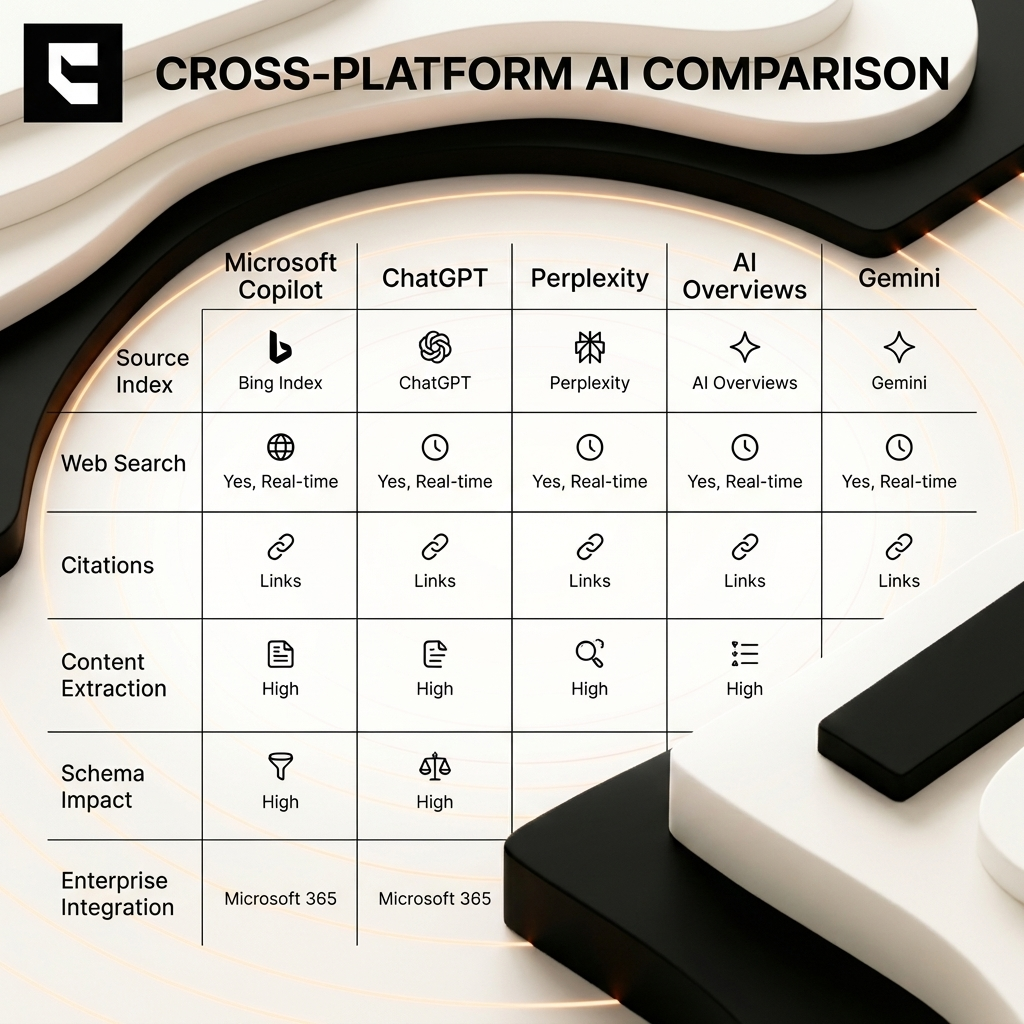
| Feature | Microsoft Copilot | ChatGPT | Perplexity | AI Overviews | Gemini |
|---|---|---|---|---|---|
| Source Index | Bing only | Multiple (Bing + Google + others) | Multiple | Google only | Google only |
| Web Search | Always-on | Optional/triggered | Always-on | Always-on | Optional |
| Citations | Always shown | Sometimes shown | Always shown | Always shown | Rarely shown |
| Passage Extraction | 30-60 word paragraphs | Variable | Full paragraphs | Featured snippet-style | Variable |
| Schema Impact | High (~25% boost) | Moderate | Moderate | Very high | Moderate |
| Enterprise Integration | M365 (Teams, Outlook, Word) | API/ChatGPT Enterprise | Web only | Google Search | Google Workspace |
| Freshness Weight | High | Moderate | Very high | High | Moderate |
Understanding these mechanics is step one. For B2B brands, the enterprise integration changes the entire calculus.
Why Does Copilot Matter More for B2B Than Any Other AI Platform?
M365 Copilot runs inside Teams, Outlook, and Word where enterprise buyers work, making it the AI search channel with the most direct access to B2B purchase decisions.
M365 Copilot integrates into daily corporate workflows. It queries Bing for web answers while users draft emails or chat in Teams. A VP of Engineering asks Copilot, "What's the best tool for cloud infrastructure automation?" Copilot pulls an answer straight from Bing. If you're not there, your brand doesn't exist in that conversation. The deal moves forward without you.
Microsoft reports 15 million paid M365 Copilot seats. These are enterprise users who rely on AI in their daily workflow, hold purchasing power, and trust answers from their secured corporate environment. It's a concentrated pool of high-value prospects.
Why Bing specifically? Enterprise IT picks it because Edge and Bing clear their compliance and data governance checkboxes right out of the box. When your IT department controls the browser and the default search engine, that decision trickles down to every employee's daily search habits.
B2B brands that ignore Copilot vanish from the workflow of Fortune 500 buyers. The opportunity cost is steep. You can explore the full multi-platform B2B strategy in our guide on AI search for B2B.
The 7-Step Microsoft Copilot Optimization Framework
Copilot optimization requires seven steps: Bing indexing setup, schema markup, passage-level content structure, E-E-A-T signals, freshness cadence, technical accessibility, and citation monitoring.
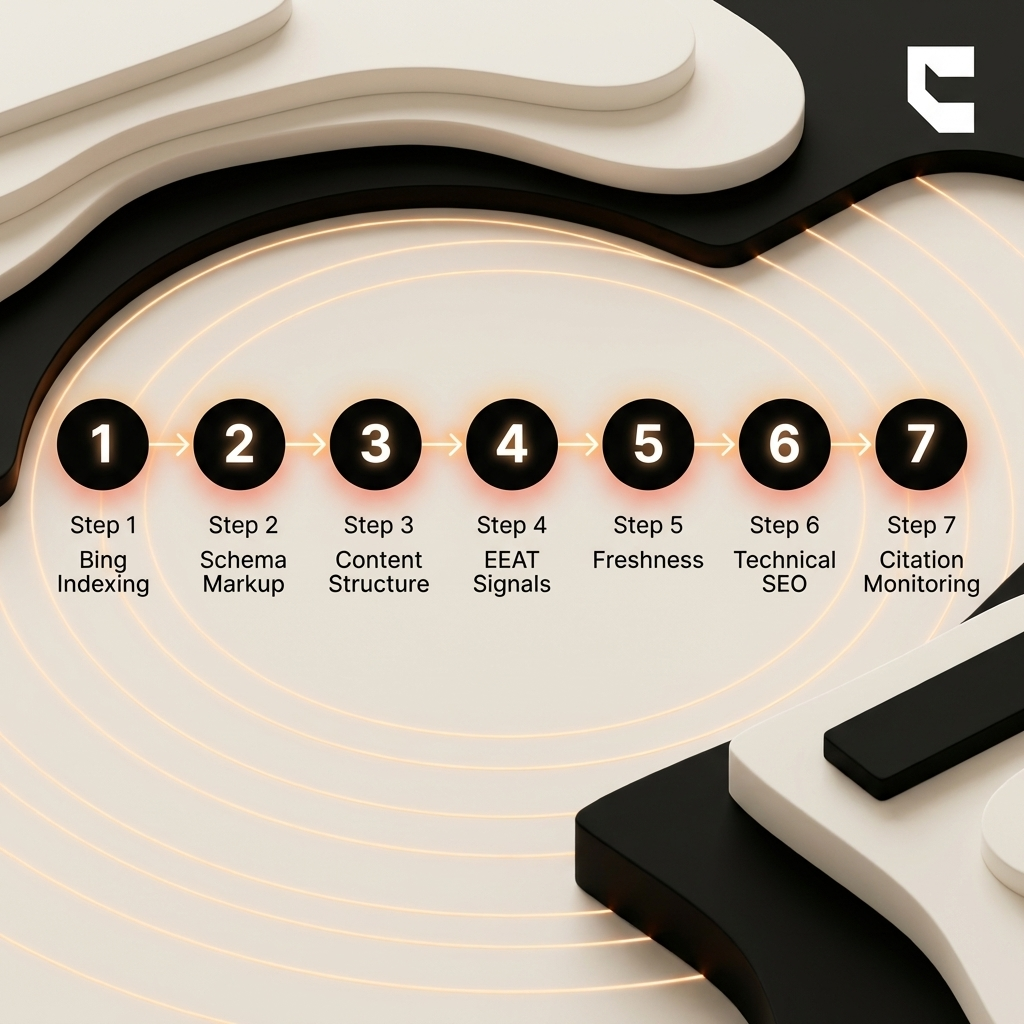
Step 1: Bing Webmaster Tools and IndexNow. First things first. Go to Bing Webmaster Tools and register your domain. Upload your sitemap and turn on IndexNow. We can't stress this enough: if Bing hasn't indexed you, none of the other steps matter. The beauty of IndexNow is speed. Instead of waiting around for Bingbot to eventually find your new pages, IndexNow pings Bing the moment you publish something.
Step 2: Schema Markup. Structured data gives Bing context about what your page actually covers. One analysis found schema can bump Copilot citations by roughly 25%. Three types matter most here: FAQPage, HowTo, and Article. Google and Bing both use schema, but Bing leans on it harder when deciding which pages to cite in AI answers.
Step 3: Content Structure for Passage-Level Extraction. Put a tight 30-60 word answer paragraph right after each heading. That's what Copilot grabs. Question heading, concise answer, then supporting detail below. If you've read our generative engine optimization guide, you know this format already. It works across every AI platform, but Copilot is especially aggressive about it.
Step 4: E-E-A-T Signals for Bing. Don't skip your author bios and about pages. Link out to credible sources. Bing cares about the same E-E-A-T factors Google does, but it weighs them differently. Social proof matters more on Bing. So do professional profiles (think LinkedIn) and whether your brand entity is consistent across every corner of the web.
Step 5: Freshness Signals. Content gets stale fast in Copilot's eyes. The Search Influence data is sobering: they watched citations drop 97% after content sat untouched for three months. Three months. If you're not refreshing your key pages on a regular cadence, someone else's newer content will eat your citations.
Step 6: Technical Accessibility. Here's a surprisingly common mistake: many sites accidentally block Bingbot in their robots.txt. They set up rules for Googlebot years ago and never thought about Bing. Go check yours right now. Bing also uses Core Web Vitals to judge page quality, though it doesn't weight them the same way Google does. Fast-loading, easy-to-crawl pages have an edge.
Step 7: Monitor via Bing AI Performance Dashboard. Use the AI Performance report in Bing Webmaster Tools to track citations, cited pages, and grounding queries. That's your feedback loop. You tweak content, watch what happens to citation counts, and iterate. If you want the full picture across ChatGPT, Perplexity, and the rest, our how to measure AI visibility guide covers the multi-platform approach.
How Do You Track Copilot Citations Using Bing's AI Performance Report?
Until February 2026, tracking Copilot citations was basically impossible. Then Microsoft launched the AI Performance Report in Bing Webmaster Tools, and for the first time, brands can see exactly which pages get cited, how often, and what queries triggered those citations.
You'll find it under the AI Performance tab in Bing Webmaster Tools. It went live as a public preview in February 2026, and honestly, it's the first tool that lets you see exactly how AI models are using your content. Before this dashboard existed, Microsoft Copilot optimization was mostly guesswork. Now you've got actual data to steer with.
You get five metrics to work with: total citations, average cited pages, grounding queries, page-level breakdowns, and visibility trends over time. The real gem here is grounding queries. These aren't like Google Search Console terms. They're the actual text prompts Copilot used when it went looking for content and decided to cite yours.
This is keyword research, but for AI retrieval. Grounding queries tell you exactly what Copilot is asking about your industry and your brand. The Search Influence study found over 400 unique grounding queries for just one topic. A big pattern they noticed: "query fanout." The AI takes a single user question and rephrases it three to five different ways before pulling sources. That means one user question can generate multiple citation opportunities if your content covers the topic from several angles.
Fair warning: the dashboard has blind spots. You'll see how often you got cited, but not whether anyone clicked through. There's no revenue attribution, no ranking within the answer. We built our multi-platform tracking to fill exactly these gaps. When you combine Bing's native data with cross-platform citation tracking, you finally get the full picture of where your brand shows up in AI-generated answers.
Frequently Asked Questions About Microsoft Copilot Optimization
These are the most common questions brands ask when starting Microsoft Copilot optimization for Bing AI search visibility.
Does Google SEO Help with Copilot?
Partially. Copilot uses Bing's index, which is separate from Google's. Core SEO fundamentals like content quality, schema, and E-E-A-T transfer. But you need Bing-specific indexing and Bing Webmaster Tools verification to appear in Copilot citations.
How Fast Do Copilot Citations Appear After Optimization?
Faster than you'd expect. If you've got IndexNow enabled, your pages can land in Bing's index within hours of publishing. Actual citation visibility usually takes two to four weeks to build as Copilot's retrieval system picks up on the new content and starts pulling from it.
Is Copilot Optimization Different from Bing SEO?
Very much so. Old-school Bing SEO is about climbing the ten blue links. Copilot optimization is a different game. You're writing for passage extraction, structuring content so the AI can grab a clean 30-60 word answer, and formatting for citations. It's closer to AEO than traditional SEO.
Can You Track Which Queries Cite Your Content?
You can now, yes. Since February 2026, Bing's AI Performance Report exposes what they call "grounding queries." Those are the exact phrases Copilot fed into its retrieval system when it decided to cite you. No other AI platform gives you this level of transparency into its sourcing logic.
Does M365 Copilot Use the Same Sources as Consumer Copilot?
M365 Copilot queries both your organization's internal data (SharePoint, OneDrive) and the public web via Bing. The public web portion uses the same Bing index as consumer Copilot. Optimizing for Bing benefits both environments.
Conclusion
Microsoft Copilot optimization isn't an edge case. It's the missing piece for any brand selling to enterprise buyers.
- Enterprise Opportunity: M365 integration makes Copilot the dominant AI search engine for Fortune 500 buyers. Ignoring it means ceding high-value enterprise visibility to competitors.
- Bing-Exclusive Architecture: Copilot operates outside the Google ecosystem. Optimization requires Bing Webmaster Tools, IndexNow, and Bing-specific technical SEO.
- Winner-Take-Most Dynamics: Four pages grab 90% of all the citations in a topic. If you're not in that top tier, you're getting scraps.
- Measurable for the First Time: The Bing AI Performance dashboard lets brands track citations and grounding queries with real data, launched just weeks ago.
Register your site in Bing Webmaster Tools and check your AI Performance report today. It takes five minutes to see if Copilot is already citing your content.
This completes our five-platform AI visibility series. Read our full methodology on what is AI visibility to understand the landscape across every platform. Book a call if your brand is ready to optimize across all of them.
For brands selling to the Fortune 500, Copilot isn't optional. It's where your buyers search during their workday.
See where your brand appears in AI search
Scan ChatGPT, Perplexity, and Google AI across buyer-intent queries, instantly, no sign-up.
Find out if AI is sending buyers to your competitors.
We audit your AI visibility across ChatGPT, Perplexity, and Google AI –and show you exactly where you rank and what to fix.
“We went from 200 visitors/day to 1,900 visitors/day and 40% of demos are from AI search.”
Sumanyu Sharma · CEO, Hamming.ai
“Cintra helped me go from 3k to 7.5k daily traffic and doubled weekly orders in 1.5 months.”
Russ Coulon · Owner, UV Blocker
“We saw a lift from 3% to 13% visibility in the first 2 weeks, and organic traffic hit its highest ever.”
Ash Metry · Founder, Keywords.am
Related Articles
Google AI Mode Link Updates: What Five Changes Mean for Your Brand's AI Visibility
Google AI Mode link updates add five new outbound link features. We analyze what changed on May 6, how each up…
AI Visibility for Automotive: The Two-Layer Problem Dealerships Don't See
AI visibility for automotive is a two-layer problem. 84% of dealership websites are invisible to AI. Learn the…
How to Fix Wrong AI Answers Brand Owners Get (2026 Guide)
Fix wrong AI answers brand owners encounter with this 6-step playbook. Learn why ChatGPT, Perplexity, and AI M…