How to Get Cited by Claude AI: The Complete Optimization Guide
Learn how to get cited by Claude AI with a 6-step framework covering Brave Search indexing, dual citation modes, and content structure. Practical playbook for 2026.
March 16, 2026 · 10 min read
- Why Does Claude Matter for AI Visibility?
- How Does Claude Search Actually Work?
- How to Get Cited by Claude AI: The 6-Step Framework
- How Does Claude Compare to Other AI Search Platforms?
- What Does Claude Get Wrong?
- Frequently Asked Questions About Claude AI Optimization
TL;DR: Claude runs on Brave Search (not Google, not Bing), has two citation modes (training data vs web search), and only overlaps 20% with ChatGPT results. Getting cited requires Brave Search indexing, answer-first content structure, entity authority, schema markup, freshness signals, and cross-platform consistency. This is platform guide #6 in our AI visibility series.
Want to know how to get cited by Claude AI? Start here: Claude processes 25 billion API calls every month. It has 18.9 million active users asking it for product recommendations, tool comparisons, and expert answers. If your brand doesn't show up, a competitor does.
Most optimization guides assume Claude works like ChatGPT. They're wrong. Claude runs on Brave Search. It has dual citation modes and uses dynamic filtering to process results before reading them. The technical mechanics couldn't be more different.
This guide covers how to get cited by Claude AI using a 6-step optimization framework, plus a cross-platform comparison across all six AI search engines.
We've published guides on ChatGPT optimization, Perplexity optimization, AI Overviews optimization, Gemini optimization, and Copilot optimization. This completes the series. No other resource covers all six platforms with this level of technical depth.
Why Does Claude Matter for AI Visibility?
Claude has 18.9 million monthly active users, 202.9 million monthly visitors, and holds 29% of the enterprise AI assistant market.
The growth numbers tell the story. Claude is growing at 14% quarter-over-quarter, making it the fastest-growing AI chatbot. For AI visibility, that growth rate is impossible to ignore. Users are adopting it for deep research, software evaluation, and procurement decisions.
The enterprise angle is even more compelling. Claude holds 29% of the enterprise AI assistant market. Seventy percent of Fortune 100 companies have adopted it. Enterprise buyers use Claude daily for vendor comparisons, technical research, and purchasing decisions.
Claude generates $14 billion in annualized revenue and sits at a $380 billion valuation. This isn't a niche tool. It's a platform with serious staying power.
With over 25 billion monthly API calls, Claude's embedded in thousands of software products and workflows. Its reach goes far beyond the chat interface you see on claude.ai.
So how does Claude actually find and select sources to cite?
How Does Claude Search Actually Work?
Claude uses Brave Search as its web index, with 86.7% result overlap between Claude's citations and Brave's top results, plus dynamic filtering to process HTML before answering.
TryProfound's research confirmed that overlap at a p-value below 0.0001. If you want Claude to cite you, you need to show up in Brave Search first.
Claude has two distinct citation modes. Training data mode kicks in for stable, evergreen topics where Claude already "knows" the answer. Web search mode activates for fresh, complex, or ambiguous queries. Claude decides when to search based on query freshness and complexity.
Here's the part most guides miss: Anthropic's latest web_search_20260209 tool lets Claude write and execute code to filter HTML before it reaches the context window. It strips ads, navigation menus, and irrelevant styling. Only the useful content survives. Clean page structure matters more here than on any other platform.
There's only a 20% overlap between Claude and ChatGPT search results. That number should stop any marketer from assuming they can optimize once and call it a day. You need a separate playbook for each platform.
| Factor | Training Data Mode | Web Search Mode |
|---|---|---|
| Triggered by | Stable, evergreen queries | Fresh, complex, or ambiguous queries |
| Source | Pre-training corpus | Brave Search live results |
| Citation format | No inline citations | Inline links with source attribution |
| Optimization focus | Entity authority, Wikipedia presence | Brave indexing, content structure, freshness |
| Time to citation | Months (next training cut) | Hours to days |
The mechanics are clear. Here's the step-by-step framework for how to get cited by Claude AI.
How to Get Cited by Claude AI: The 6-Step Framework
Getting cited by Claude requires six coordinated steps: Brave Search indexing, answer-first content structure, entity authority building, technical optimization, freshness signals, and cross-platform consistency.
Step 1: Get indexed in Brave Search
Brave doesn't use Google's index. Sites need organic discovery through Brave browser users or submission via Brave Web Discovery. Search for your domain in Brave right now. If your pages aren't there, you're invisible to Claude. Getting traffic from Brave browser users forces indexing faster.
Step 2: Structure content for extraction
Lead with 15-30 word answer capsules after question headings. Use clean tables, clear lists, and a strict H2/H3 hierarchy. Claude's dynamic filtering strips irrelevant HTML. Clean structure survives the filter and gets fed directly into the model's context window.
Step 3: Build entity authority
When Claude answers from training data, it gravitates toward brands that show up on Wikipedia and get mentioned consistently across trusted publications. So build your off-site presence: detailed author bios, guest contributions, and industry roundups that name your brand. Digital PR feeds directly into this.
Step 4: Optimize technical foundations
Add FAQPage, HowTo, and Organization schema to your key pages. We wrote a full walkthrough in our schema markup for AI visibility guide. Load times need to stay under 3 seconds. And if your site relies on heavy client-side JavaScript to render content, Claude's crawler probably can't read it properly.
Step 5: Maintain freshness signals
Update high-value pages monthly. Add visible "Last Updated" dates. Add fresh data points and statistics. Fresh content ranks higher in Brave Search. Claude doesn't have Perplexity's strict 30-day decay cliff, but recent content still wins for complex queries.
Step 6: Ensure cross-platform consistency
What's nice about Claude optimization is the spillover. Perplexity also uses web retrieval, so clean structure helps there too. The answer-first approach we recommend? It works in ChatGPT and AI Overviews as well. We've spelled out the specifics in each of our five other platform guides. One cohesive strategy beats six siloed ones every time.
How does Claude stack up against the other five platforms?
How Does Claude Compare to Other AI Search Platforms?
Claude uses Brave Search (not Google or Bing), has dual citation modes, and shows only 20% result overlap with ChatGPT.
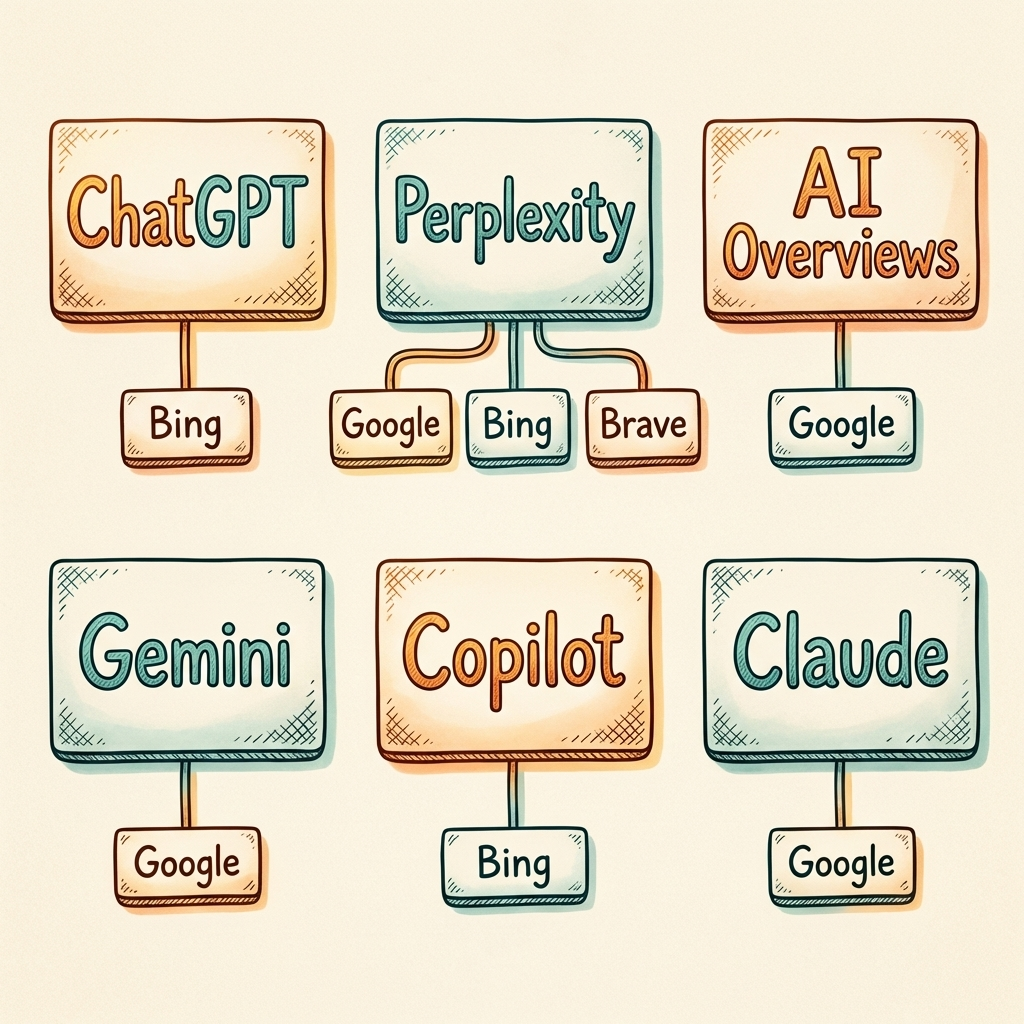
| Factor | Claude | ChatGPT | Perplexity | AI Overviews | Gemini | Copilot |
|---|---|---|---|---|---|---|
| Search Index | Brave Search | Bing + others | Multiple | Bing | ||
| Web Search | On-demand | On-demand | Always-on | Always-on | On-demand | Always-on |
| Citations | Inline (when searching) | Sometimes | Always | Always | Rarely | Always |
| Top Source | Brave index | Wikipedia (47.9%) | Reddit (46.7%) | Reddit (21%) | Google index | Bing index |
| Enterprise Share | 29% | ~15% | ~2% | N/A | ~10% | ~35% |
| Unique Factor | Dynamic filtering | Largest user base | Real-time RAG | Google integration | Workspace integration | M365 integration |
Claude and ChatGPT overlap only 20% on search results. Optimizing for one doesn't guarantee the other. They pull from different indexes and process content differently.
Claude's Brave Search dependency makes it unique. It's the only major AI platform not running on Google or Bing. Marketers who rely on Google SEO tactics alone will miss it completely.
All six platforms reward structured, authoritative content. But each has platform-specific requirements that need individual attention. That's exactly why a cross-platform strategy matters. We handle this for our clients every day.
What Does Claude Get Wrong?
Claude struggles with real-time pricing, local business data, and niche topics where Brave Search has limited coverage. It also lacks publisher-specific opt-out controls.
Publishers have no opt-out. Google lets you control snippets and summaries. Claude doesn't. If your page is indexed in Brave, Claude can summarize it however it wants. The only levers you have are noindex tags and robots.txt, and even those are limited. Most competitor guides skip this entirely.
Brave's index is smaller than Google's or Bing's, and that creates real gaps. Niche content and international pages might not show up at all. Here's the catch: Brave needs 20+ user visits with data-sharing enabled before it even indexes a page. If you're a new site, that's a serious cold-start problem.
Training data ages out. Once Anthropic trains a model, that snapshot is frozen. Your content might not make it into the next training run for months after you publish. There's no submission form, no way to speed it up.
Commercial queries are Claude's weak spot. Ask it for real-time pricing, product availability, or local restaurant recommendations and it'll often refuse to cite anything. It's built for research and informational queries. Don't expect it to replace Google Shopping anytime soon.
Frequently Asked Questions About Claude AI Optimization
Here are the questions brands ask us most about how to get cited by Claude AI. We hear these regularly in our optimization work.
Does Claude use Google to find sources?
Nope. Claude's powered by Brave Search, and testing shows 86.7% overlap between what Claude cites and what Brave surfaces. Your Google rankings? They don't carry over here. If you want Claude to find you, you need to be in Brave's index.
How long until new content appears in Claude's responses?
It depends on the mode. If Claude triggers a web search for your topic, new content can show up within hours. Training data citations? Those take months because they're tied to when Anthropic retrains the model. For quick wins, focus on web search optimization. The training data side builds slowly.
Can I optimize for Claude and ChatGPT at the same time?
Sort of. They both like well-structured, authoritative pages. But Claude pulls from Brave while ChatGPT leans on Bing, and there's only 20% overlap in what they surface. You can't treat them as interchangeable. Our ChatGPT optimization guide breaks down the key differences.
What content format does Claude prefer to cite?
Tables, FAQs, and tight paragraphs with a clear point. Put the answer right after the heading, in 15-30 words. Claude's filtering throws out messy HTML before it even starts reasoning, so if your page is bloated with ads and nav menus, the good stuff gets lost.
Is Claude worth optimizing for with only 4.5% consumer market share?
Absolutely. That 4.5% number only measures consumer chatbot usage. Claude owns 29% of enterprise AI assistants, and its 14% quarterly growth rate is the fastest in the category. The real opportunity is in enterprise buyers and the 25 billion monthly API calls powering thousands of apps. AI visibility tools can help you track whether you're showing up.
Conclusion
Claude runs on Brave Search. Not Google. Not Bing. That one fact changes everything about how you approach optimization. And the two citation modes (training data vs live web search) each require their own tactics.
The playbook: get your pages into Brave's index, structure content so Claude can extract it cleanly, build entity authority across the web, nail the technical foundations, keep publishing fresh data, and maintain consistency across all six platforms.
This is guide number six. With all six published, you now have a complete AI visibility strategy for every major platform your buyers use.
Do this right now: search for your brand name in Brave Search. If your key pages don't appear, that's the first thing standing between you and getting cited by Claude AI. Fix it before anything else.
For brands that want Claude optimization handled alongside all six platforms, explore our AI visibility plans.
Related Articles
AI Visibility for Insurance: The Compliance-First Playbook
AI visibility for insurance turns compliance into a citation advantage. Learn the framework to get carriers and agencies...
AI Visibility for Real Estate: The Complete Agent and Brokerage Playbook
AI visibility for real estate determines which agents get recommended by ChatGPT and Perplexity. Learn the 6-step framew...
AI Visibility for Law Firms: Get Cited Without Breaking Bar Rules
AI visibility for law firms means navigating bar ethics, YMYL standards, and the disclaimer paradox. A compliance-first...